The Cashier Recognized My 83-Year-Old Mother — Then She Brought Out an Old Box
My 83-year-old mother had always insisted on doing her own grocery shopping.
Even after she began walking more slowly, even after opening a jar became more difficult for her hands, and even after I started offering to take care of errands myself, she would smile and shake her head.
“I can still buy my own groceries,” she would say.
I never wanted to argue with her.
There was something important to Mom about remaining independent.
She had spent most of her life taking care of other people. She had raised children, worked, managed a household, helped neighbors, and somehow always found a way to make herself useful.
So when she said she wanted to go to the supermarket, I usually went with her.
Not because I thought she couldn’t manage.
I simply wanted to be nearby in case she needed help.
That Saturday afternoon, we went to our usual supermarket.
It was busier than normal.
Cars filled most of the parking spaces, shopping carts were lined up near the entrance, and every checkout lane seemed to have a long line.
Mom didn’t mind.
She pushed her cart slowly through the aisles, checking the list she had written on a small piece of paper.
Milk.
Bread.
Eggs.
Apples.
Tea.
And a jar of the strawberry jam she had liked for years.
Six things.
That was all.
She had no interest in filling her cart with unnecessary items.
“This should be quick,” she told me.
I smiled.
“You always say that.”
“And I’m usually right.”
She wasn’t wrong.
We found everything within about fifteen minutes and headed toward the checkout.
There were several lines open, but all of them were busy.
We chose one that looked like it was moving steadily.
Mom placed her six items on the conveyor belt one at a time.
Then she waited.
The woman behind us had a much fuller cart.
She had groceries stacked almost to the top.
At first, I didn’t think anything of her.
Everyone was tired.
Everyone wanted to get home.
The store was crowded.
Then Mom reached into her purse for her wallet.
She couldn’t find it immediately.
She checked one pocket.
Then another.
Her hands were slightly unsteady.
I leaned toward her.
“Take your time.”
“I know it’s here,” she said quietly.
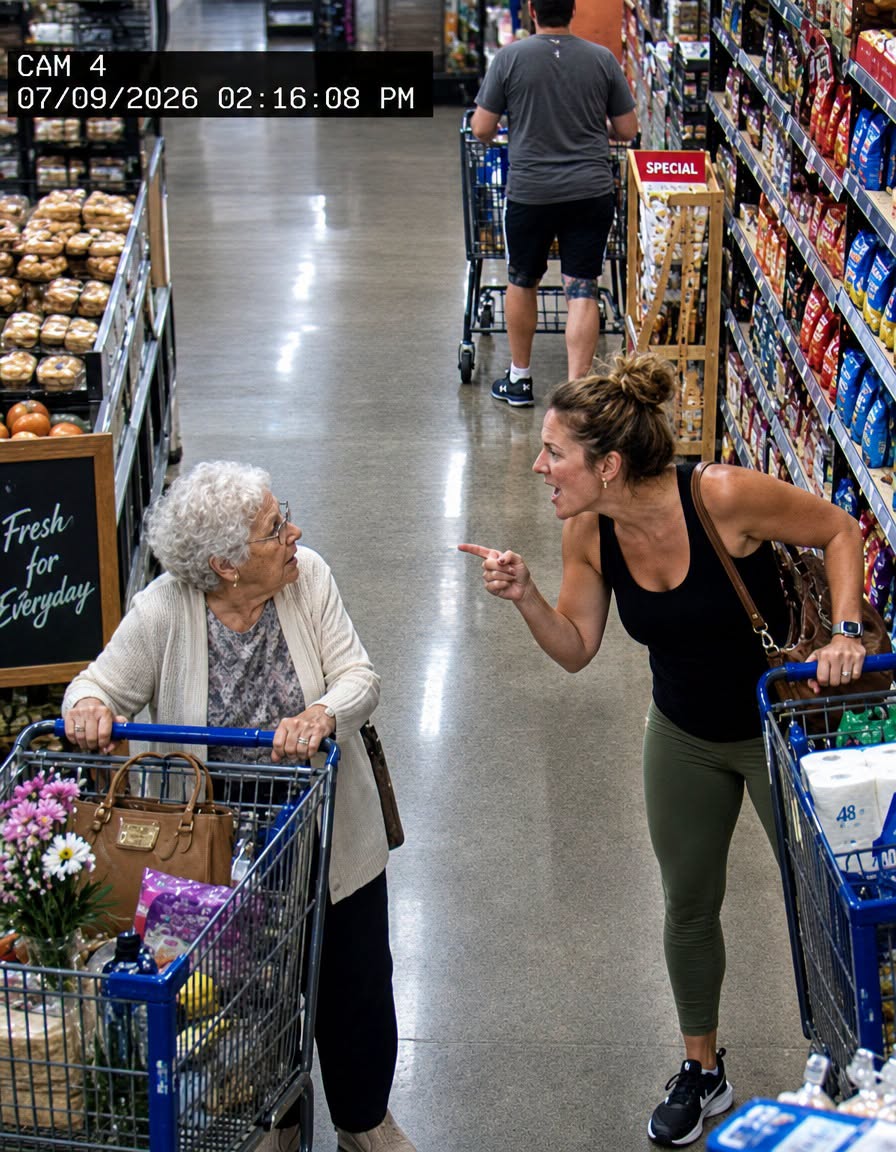
The woman behind us sighed loudly.
Mom heard it.
She looked back.
“I’m sorry,” she said.
The woman crossed her arms.
“It’s okay.”
But her tone suggested it wasn’t.
Mom continued searching.
Finally, she found her wallet tucked into a smaller compartment inside her purse.
“There it is.”
She smiled with relief.
The cashier began scanning the groceries.
The woman behind us moved her cart closer.
Then she said, loudly enough for everyone around us to hear:
“If you’re having that much trouble, maybe someone else should do your shopping.”
Mom’s expression changed.
Not dramatically.
She simply became quiet.
I turned around.
“There’s no need for that.”
The woman looked at me.
“I didn’t say anything to you.”
“You said it to my mother.”
She shrugged.
“I’m just saying. Some people need to realize when they’re slowing everyone down.”
Mom looked down at the counter.
I could see that the comment had embarrassed her.
That bothered me more than the woman’s words themselves.
My mother had done nothing wrong.
She was an elderly woman trying to pay for six groceries.
That was all.
The cashier continued scanning.
The woman behind us muttered something under her breath.
Mom finally handed over her card.
The cashier looked at it.
Then she looked at Mom.
She paused.
At first, I thought there was a problem with the payment.
Maybe the card wasn’t working.
Maybe the register had frozen.
But the cashier wasn’t looking at the screen.
She was looking directly at my mother’s face.
“Margaret?”
Mom looked surprised.
“Yes.”
The cashier’s expression changed.
“Margaret Wilson?”
Mom slowly nodded.
“Yes. That’s me.”
The cashier didn’t say anything for several seconds.
Then she looked toward the employee standing at the neighboring register.
“Could you cover this lane for a moment?”
The other employee came over.
The cashier stepped away from the register.
The woman behind us immediately became impatient.
“What is going on?”
The cashier didn’t respond.
Instead, she picked up the phone beside the register.
“Could you ask the manager to come up front?”
There was something unusual about her voice.
She sounded less like a cashier dealing with a customer and more like someone who had suddenly remembered something important.
Mom looked at me.
“I don’t know her.”
“I don’t think she knows you personally.”
The cashier hung up the phone.
Then she turned toward my mother.
“Would you mind waiting here for a moment?”
Mom looked confused.
“Did I do something wrong?”
The cashier immediately shook her head.
“No. Absolutely not.”
She glanced toward the impatient woman.
“And neither did you.”
That seemed to quiet the conversation.
A few minutes later, the store manager arrived.
He was carrying an old cardboard box.
It wasn’t large.
It looked like something that had been stored in a back room for years.
The manager placed it on a small counter behind the register.
The cashier looked at Mom.
“I want to make sure I’m not mistaken,” she said. “You used to work at St. Anne’s Community Center, didn’t you?”
Mom’s eyes widened.
“Yes.”
The cashier smiled.
“I knew it.”
Mom stared at her.
“How do you know that?”
The cashier opened the box.
Inside were old photographs, newspaper clippings, handwritten notes, and several envelopes.
She carefully removed one photograph.
It showed a group of people standing outside a brick building.
Mom was in the center.
She was much younger.
Probably in her forties.
She was wearing a simple dress and smiling at the camera.
Mom took the photograph with both hands.
For a moment, she didn’t speak.
Then she smiled.
“Oh, my goodness.”
The cashier pointed toward the photograph.
“That was the first community food drive my mother ever volunteered at.”
Mom looked up.
“Your mother?”
The cashier nodded.
“Her name was Linda.”
Mom stared at the picture again.
“Linda Parker?”
The cashier laughed softly.
“Yes.”
Mom’s face lit up.
“I haven’t heard that name in years.”
The manager stepped closer.
“My mother used to talk about you all the time,” the cashier said. “She said you were one of the people who taught her how to organize the food pantry.”
Mom shook her head.
“She didn’t need me to teach her anything. She was one of the most determined people I ever met.”
The cashier smiled.
“She always said you helped her when she was overwhelmed.”
Mom looked through the photographs.
“I remember those days.”
She turned another picture over.
There was a handwritten note on the back.
Mom read it silently.
Her eyes became moist.
“What does it say?” I asked.
She handed it to me.
It was a short note from Linda.
It thanked Mom for helping her during the first year of the community food program.
The note wasn’t dramatic.
It wasn’t some secret confession.
It was simply a few sentences written by someone who wanted to remember a kindness.
And suddenly, I understood why the cashier had recognized my mother.
She hadn’t recognized her from the supermarket.
She had recognized her from her younger years.
From old photographs.
From stories her mother had told her.
The cashier explained that her mother had passed away several years earlier.
Afterward, the family had gone through boxes of old belongings.
The photographs and documents from the community center had been placed in a box.
The cashier had kept them.
“I’ve seen this picture dozens of times,” she said. “I never forgot your face.”
Mom smiled.
“Your mother was a wonderful woman.”
The cashier nodded.
“She really admired you.”
Behind us, the line had become quieter.
The woman who had complained earlier was still standing there.
She looked uncomfortable.
The manager finally spoke.
“I’m sorry for the delay, everyone. We had a personal connection come up unexpectedly.”
He turned toward the customers.
“We’ll open another register.”
Two employees immediately began directing people toward another checkout.
The woman behind us moved away with her cart.
Before she left, she stopped.
She looked at Mom.
“I owe you an apology.”
Mom looked at her.
The woman continued.
“I shouldn’t have spoken to you that way.”
Mom didn’t respond immediately.
Then she said:
“Thank you.”
That was all.
She didn’t lecture the woman.
She didn’t embarrass her.
She didn’t demand an explanation.
She simply accepted the apology.
The cashier watched quietly.
Then she looked at Mom.
“My mother used to say you never made people feel small when they were struggling.”
Mom smiled.
“She was being generous.”
“No,” the cashier said. “She wasn’t.”
For some reason, that sentence stayed with me.
The entire incident had started with a woman becoming impatient because my mother took a little longer to find her wallet.
Yet the cashier had just reminded us of something that seemed much more important.
We often see only a few seconds of another person’s life.
We don’t know what they have carried for decades.
We don’t know who they helped.
We don’t know what responsibilities they once had.
And we certainly don’t know what someone may have meant to another person’s family.
My mother didn’t look like the woman in the photograph anymore.
Time had changed her.
Her hair had turned completely gray.
Her shoulders were slightly bent.
She walked carefully.
Her hands sometimes shook.
But she was still the same person.
The same Margaret.
The same woman who had spent years helping people without expecting recognition.
The same woman who believed that small acts of kindness mattered.
We finished paying for our groceries.
The cashier refused to let us leave without giving Mom a copy of the photograph.
“You should have this,” she said.
Mom hesitated.
“Are you sure?”
“Absolutely.”
Mom looked at the picture again.
“I haven’t seen myself like this in a very long time.”
“You look happy,” I said.
Mom smiled.
“I was.”
The cashier laughed.
“You still are.”
Mom tucked the photograph carefully into her purse.
Before we left, she turned back.
“Please tell your mother, wherever you believe she is, that I remember her.”
The cashier’s expression softened.
“I will.”
We walked out of the supermarket together.
The afternoon sun was bright, and the parking lot was still crowded.
Mom pushed the cart toward the car.
After a few steps, she stopped.
“You know,” she said, “I think I remember that little girl.”
“The cashier?”
“Yes.”
She looked back toward the store.
“She was very young. She used to come with her mother sometimes.”
I smiled.
“You really do remember everyone.”
Mom shook her head.
“No. I just remember people who mattered.”
When we got home, she put the groceries away and placed the photograph on the kitchen table.
She stared at it for several minutes.
Then she opened a drawer and pulled out an old photo album.
She found a blank page.
Very carefully, she placed the new photograph inside.
“This belongs here,” she said.
That evening, we talked about those years.
I learned things about my mother’s life that I had never heard before.
She told me about the community center.
About families who needed temporary help.
About volunteers who showed up after work.
About people who donated food even when they didn’t have much themselves.
She told me about Linda.
“She was nervous at first,” Mom said. “She thought she wasn’t good at organizing things.”
“Was she?”
Mom laughed.
“She became excellent at it.”
Then she told me something else.
“One time, we had more families than food. Linda wanted to turn people away.”
“What happened?”
“I told her we would find another way.”
“And did you?”
“We did.”
Mom smiled.
“We divided what we had, contacted two nearby organizations, and found additional donations.”
I looked at the photograph.
“So that’s what the cashier’s mother remembered.”
“Probably.”
Mom closed the album.
“I never thought it was anything special.”
I knew what she meant.
People who spend their lives helping others often don’t realize which moments stay with the people they helped.
To Mom, that day at the community center had been one ordinary day among thousands.
To Linda, it had apparently been something worth remembering for decades.
And to Linda’s daughter, that memory had become part of her own family history.
The next week, we returned to the supermarket.
Mom still wanted to do her own shopping.
“I thought you were going to let me take care of it,” I joked.
She smiled.
“I changed my mind.”
“You’re serious?”
“Of course.”
We walked through the aisles together.
This time, Mom moved a little more slowly.
But she seemed happier.
When we reached the checkout, the same cashier was working.
She saw Mom and smiled.
“Margaret.”
Mom smiled back.
“Hello.”
The cashier came around the register for a quick hug.
Then she handed Mom a small envelope.
“What is this?”
“Something I found at home.”
Inside was another photograph.
It showed Mom, Linda, and several volunteers standing outside the community center.
On the back was the date.
Nearly forty years earlier.
Mom looked at it for a long time.
“This is a good one,” she said.
“I thought you might like it.”
“I do.”
Mom carefully placed it inside her purse.
The woman who had insulted her the previous week was nowhere around.
But Mom didn’t mention her.
She didn’t talk about the rude comment.
She didn’t talk about how embarrassed she had felt.
Instead, she talked about Linda.
She talked about the people in the photograph.
She talked about the community center.
She talked about a time when a group of ordinary people had decided to help one another.
As we walked back to the car, I asked her something.
“Does it bother you when people treat you differently because you’re older?”
She thought about it.
“Sometimes.”
“What do you do?”
She smiled.
“I remind myself that their opinion doesn’t erase my life.”
That answer stayed with me.
My mother was 83 years old.
She wasn’t as fast as she used to be.
She sometimes needed help.
She sometimes forgot where she had put her keys.
And yes, sometimes she needed a few extra seconds to find her wallet.
But none of those things erased the decades behind her.
The people she had raised.
The work she had done.
The friends she had made.
The people she had helped.
The memories she had given others.
And the fact that somewhere, inside an old cardboard box, a family had kept photographs of her because she had once made a difference in their lives.
That Saturday at the supermarket taught me something I wish more people remembered.
Patience costs very little.
A few extra minutes at a checkout line are not a crisis.
Someone who moves slowly isn’t necessarily careless.
Someone who needs assistance isn’t necessarily incapable.
And an older person shouldn’t have to prove their value simply because they take longer to complete an ordinary task.
My mother didn’t need the cashier to make a scene.
She didn’t need anyone to declare her important.
She didn’t need revenge against the woman who had embarrassed her.
What she received instead was something much quieter.
She was remembered.
Not for how quickly she could shop.
Not for how steady her hands were.
Not for how old she was.
She was remembered for who she had been and for the kindness she had shown.
And when we got home that evening, Mom placed the photograph on the kitchen table again.
She looked at it and smiled.
“Forty years,” she whispered.
Then she closed the album.
“Where does all the time go?”
I sat beside her.
“I don’t know.”
She smiled.
“But I’m glad I remember some of it.”
And I was glad too.
Because sometimes the most meaningful reminder of a person’s life doesn’t come from a ceremony, an award, or a newspaper article.
Sometimes it comes from an old photograph in a cardboard box.
Sometimes it comes from a stranger who remembers your name.
And sometimes, it comes from simply being treated with the patience and dignity every person deserves.