High school graduation is supposed to be a scripted, predictable ritual. It is a carefully choreographed afternoon of stiff robes, identically colored mortarboards, polite applause, and the low, collective hum of hundreds of proud family members waiting for a specific name to echo across the gymnasium speakers. Everyone expects conformity. Everyone expects tradition.
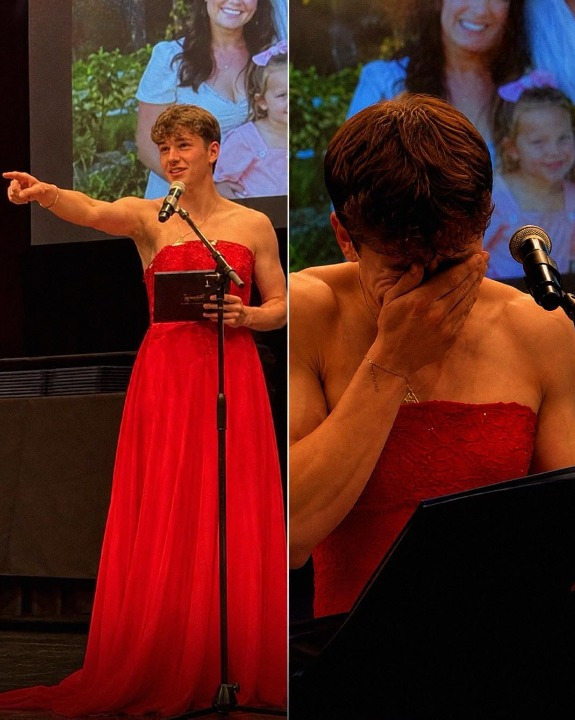
Nobody expects a high-achieving eighteen-year-old honor student to stride across the hardwood stage wearing a vibrant, unapologetically bright red cocktail dress.
The whispering began before Aaron had even cleared the second row of folding chairs on the stage. It started as a low, rustling murmur, like wind blowing through dry autumn leaves. By the time his tall, lanky frame stepped up to shake the principal’s hand, the murmurs had escalated into outright, unabashed giggles.
Way back in the ninth row, someone didn’t even bother lowering his voice, cutting through the celebratory silence with a harsh, mocking sneer: “What is actually WRONG with that guy?”
Aaron didn’t flinch. His posture remained rigid, his shoulders back, his expression entirely unreadable. He calmly extended his hand, shook the principal’s visibly bewildered hand, accepted his diploma holder, and turned to face an auditorium packed with six hundred people who were openly laughing at him.
I was sitting right there in the third row, clutching the armrests of my folding chair so tightly my knuckles had turned pure white. I wasn’t laughing. I was the only person in that entire stifling room who knew the devastating, beautiful reason why he was wearing it.
He had first told me his insane, terrifying plan two weeks earlier, right in the middle of our cramped kitchen at two in the morning. Neither of us had been sleeping much for months—the grief had seen to that, hovering over our house like a heavy, suffocating fog. He had walked in wearing an oversized hoodie, held up a hanger with a flash of brilliant crimson fabric, and told me what he intended to do.
My immediate reaction had been pure, unadulterated panic.
“Aaron, you can’t,” I had begged him, my voice cracking as tears spilled over my eyelashes. “They’ll eat you alive. The school will suspend you. The kids will tear you apart on social media. Please, don’t do this to yourself.”
He had looked at me with a maturity and a quiet, immovable resolve that completely broke my heart. “I know, Mom,” he had said softly, his voice steady. “They’ll laugh. They’ll talk. It doesn’t matter.”
He was right about the school. They had called me bright and early that very morning, treating his attire like an administrative crisis. The vice principal had phoned my cell phone, offering him a “more appropriate alternative” and warning me that if he didn’t change into a standard cap and gown, he wouldn’t be allowed to walk across the stage with his peers.
When I brought it up to Aaron, he didn’t hesitate for a single second. He pulled on the dress anyway.
His father had refused to come to the ceremony entirely, calling it a public humiliation and refusing to be associated with the spectacle. Even Aaron’s lifelong best friend had stopped answering his text messages by midnight. He was entirely alone against a sea of judgment.
And yet, he wore it anyway.
The Walk Up the Aisle
And now, he was walking down the stage steps.
He didn’t head toward his classmates in the reserved seating section. He didn’t look toward the professional photographers flashing their cameras by the podium. Instead, his eyes locked onto mine, and he walked straight down the center aisle, marching right toward my seat in that bright red dress while six hundred people stared, whispered, and judged.
The air in the gymnasium felt thick enough to chew. Every eye in the house was glued to his back.
He stopped directly in front of my seat in the third row, towering over me. The auditorium had quieted down just enough to hear the soft squeak of his dress shoes on the polished floor.
“This is FOR YOU,” he said quietly, his voice thick with emotion. “Both of them.”
Before I could process his words, he reached deep into the hidden side pocket of the red dress. He withdrew something small, carefully pressed flat, and wrapped with immense tenderness in layers of old, yellowed tissue paper.
He placed it gently into my trembling hands.
The moment I saw the edges of what was hidden inside that tissue paper, the roaring sound of the crowd vanished. The whispers, the giggles, the judgmental stares—they all dissolved into absolute nothingness.
I carefully peeled back the paper.
Resting in my palms were two folded, identical paper cranes, slightly worn at the edges and faded by time. They were the very last art projects my younger twin boys—Aaron’s ten-year-old brothers—had ever made before the tragic car accident that stole them from us sixteen months ago. I had searched our entire house for those missing cranes after the funeral, heartbroken that they seemed to have vanished forever.
Aaron had spent the last two weeks secretly tearing apart the lining of an old storage chest in the attic where their old belongings were boxed away, finally finding them tucked deep inside.
To the rest of the auditorium, he was just a rebellious teenager wearing a dress to shock the crowd. But to Aaron, the bright red dress wasn’t a joke or a political statement—it was the exact shade of the favorite shirt my youngest son used to wear every single day, the color of the paint in their bedroom, the symbol of the joy that had been ripped from our home. He wore it to carry their memory across a stage where they never got the chance to walk.
Down the row of folding chairs beside me, the group of judgmental mothers who had been giggling and whispering just moments before suddenly fell completely, awkwardly silent. They watched, confused and stunned, as I brought the paper cranes to my face, buried my hands in my lap, and completely came apart in my seat.