When I was nineteen years old, life changed in ways I never imagined. My younger sister, Della, was only eight when our parents disappeared during a hiking trip. Search teams spent weeks looking for them, but despite every effort, they were never found. Overnight, I became more than an older brother—I became her guardian, provider, and the only family she had left.
Those first few years were the hardest. I worked two jobs just to keep a roof over our heads in our small one-bedroom home. Money was always tight. Every dollar had to stretch as far as possible, and luxuries simply weren’t part of our lives.
Despite everything, Della rarely complained. She never asked for expensive toys or fashionable clothes like the other children at school. Instead, she carried herself with remarkable kindness and optimism that often amazed me.
One thing I noticed was that she always tucked away whatever lunch money she didn’t spend. She kept the coins inside an old mint tin hidden beneath her bed. Every few days I would hear the soft clinking of coins as she counted them.
I assumed she was saving for one of those popular dolls that could cry, laugh, and talk. Nearly every child in her class had one except her, so it seemed like a reasonable guess.
I couldn’t have been more wrong.
A children’s hospital stood just two blocks from Della’s elementary school. Every afternoon on her walk home, she passed the same third-floor window where a young boy often sat quietly beside medical equipment. His skin was pale, and an IV pole stood beside his bed. While other children laughed on the playground or hurried home with friends, he watched them through the glass.
The first day Della noticed him, she simply smiled and waved.
To her surprise, he smiled back.
Soon that small wave became part of her daily routine. Every afternoon she greeted him from the sidewalk, and before long they began communicating through gestures and handwritten notes held against the window.
Eventually, one of the nurses helped them exchange short messages.
The boy’s name was Tobias.
Although he faced serious health challenges, Tobias remained cheerful whenever Della visited. Their conversations were simple at first—favorite colors, favorite cartoons, and dreams for the future—but over time they became genuine friends.
One afternoon, Della came home unusually quiet.
“What’s wrong?” I asked.
She looked down at her shoes.
“It’s Tobias’ birthday next week,” she whispered. “He’s turning eleven.”
“That’s wonderful.”
She shook her head.
“He told me nobody is coming.”
The words lingered in the room.
According to the nurses, Tobias had very few visitors. His circumstances were difficult, and his birthday was expected to pass like any other ordinary day.
Della couldn’t stop thinking about it.
Without telling me, she opened her little mint tin and counted every coin she had spent months saving.
Eleven dollars and forty cents.
It wasn’t much by most standards, but to an eight-year-old girl, it represented weeks of sacrifice.
Instead of buying herself a toy, she walked into a neighborhood bakery after school and purchased a small birthday cake. With the remaining money, she found a plush dinosaur at a discount store because Tobias had once told her dinosaurs were his favorite.
The following afternoon, she handed both gifts to one of the nurses and stood outside Tobias’ window.
As hospital staff gathered around his room, Della sang “Happy Birthday” from the sidewalk below.
Several nurses joined in.
For the first time in a long while, Tobias smiled so widely that everyone noticed.
When Della told me the story that evening, I struggled to hold back tears.
She had quietly given away everything she had simply to make another child feel remembered.
The next morning, something unexpected happened.
When I opened our front door before leaving for work, I stopped in my tracks.
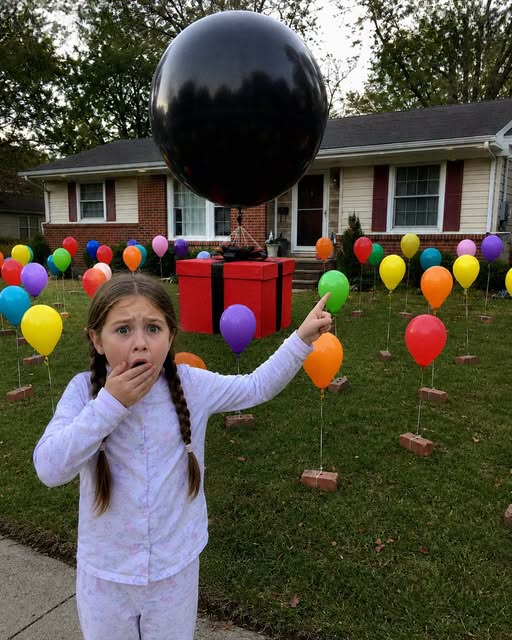
Our front lawn was covered with balloons.
There were dozens of them.
Red, blue, yellow, green, purple, orange, and white balloons stretched across the yard, each carefully tied to a small brick so they wouldn’t drift away.
The colorful display looked almost magical in the early morning sunlight.
Right in the center stood one large black balloon tied to a bright red gift box.
Della stepped beside me, her eyes wide with surprise.
“Did someone do this for us?” she asked.
“I honestly don’t know.”
We slowly walked across the grass.
Attached to the box was a neatly folded note written in careful handwriting.
It read:
“Thank you for visiting me every day. Thank you for seeing me when so many people walked by without looking. Your kindness made every afternoon brighter. Please open the box.”
I exchanged a puzzled glance with Della before carefully lifting the lid.
Inside wasn’t money or anything expensive.
Instead, the box contained dozens of handwritten envelopes.
Each one carried the name of a local family, business owner, teacher, or community member.
Another note rested on top.
“The nurses asked people if they wanted to help surprise the girl who made my birthday special. Everyone wanted to say thank you.”
One by one, we opened the envelopes.
Some contained grocery gift cards.
Others held bus passes.
One local bookstore had donated children’s books.
A nearby restaurant offered several family meals.
Someone had included warm winter coats.
Another envelope contained a handwritten promise to repair our leaking roof free of charge.
One local mechanic offered free maintenance for my aging car.
Teachers had collected school supplies.
Neighbors contributed household essentials.
None of it was extravagant.
Together, however, it represented something priceless.
People who had never met us had come together because one little girl chose compassion over possessions.
As we continued opening the envelopes, I realized many included personal letters.
One nurse wrote that Della reminded everyone in the hospital that kindness doesn’t require wealth.
A doctor explained that acts of generosity often improve emotional well-being for patients just as much as medicine supports physical healing.
Parents whose own children were receiving treatment thanked Della for bringing hope into difficult days.
By the time we reached the final envelope, tears streamed freely down my face.
It contained a simple drawing from Tobias.
The picture showed two children smiling on opposite sides of a hospital window.
Above them he had written:
“Friends don’t need to be in the same room to make each other feel less alone.”
That drawing eventually became our most treasured possession.
Months later, Tobias’ health gradually improved enough for him to spend more time outside the hospital. On one sunny afternoon, he and Della finally met face to face in the hospital garden instead of through a window.
Watching them laugh together reminded me that compassion has a remarkable way of bringing people together.
Della never expected recognition for her actions. She never imagined anyone would repay her sacrifice.
She simply saw a lonely child and decided that no one should spend their birthday feeling forgotten.
Her kindness inspired nurses, doctors, neighbors, business owners, and complete strangers to create something extraordinary.
Even today, whenever life feels overwhelming, I remember that morning filled with colorful balloons.
It wasn’t the gifts that mattered most.
It was the reminder that genuine kindness often creates a ripple effect far beyond what we can see. A small act of compassion can inspire an entire community, proving that generosity is measured not by how much we give, but by the heart behind the gift.
That lesson, taught by an eight-year-old girl with eleven dollars and forty cents, remains the greatest wealth I’ve ever witnessed.