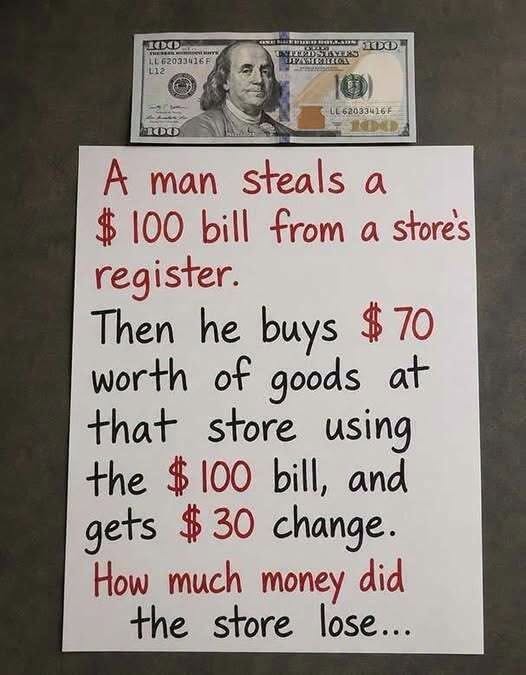
The $100 Store Riddle: Can You Solve This Tricky Money Puzzle Without Getting Confused?
A customer steals $100 from a store, returns a few minutes later, buys $70 worth of merchandise using the same bill, and receives $30 in change. How much money has the store actually lost? The answer seems obvious to some people, but the puzzle has a way of making even confident problem-solvers question their calculations.
At first glance, this sounds like a straightforward question about money.
There is a store, a dishonest customer, a missing $100 bill, and a second transaction involving merchandise and change.
However, when people try to calculate the store’s total loss, the answers can become surprisingly different.
Some say the store lost $200.
Others believe the answer is $170 or $130.
A few immediately recognize that the correct answer is $100.
So who is right?
The puzzle is interesting because it encourages people to count the same money more than once. It combines two separate events and makes them appear like independent financial losses, even though they are connected by the same $100 bill.
To solve it correctly, we need to follow the money from the moment it disappears from the register until the moment the customer leaves the store.
Once we separate the transactions and look at what the store actually gives away, the mystery becomes much easier to understand.
1. The Situation: A Thief Takes $100 From the Cash Register
Imagine a small neighborhood store on an ordinary afternoon.
The cashier is busy helping customers, and a dishonest visitor notices an opportunity.
While the cashier is distracted, the visitor takes a $100 bill from the cash register.
The customer does not purchase anything at this point.
He simply takes the money and leaves the store.
Immediately after the theft, the situation is easy to calculate.
The store had $100 in its cash register.
After the theft, that money is gone.
The store has therefore suffered a financial loss of $100.
At this stage, there is no complicated mathematics involved.
The missing money represents a direct loss to the business.
But the puzzle does not end there.
A few minutes later, the same person returns to the store.
This time, he behaves like an ordinary customer.
He selects merchandise worth $70 and approaches the cashier to pay.
The surprising detail is that he uses the exact same $100 bill he stole earlier.
The cashier accepts the payment and gives him $30 in change.
The customer then walks away with both the merchandise and the remaining cash.
Now the real question begins.
How much has the store lost after everything is finished?
2. Why Many People Believe the Answer Is $200
One common answer is $200.
People who choose this amount usually think about the two events separately.
First, the thief takes $100 from the register.
That creates a loss of $100.
Second, the thief returns and receives $70 worth of merchandise and $30 in change.
Those two amounts also add up to $100.
Therefore, someone might calculate:
$100 + $70 + $30 = $200.
At first, this calculation appears reasonable.
The thief did take $100 from the register, and he also left with merchandise and additional cash.
However, there is a major problem with this reasoning.
It counts the original $100 bill as a permanent loss even though that same bill eventually returns to the store.
The money is not stolen twice.
It leaves the register once, then comes back during the purchase.
That is the important detail that changes the entire calculation.
The store cannot count the original $100 bill as missing after it has been returned.
Instead, the final loss must be calculated by examining what the thief actually takes away when the transaction is complete.
3. The Correct Answer: The Store Loses $100
<badge color=”success”>Correct answer: $100</badge>
The store’s total loss is $100.
That amount consists of two things:
- $70 worth of merchandise.
- $30 in cash given as change.
Together, these amounts equal $100.
The original stolen bill returns to the cash register when the customer uses it to pay for the merchandise.
Consequently, the store no longer has a missing $100 bill.
However, it has given away goods worth $70 and paid out another $30 in cash.
The total value leaving the store is therefore $100.
The easiest way to remember the solution is to focus on the final result rather than counting every movement of the same bill as a separate loss.
The store ends with the original $100 bill back in its register.
The customer ends with $70 worth of merchandise and $30 in cash.
That is why the final loss is $100 rather than $200.
4. Follow the Money Step by Step
One of the best ways to solve this puzzle is to use a simple financial breakdown.
Let’s examine the store’s position after each event.
Before the theft
The store has its original $100 bill.
After the theft
The thief takes the bill.
The store is now missing $100.
After the purchase
The thief returns the same bill and uses it to pay for $70 worth of goods.
The cashier accepts the bill and gives $30 in change.
The original $100 is now back in the store.
However, the store has lost merchandise worth $70 and cash worth $30.
After the customer leaves
The store has recovered the original bill, but the customer has taken goods and change worth a combined $100.
The final result is:
| Item | Amount |
|---|---|
| Original bill returned to register | $100 |
| Merchandise given to customer | $70 |
| Change given to customer | $30 |
| Total final loss | $100 |
This breakdown shows why the answer is not $200.
The original bill is not an additional loss once it has returned to the register.
5. Another Way to Understand the Puzzle: Think Like an Accountant
There is another useful way to approach the riddle.
Instead of thinking about what happened first and second, compare the store’s position before the theft with its position after the customer leaves.
This is essentially a balance-sheet approach.
Before anything happens, the store has:
- $100 in cash.
- Merchandise worth $70 available for sale.
For simplicity, assume the merchandise has a value of $70 for the purpose of the puzzle.
After the entire incident, the store has:
- The original $100 bill back in the register.
- No longer has the $70 worth of merchandise.
- Has also paid out $30 in change.
The cash position has returned to where it started.
The merchandise position has changed.
The store has lost goods worth $70 and cash worth $30.
That produces a total loss of $100.
This method is especially useful because it prevents confusion caused by counting the same money repeatedly.
Accountants often examine the difference between an organization’s financial position before and after a transaction.
The same principle works perfectly here.
6. Why the Same $100 Bill Matters So Much
The entire riddle depends on one small detail.
The thief uses the exact same $100 bill that he originally stole.
If he had stolen one bill and later paid with a completely different $100 bill, the situation would require a different calculation.
But because the same bill returns to the register, the original cash theft is effectively reversed by the later payment.
The store’s loss comes from the goods and change provided during the second transaction.
This is why careful attention to the wording matters.
Many brain teasers are designed to make readers overlook a particular detail.
In this case, that detail is the identity of the banknote.
People often focus on the amount of money involved rather than tracking the actual movement of the money.
The puzzle demonstrates how easily a