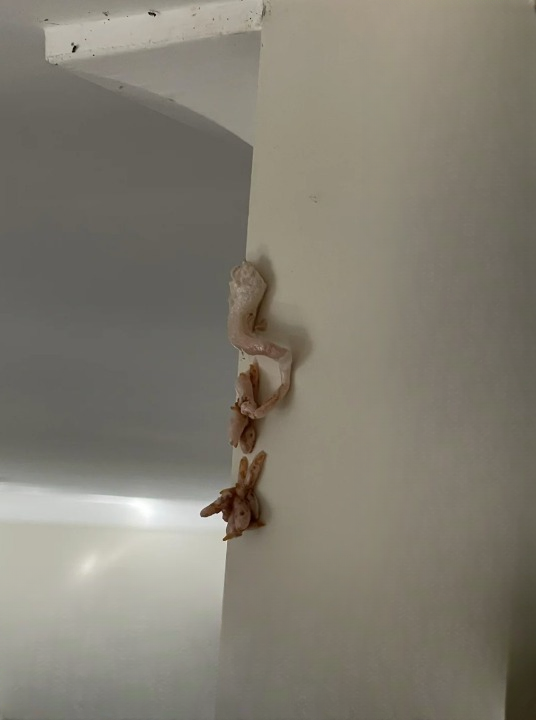
Strange Pink, Crunchy Growth Appears on a Kitchen Wall—What Could It Be and What Should You Do?
Have you ever walked into your kitchen expecting an ordinary morning, only to discover something unusual that immediately catches your attention?
That is exactly what happened one Tuesday morning.
The coffee was brewing, the house was quiet, and everything seemed perfectly normal. But as I walked toward the kitchen counter, something strange caught my eye.
There, in the corner of the wall, was an unusual pink substance.
It looked soft and slightly foamy, almost like a collection of tiny flowers or delicate cotton-like pieces. But when I looked more closely, I noticed that parts of it appeared dry and crunchy.
My first reaction was confusion.
Where had it come from?
Had something spilled behind the kitchen furniture? Was it connected to moisture? Could it be an unusual household material, or was something growing inside the wall?
I had never seen anything quite like it.
And because the kitchen is one of the most frequently used areas of a home, I knew I shouldn’t ignore it.
What initially appeared to be a strange little decoration turned into an unexpected reminder of how important it is to understand what is happening inside our homes.
If you have ever discovered an unusual patch, discoloration, or growth on a wall, there are several possible explanations worth considering.
Why Do Strange Substances Appear on Indoor Walls?
Walls are designed to provide protection, insulation, and structure.
However, they are not completely isolated from the environment.
Changes in temperature, moisture, ventilation, plumbing conditions, and building materials can sometimes create unexpected problems.
An unusual substance appearing on a wall may be connected to several different causes.
Some possibilities include:
- Moisture-related growth: Damp conditions can encourage certain types of mold and other microorganisms to develop.
- Mineral deposits: Water moving through building materials can leave behind visible deposits as it evaporates.
- Paint or plaster deterioration: Aging finishes can change texture, discolor, or develop unusual surface patterns.
- Household residue: Cleaning products, cooking materials, adhesives, and other substances can sometimes leave unexpected marks.
- Material breakdown: Certain construction materials may deteriorate when exposed to prolonged moisture or unsuitable environmental conditions.
The appearance alone is not enough to identify the cause.
Color, texture, and location can provide clues, but they should not be treated as a reliable diagnosis.
That is particularly important when an unusual substance resembles mold.
Could the Pink Substance Be Mold?
One of the first questions people ask when they discover something unusual on a wall is whether it could be mold.
Mold is a type of fungus that can develop in areas where moisture is present.
Bathrooms, kitchens, basements, laundry rooms, and spaces around leaking pipes can sometimes provide suitable conditions for growth.
Mold does not always appear as the familiar dark patches people expect.
Depending on the organism and the surface involved, growth may appear in different colors and textures.
Some varieties can look powdery, fuzzy, slimy, or irregular.
However, a pink appearance does not automatically mean that something is mold.
Other substances can produce similar visual effects.
For example, certain bacteria, residues, and mineral-related deposits may create pink or reddish discoloration under particular conditions.
This is why identifying an unknown substance based only on a photograph or description can be misleading.
If the material is spreading, appears alongside dampness, or is accompanied by a persistent musty smell, it is sensible to investigate the underlying moisture problem.
What Causes Pink Discoloration in a Kitchen?
Kitchens contain several conditions that can contribute to unusual wall discoloration.
Cooking produces moisture.
Dishwashing creates humidity.
Steam can collect around poorly ventilated areas.
Water pipes may develop small leaks behind cabinets or inside walls.
Over time, these conditions can affect painted surfaces, plaster, grout, and other materials.
There are several areas worth checking when unexplained discoloration appears.
1. Areas Around the Sink
The space beneath and behind a kitchen sink deserves particular attention.
Small plumbing leaks can go unnoticed for weeks.
A loose connection, worn seal, or damaged pipe may allow water to escape slowly.
The moisture can affect nearby materials and eventually become visible on surrounding surfaces.
Check for damp cabinet interiors, swollen wood, water stains, or an unusual smell.
If you notice signs of an active leak, contact a qualified plumber.
2. Areas Behind Kitchen Cabinets
Cabinets can hide problems because they limit airflow and make wall surfaces difficult to inspect.
If water enters the space behind a cabinet, moisture may remain trapped for extended periods.
This can contribute to deterioration of the wall surface.
A small visible patch may therefore indicate a problem that extends beyond the area you can see.
Avoid assuming that cleaning the visible surface will resolve the issue.
The underlying cause needs to be identified.
3. Corners With Limited Ventilation
Corners are sometimes overlooked during ordinary cleaning.
If furniture or appliances are placed too close to a wall, airflow may become restricted.
In combination with moisture and temperature differences, this can create conditions that encourage condensation.
Over time, repeated condensation may damage paint or contribute to moisture-related growth.
Improving ventilation and maintaining reasonable indoor humidity can help reduce these conditions.
4. Areas Near Windows
Windows can also contribute to moisture problems.
During colder weather, warm indoor air can meet cooler glass and surrounding surfaces.
This may cause condensation.
If water repeatedly collects along window frames or nearby walls, the surrounding materials can become damp.
Inspect window seals and look for signs of water entering from outside.
Why Does the Substance Look Crunchy?
The texture of an unusual wall deposit can offer useful information, although it cannot establish its identity by itself.
A substance that appears dry and crunchy may be a surface deposit, deteriorated paint, dried residue, or another material.
For example, mineral deposits can form when water moves through masonry or plaster and leaves dissolved minerals behind as it evaporates.
These deposits are sometimes called efflorescence.
They may appear as white or pale crystalline material on walls.
However, their appearance varies depending on the minerals involved and the surface.
Paint and plaster can also become brittle or flaky when exposed to moisture over time.
A previously damp surface may develop a different texture as it dries.
The important point is that texture alone should not be used to decide whether an unknown substance is harmless.
If the material is unidentified, avoid touching, scraping, or breaking it apart unnecessarily.
What Should You Do When You Discover an Unknown Substance?
Finding an unfamiliar substance inside your home can be unsettling.
Fortunately, there are sensible steps you can take without making the situation worse.
Step 1: Avoid Touching It
The first instinct might be to examine the material closely or remove a small piece.
However, disturbing an unidentified substance could release dust, particles, or spores.
Keep children and pets away from the affected area until you understand what it is.
If the substance is extensive or appears to be growing, seek professional advice.
Step 2: Take Photographs
Photographs can help document changes over time.
Take a picture of the entire affected area and another from a safe distance showing the surrounding wall.
Record when you first noticed it.
If the patch changes in size, color, or appearance, the photographs may help a professional understand the situation.
Avoid getting close enough to disturb the material.
Step 3: Look for Possible Sources of Moisture
Without disturbing the substance, inspect the surrounding area.
Look for:
- Water stains.
- Damp paint.
- Peeling or bubbling wall finishes.
- Condensation.
- Plumbing problems.
- Damaged seals around windows.
- Persistent musty odors.
These observations can help narrow down the possible source of the problem.
Step 4: Improve General Ventilation
If the area is safe to access, make sure the kitchen has appropriate ventilation.
Use an extractor fan when cooking.
Open windows when weather conditions permit.
Avoid allowing steam to accumulate unnecessarily.
However, ventilation alone will not solve a plumbing leak or a serious moisture problem.
Step 5: Contact the Appropriate Professional
If the substance is unidentified, widespread, or associated with dampness, a qualified building professional or mold assessment specialist can help determine what is happening.
A plumber may be needed if water is suspected.
A building specialist may be able to investigate damaged plaster, masonry, or concealed moisture