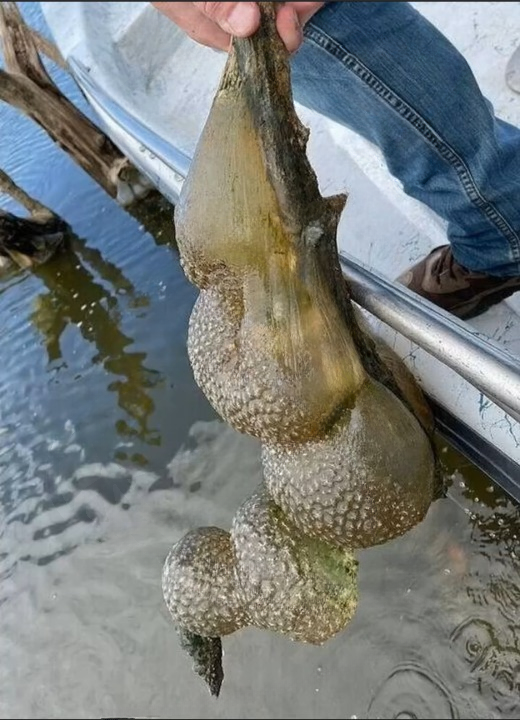
Strange Jelly-Like Clusters in an Oklahoma Lake Have a Fascinating Explanation
Imagine enjoying a peaceful day on the water when you notice something unusual hanging from branches beneath the surface. At first glance, the translucent masses look like mysterious jelly balls, strange egg clusters, or something that doesn’t belong in a freshwater lake.
That was the kind of discovery that caught people’s attention at McGee Creek Reservoir in Atoka County, Oklahoma. In March 2024, reports and photographs of these unusual formations sparked curiosity among boaters and nature enthusiasts. But the explanation was far more fascinating than frightening.
The strange-looking clusters were identified as bryozoans—small aquatic animals that live together in colonies.
What Are These Mysterious Jelly-Like Masses?
Bryozoans are tiny aquatic animals that can form large, gelatinous colonies on submerged branches and other underwater surfaces. Although a colony may look like one enormous organism, it is made up of many individual animals working together.
Each individual, called a zooid, performs essential functions that help the colony survive. These animals feed by filtering tiny food particles from the surrounding water, making them an interesting part of freshwater ecosystems.
Their unusual appearance can make them easy to mistake for eggs or unfamiliar organisms. The soft, translucent material surrounding the colony gives it a jelly-like texture, while its irregular shape can make it look almost otherworldly.
Are Bryozoans Dangerous to People?
Despite their strange appearance, bryozoans found in Oklahoma’s freshwater environments are native organisms and are not considered dangerous to people or wildlife.
The Oklahoma Department of Wildlife Conservation has explained that these colonies can be found attached to submerged tree limbs in places such as McGee Creek Reservoir. Their presence is a natural part of the aquatic environment, not necessarily a sign of contamination or an infestation that requires treatment.
For anyone encountering these formations while boating, fishing, or swimming, there is generally no reason to panic. As with any unfamiliar aquatic organism, however, it’s sensible to avoid disturbing it unnecessarily.
How Do They Grow Into Such Large Colonies?
One of the most remarkable features of bryozoans is how they multiply. Individual zooids can reproduce asexually, creating additional members of the colony. Over time, countless tiny animals can form a much larger structure that becomes visible beneath the water.
The colony’s gelatinous material helps hold it together and gives it the distinctive appearance that attracts attention. Some freshwater bryozoans also produce resistant structures that help them survive unfavorable conditions, allowing them to persist until the environment becomes suitable again.
When conditions are favorable, these colonies can become particularly noticeable during warmer months. Finding several clusters in one location may therefore be a natural seasonal occurrence rather than evidence of a sudden environmental problem.
Why These Unusual Animals Matter
Bryozoans do more than create an unusual sight for people exploring a lake. By filtering small particles from the water, they contribute to aquatic food webs and interact with other organisms in their environment.
Their colonies can also provide food for certain aquatic animals, including small fish and invertebrates. This makes them part of a broader ecosystem in which even the smallest creatures can play an important role.
Their presence may offer useful ecological clues, although one observation alone cannot establish whether an entire lake has good water quality. Environmental conditions are complex, and scientists consider multiple indicators when assessing the health of a freshwater habitat.
A Reminder That Nature Still Holds Surprises
The next time you spot a strange, jelly-like mass beneath the surface of a lake, you may be looking at a colony of bryozoans rather than something dangerous or mysterious.
What initially appears unsettling can turn out to be an extraordinary example of how life adapts and thrives underwater. These tiny animals demonstrate that even an ordinary day on the lake can reveal something remarkable.
Sometimes, the best response to an unexpected discovery is not fear, but curiosity—and a closer look at the natural world around us.
Source note: The Oklahoma Department of Wildlife Conservation discussed these jelly-like bryozoan colonies in its March 2024 fishing report, noting that they are native and harmless to people and wildlife.