Strange Jelly-Like Clusters Found in an Oklahoma Lake Reveal a Fascinating Freshwater Organism
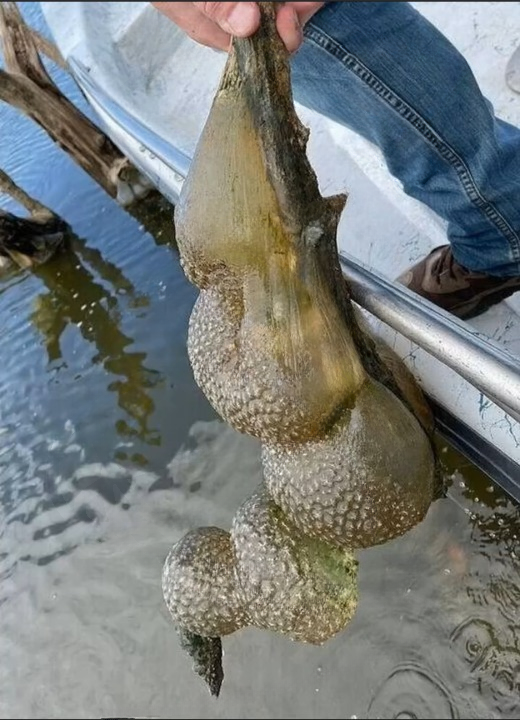
In March 2024, boaters exploring McGee Creek Reservoir in Atoka County, Oklahoma, encountered an unusual sight beneath the water. Attached to submerged branches were translucent, jelly-like clusters that looked unlike the plants, rocks, and familiar aquatic life people typically expect to see in a freshwater lake.
The formations had irregular shapes and soft, gelatinous surfaces. Some appeared to hang from underwater branches, while others resembled rounded masses suspended beneath the surface. Their unusual appearance naturally attracted attention, especially among people who had never encountered anything similar.
At first glance, the clusters might have been mistaken for an unfamiliar type of fungus, a collection of eggs, or some kind of artificial material caught underwater. In reality, such formations can be produced by a group of freshwater animals known as bryozoans.
These organisms are small, colonial invertebrates that live together in connected groups. Although individual animals are tiny, their combined structures can become large enough to be noticed by boaters, anglers, and people walking along a shoreline.
The discovery provides an opportunity to explore an often-overlooked part of freshwater ecology. What looks strange or unfamiliar in a lake may actually be an established part of the local ecosystem, quietly performing its role beneath the surface.
What Are the Jelly-Like Clusters?
One possible explanation for gelatinous freshwater formations like those observed at McGee Creek Reservoir is the presence of freshwater bryozoans, particularly species that form large colonies.
Bryozoans are aquatic invertebrates belonging to a group sometimes called moss animals. They occur in freshwater and marine environments, and many species live attached to submerged surfaces rather than swimming freely through the water.
A bryozoan colony consists of numerous individual animals connected within a shared structure. Each animal is known as a zooid. Although zooids are generally microscopic or very small, they work together as part of a larger colony.
Depending on the species, the colony may form a thin coating on a surface, a branching structure, or a soft, rounded mass. Certain freshwater species produce gelatinous colonies that can grow considerably larger than the individual animals themselves.
This explains why a cluster may look like a single organism even though it contains many tiny animals living together.
The gelatinous material surrounding the colony provides structure and support. It also creates the distinctive translucent appearance that can make these organisms resemble jelly, especially when viewed through clear water.
For people encountering them for the first time, the formations can be surprising. Their shape may not resemble anything familiar from everyday life, and their attachment to submerged branches can make them seem almost suspended in place.
However, unusual appearance alone does not indicate that a formation is dangerous, newly introduced, or harmful to the environment.
Why Do They Look Like Transparent Jelly?
The appearance of freshwater bryozoan colonies is closely connected to the material in which their tiny inhabitants live.
In some species, a soft, gelatinous matrix surrounds the individual zooids and holds the colony together. Because this material can contain a high proportion of water, it may appear clear or translucent.
The resulting structure can look like a large blob of jelly, particularly when light passes through it beneath the water’s surface.
The colony’s outline may be rounded, uneven, or lobed. It can also appear somewhat different depending on the angle from which it is viewed, the clarity of the water, and whether the colony is growing around a submerged object.
Branches, sticks, aquatic vegetation, and other stable surfaces can provide suitable places for colonies to develop. Once attached, the colony may expand over time as more individual animals become part of the structure.
Water movement can also influence its appearance. A gelatinous colony may move slightly with changing currents, creating the impression that it is a loose object rather than an attached living community.
The color can vary as well. Some colonies appear nearly transparent, while others may look pale brown, greenish, or cloudy because of their surroundings, the material within the colony, or the conditions in which they grow.
These differences are part of the reason that freshwater bryozoans can be difficult to recognize. Their appearance does not always match the illustrations people might find in a field guide.
How Do These Organisms Feed?
Despite their unusual appearance, freshwater bryozoans are active filter feeders.
Rather than chasing prey or searching for food across the lake bottom, they obtain nourishment from tiny particles suspended in the surrounding water.
Individual zooids have specialized structures called lophophores. These structures contain a crown of fine, tentacle-like extensions equipped with tiny hairlike cilia.
The cilia create currents that help bring small food particles toward the feeding structures. The particles may include microscopic algae, bacteria, and other suspended organic material, depending on the species and local conditions.
Food is then collected and transported toward the animal’s mouth.
Because an entire colony contains many feeding individuals, the combined activity allows it to gather nourishment from the water around it.
This feeding method connects bryozoans to the wider freshwater food web. Microscopic organisms and organic particles are consumed by small aquatic animals, which in turn form part of a larger network involving insects, fish, and other wildlife.
The colonies are therefore more than unusual objects attached to underwater branches. They are living communities participating in the movement of energy through the ecosystem.
Their presence also illustrates how much biological activity can take place in a lake without being obvious to people above the surface.
Are They Ancient Life Forms?
Bryozoans belong to an ancient animal group with a fossil record extending back hundreds of millions of years.
Fossils of bryozoans occur in rocks from many geological periods, and scientists study them to understand ancient marine environments, changes in biodiversity, and the history of life in the oceans.
The group’s long evolutionary history is one reason these animals are sometimes described as ancient organisms.
However, that description needs an important distinction. A modern bryozoan colony found in an Oklahoma lake is not necessarily an ancient individual that has survived unchanged since prehistoric times.
The group itself is ancient, but the colony observed today is a living community made up of modern organisms. Like other animals, these organisms live, grow, reproduce, and eventually die.
Some freshwater bryozoans can also produce resistant structures called statoblasts. These structures help certain species survive unfavorable environmental conditions and contribute to their ability to spread to new locations.
A statoblast is not the same thing as a miniature adult colony that has simply remained alive for millions of years. It is a specialized reproductive or survival structure produced as part of the organism’s life cycle.
When conditions become favorable, a statoblast can develop into a new colony.
This ability helps explain how some freshwater bryozoans persist through seasonal changes and appear in places where people may not have noticed them before.
Their ancient evolutionary heritage is remarkable, but the most accurate description is that they belong to a long-established animal group rather than representing unchanged prehistoric creatures.
How Do Bryozoans Reproduce?
Freshwater bryozoans have life cycles that allow them to establish colonies and persist through changing conditions.
Depending on the species, reproduction can involve both sexual and asexual processes. Individual zooids within a colony may produce additional zooids, allowing the colony to grow as new feeding animals develop.
In certain freshwater species, statoblasts play an important role in reproduction and survival.
These structures contain developing material that can produce a new colony when environmental conditions are suitable. Some statoblasts are adapted to remain dormant during periods when conditions are unfavorable.
This is particularly useful in freshwater environments, where temperatures, water levels, and food availability may change substantially throughout the year.
A lake may experience warm summers, cold winters, changes in water levels, or periods when the amount of available food declines. Structures that can tolerate difficult conditions give certain bryozoans a way to persist until the environment becomes more favorable.
Statoblasts may also contribute to dispersal. Depending on the species and circumstances, they can be transported by water movement, animals, or other natural processes.
As a result, a colony may develop in a location where it was not previously noticed, even though the organism has been present elsewhere in the broader ecosystem for a long time.
This life cycle is one reason freshwater bryozoans can be widespread without attracting much attention. Their colonies may be visible for part of the year, while their reproductive structures remain less noticeable.
Why Do They Grow on Submerged Branches?
Submerged branches provide stable surfaces on which many aquatic organisms can settle.
Freshwater bryozoans generally need a suitable place to attach and grow. Depending on the species, colonies may develop on wood, rocks, aquatic plants, or other solid surfaces that remain underwater for an appropriate period.
A branch that has fallen into a reservoir can become a small habitat of its own.
Algae may grow across its surface, microorganisms may colonize the wood, and tiny invertebrates may use it as shelter. Bryozoans can become part of this community when conditions support their growth.
The branch does not need to be living wood. Once submerged, dead wood can provide a stable surface for a variety of aquatic organisms.
The availability of light, water movement, nutrients, temperature, and other environmental conditions can influence which organisms settle in a particular location.
For a boater looking down into the water, a gelatinous colony attached to a branch may appear to be hanging freely. In reality, it may be firmly attached to the wood.
Its unusual shape can make the attachment point difficult to recognize, particularly if the water is cloudy or the branch is partly covered by other material.
Finding colonies in one area does not necessarily mean they are evenly distributed throughout the reservoir. Suitable surfaces and environmental conditions may vary from one part of a lake to another.
This is why observations made by anglers, boaters, and other lake visitors can be useful. They may notice organisms that are rarely examined during ordinary recreational activities.
Do They Pose a Risk to People?
Freshwater bryozoans are generally considered harmless to people who encounter them during normal recreational activities.
They are not parasites of humans, and their usual feeding method does not involve biting or attacking people. Their gelatinous appearance is not, by itself, a reason to assume that they contain a dangerous substance.
Nevertheless, it is important to identify an organism correctly before making firm conclusions about a particular specimen.
Several different organisms and natural materials can appear jelly-like in freshwater. Depending on the location and conditions, a similar-looking mass might be a bryozoan colony, an egg mass, algae, fungal growth, or another biological material.
Not every translucent cluster should automatically be identified as a bryozoan simply because it resembles a familiar photograph.
For that reason, people who encounter an unfamiliar formation should avoid touching, collecting, or handling it unnecessarily. A photograph taken from a safe distance may be enough for an expert to help with identification.
If a formation is accompanied by unusual water discoloration, a strong odor, a large number of dead fish, or other signs of a possible water-quality problem, it is sensible to contact the relevant lake authority or environmental agency.
Those observations would not prove that the gelatinous mass itself is harmful, but they could justify a closer look at the surrounding conditions.
For ordinary encounters with correctly identified freshwater bryozoans, however, there is generally no reason for alarm.
Are They Harmful to Fish or Other Wildlife?
Freshwater bryozoans are part of aquatic ecosystems and are not generally considered direct threats to fish.
Their filter-feeding activity allows them to consume small particles from the water, and their colonies may provide surfaces that other tiny organisms use.
The wider ecological effects of a colony depend on its species, abundance, and environment. As with most organisms, its role cannot be understood solely from its appearance.
A large gelatinous mass may look unusual, but size alone does not establish that it is invasive or damaging.
It is also important to distinguish between a naturally occurring colony and a separate environmental issue that happens to be present in the same area.
For example, a lake might experience changes in water quality, increased algal growth, or shifts in aquatic vegetation for reasons unrelated to bryozoans. Observing a colony alongside one of these changes does not establish that the colony caused it.
Determining whether an organism is native, introduced, or ecologically disruptive requires information about its identity, distribution, and effects.
Scientists and environmental specialists may consider water conditions, species identification, local records, and repeated observations before drawing conclusions.
For visitors to McGee Creek Reservoir, the appearance of an unfamiliar jelly-like formation is therefore best treated as an opportunity to learn about freshwater life rather than evidence of an environmental problem.
Why Might Someone Notice Them Suddenly?
A person can visit the same lake for years without noticing an organism that has been present there for a long time.
Visibility depends on several factors, including seasonal growth, water clarity, the location of submerged objects, and the amount of time people spend looking beneath the surface.
Some freshwater bryozoan colonies become more noticeable during warmer periods when conditions favor their growth. Their size and appearance can change as a colony develops, making it easier to spot later than it was earlier in the season.
Water levels can also affect visibility. A submerged branch that was previously too deep to see might become easier to observe when the water level changes or when sunlight reaches it from a different angle.
The position of the observer matters, too. Someone traveling by boat may see a formation from an angle that reveals its shape, while someone standing on shore may never notice it.
Public attention can create another kind of sudden appearance. Once a photograph of an unusual organism circulates online