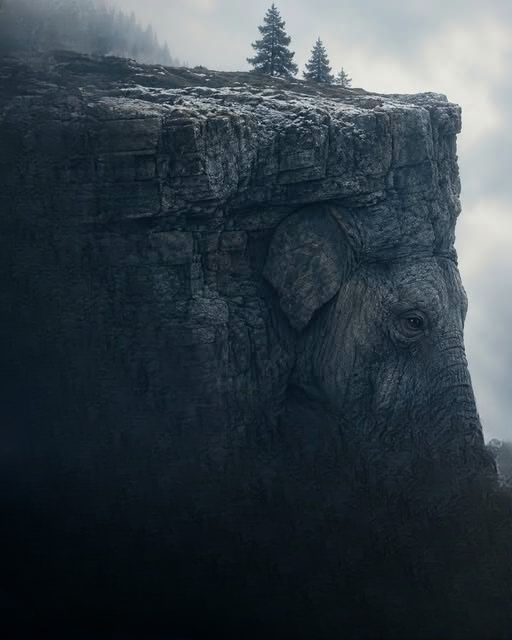
Take a close look at the image.
What do you notice first?
Is it a snake?
An elephant?
Perhaps you can see both almost immediately.
Or maybe neither shape stands out at first.
This type of optical illusion has become popular because the same collection of lines, shadows, and shapes can be interpreted in more than one way. Depending on what catches your attention first, you may suddenly recognize one animal before the other.
That simple experience can be surprisingly interesting.
The internet is full of visual personality quizzes that claim your first impression can reveal something about your personality, your thinking style, or even the way you approach the future.
Those claims should be taken lightly.
There is no reliable scientific evidence that seeing a snake or an elephant first can predict your future behavior or determine your personality. However, the illusion can still provide an entertaining opportunity to think about perception, attention, and how easily two people can interpret the same image differently.
So, before reading the explanations, look at the picture again.
What did your eyes notice first?
If You Saw the Snake First
If the snake immediately stood out to you, the image may have drawn your attention toward its curves, lines, or more detailed features.
In the playful interpretation commonly associated with this type of puzzle, people who notice the snake first are sometimes described as observant and attentive to details.
The snake is often associated with ideas such as transformation, change, caution, mystery, and hidden information.
Because snakes move in distinctive patterns and periodically shed their skin, they have become symbols of transformation in many cultural traditions.
As a result, the snake interpretation can be connected symbolically with someone who is comfortable noticing changes and looking beneath the surface of a situation.
You might enjoy examining small clues before reaching a conclusion.
You may also prefer to understand what is happening in detail rather than immediately accepting the first explanation available.
Of course, none of this can be determined from an optical illusion.
Seeing the snake first does not prove that you are more observant, cautious, intelligent, or intuitive than someone who sees the elephant.
It simply provides a fun interpretation of your first visual impression.
What Does the Snake Symbolize?
The snake has carried many different meanings throughout human history.
In some cultures and traditions, snakes have been associated with transformation and renewal.
In others, they have represented danger, wisdom, healing, mystery, or hidden knowledge.
Part of this symbolism comes from the snake’s unusual physical characteristics.
A snake can move without visible limbs.
It can disappear into narrow spaces.
Many species shed their skin as they grow.
These characteristics have contributed to the animal’s powerful symbolic role in stories, myths, art, and cultural traditions around the world.
That symbolism makes the snake an especially interesting choice for an optical-illusion personality puzzle.
If you see it first, the playful interpretation might suggest that you are someone who pays attention to changes or prefers to examine what may be happening beneath the surface.
But remember that symbolism is not the same as science.
Your answer is an interpretation, not a diagnosis.
If You Saw the Elephant First
Perhaps the elephant was the first shape you noticed.
In the traditional playful interpretation of the puzzle, elephant viewers may be described as people who naturally look at the bigger picture.
The elephant is commonly associated with qualities such as strength, wisdom, patience, loyalty, endurance, and stability.
Its social behavior has also contributed to its symbolic importance.
Elephants are known for living in complex social groups, and their relationships within those groups have attracted considerable attention from scientists and observers.
Because of this, the elephant is often used symbolically to represent family, cooperation, memory, and resilience.
So, if the elephant stood out first, the personality description may suggest that you appreciate stability and relationships or that you tend to consider the broader situation before focusing on individual details.
Again, this is simply a playful interpretation.
There is no scientific test hidden inside the picture that can determine whether you are naturally wiser, more loyal, or more emotionally intelligent.
Your brain simply interpreted the available shapes in a particular way.
Why Can Two People See Different Things?
This is where the illusion becomes genuinely fascinating.
Imagine showing the exact same image to two people.
One person immediately points to the snake.
The other insists that the elephant is obvious.
Both are looking at the same picture.
So how can their experiences be different?
Visual perception is not simply a matter of the eyes recording an image and sending an identical picture to the brain.
The brain actively organizes and interprets visual information.
When an image is ambiguous, it may consider multiple possible interpretations.
Attention plays an important role.
If certain lines or shapes catch your attention first, your brain may begin organizing the surrounding information around that interpretation.
Expectations can also influence perception.
If someone tells you that an elephant is hidden in the picture, you may begin searching for elephant-like shapes.
Once you see it, it can become difficult to understand how you missed it previously.
What If You See Both?
Some people may recognize the snake and elephant almost immediately.
If that happened to you, the playful interpretation might describe you as flexible or comfortable with multiple perspectives.
You may enjoy considering several possibilities before deciding what something means.
You might also be comfortable with ambiguity.
Instead of immediately deciding that one interpretation is correct, you may naturally ask whether another explanation could also make sense.
This can be a useful habit in everyday life.
However, seeing both animals does not scientifically demonstrate that you are more open-minded or adaptable than other people.
It simply means that you were able to identify multiple patterns in an ambiguous image.
Interestingly, many people can learn to see both interpretations once someone points them out.
That demonstrates just how flexible visual perception can be.
What If You See Neither?
Perhaps you looked at the image and could not identify either animal.
That’s completely fine.
Not everyone will interpret an ambiguous picture in the same way.
Some people may initially focus on individual lines, colors, or textures rather than immediately grouping them into a recognizable object.
The playful interpretation sometimes describes these viewers as practical or literal thinkers.
They may supposedly prefer information that is clear and directly observable.
But once again, this is not a scientifically established personality characteristic.
Failing to see the snake or elephant immediately does not mean that you lack creativity or imagination.
It may simply mean that the particular visual arrangement did not immediately form a recognizable pattern for you.
Can Your Mood Affect What You See?
Your state of attention can influence how you interpret an ambiguous image.
If you’re tired, distracted, or looking at the picture quickly, you may notice different features than you would if you were carefully examining it.
Your expectations can also change what stands out.
This is one reason optical illusions are so useful for demonstrating the complexity of perception.
The image remains the same, but your interpretation can change.
Look at it once.
Then read that a snake is hidden inside.
Look again.
You may suddenly notice a curved shape that you completely overlooked before.
Now search for the elephant.
Another set of shapes may become apparent.
The information was there the entire time.
Your attention simply wasn’t directed toward it.
Why First Impressions Can Be Misleading
One of the most interesting lessons from ambiguous images is that our first interpretation is not necessarily the only interpretation.
This happens outside of optical illusions too.
We often make quick judgments based on limited information.
We see a situation.
We form an explanation.
And because that explanation arrived quickly, we may assume it must be correct.
But there may be other possibilities that we have not considered.
The illusion provides a harmless example of this process.
You might initially see a snake and believe that the image obviously contains a snake.
Then someone points out the elephant.
Suddenly, you realize that the same shapes can support another interpretation.
Nothing about the picture changed.
Only your perspective changed.
The Elephant’s Symbolic Meaning
Elephants have played important roles in many cultures and traditions.
They are often associated with strength and wisdom.
Their social behavior and long lifespans have also contributed to their symbolic reputation.
In different cultural contexts, elephants can represent good fortune, prosperity, leadership, protection, memory, or spiritual significance.
These associations make the elephant a natural symbol for a personality puzzle centered around ideas such as stability and resilience.
If the elephant is what you notice first, the quiz might playfully suggest that you are drawn toward the larger structure of a situation rather than its smallest details.
That can be an appealing interpretation.
But it should remain just that—an interpretation.
An optical illusion cannot measure your intelligence, character, emotional intelligence, or future decisions.
The Snake’s Symbolic Meaning
The snake has an equally complicated symbolic history.
Its ability to shed its skin has often been connected with renewal and transformation.
Its movement and behavior have also led to associations with mystery and hidden knowledge.
At the same time, snakes have been symbols of danger and caution in many traditions.
These contrasting meanings make the snake particularly interesting.
It can represent both positive and negative ideas depending on the cultural context.
That is another reason why personality interpretations based on the animal should not be treated as universal truths.
Different people can attach completely different meanings to the same animal.
Can This Illusion Really Predict Your Future?
No.
Despite titles and social-media descriptions that may suggest otherwise, seeing a particular animal in an optical illusion cannot reliably predict what will happen in your future.
It cannot tell you which career you will choose.
It cannot determine whether you will make a particular decision.
It cannot reveal exactly how your relationships will develop.
And it cannot provide a scientific forecast of your personality.
The appeal comes from something much simpler.
People enjoy discovering patterns about themselves.
A quick visual puzzle provides an entertaining way to ask questions such as:
“Why did I see that first?”
“Why did my friend see something completely different?”
“Can I see the other animal now?”
Those questions are much more interesting—and much more defensible—than claiming that one answer predicts someone’s future.
Try Looking at the Image Again
Now that you’ve read the different interpretations, return to the picture.
Can you find the snake?
Can you find the elephant?
Can you see both at the same time?
You may discover that your perception has changed.
Once you know what to look for, previously meaningless shapes can suddenly become recognizable.
This is one of the most enjoyable features of ambiguous images.
They encourage you to slow down and reconsider what you initially thought you saw.
The Bigger Lesson Behind the Puzzle
Perhaps the most valuable takeaway from this illusion has nothing to do with snakes or elephants.
It is the idea that our first interpretation is not always the only possible interpretation.
In everyday situations, we can become attached to our initial assumptions.
We see one explanation and stop looking.
But sometimes another perspective reveals information that was there all along.
Optical illusions make this principle easy to experience because the consequences are harmless.
You can see one animal, learn about the other, and then look again.
Suddenly, the picture seems different.
The exercise encourages curiosity.
It reminds us that perception is active, flexible, and sometimes surprisingly subjective.
So, Which Animal Did You See First?
If the snake appeared first, enjoy the playful idea that you may be drawn toward details, patterns, or signs of change.
If the elephant appeared first, the traditional interpretation might describe you as someone who appreciates the bigger picture, stability, and resilience.
If you saw both, perhaps you simply recognized multiple patterns quickly.
And if you saw neither, there is nothing wrong with your answer. The image may simply require a different angle, more time, or a different visual cue.
There is no winning answer.
There is no scientific personality score hidden inside the picture.
And there is certainly no guaranteed prediction of your future.
The real appeal is the opportunity to discover how differently the same visual information can be interpreted.
So take another look.
What did you see first?
The snake, the elephant, both, or neither?
Whatever your answer, the most interesting part may be what happens when you look again.
Because sometimes the biggest lesson from an optical illusion is not what you see first.
It is discovering that there was always another way to see it.