For nearly two years, I had driven my daughter and her classmate to school every weekday.
It had become such a normal part of our mornings that I barely thought about it anymore.
My daughter, Emma, was ten years old, and her classmate Sophie lived only a few houses away. Sophie’s mother, Vanessa, usually left home early for her morning activities, so picking Sophie up on the way to school was convenient for everyone.
At least, that’s what I thought.
I never expected anything in return.
I didn’t ask Vanessa to contribute toward fuel. I didn’t keep track of how many mornings I’d driven Sophie. If Sophie forgot something at home, I’d turn the car around. If she had soccer practice after school, I’d sometimes wait or adjust our schedule.
Whenever Vanessa saw me, she’d smile and say, “You’re such a lifesaver.”
I never considered myself one.
I was simply another parent helping another family.
And honestly, I liked having Sophie with us. The girls were friends, and their conversations during the morning drive often made me laugh.
Then Vanessa bought a brand-new SUV.
It was a beautiful vehicle with a spotless interior, light-colored seats, and all the latest features.
She was extremely proud of it.
She showed it to everyone in the neighborhood and talked about how carefully she planned to keep it clean.
“I waited years for this car,” she told me one afternoon. “I’m going to take really good care of it.”
I congratulated her.
I had no reason to think her new vehicle would change anything between us.
I was wrong.
A few days later, I woke up to the sound of heavy rain against the windows.
The weather had changed overnight.
I went outside to start my car and immediately realized there was a problem.
Nothing happened.
I tried again.
Still nothing.
The battery had completely failed.
I checked the time.
School started in less than half an hour.
Emma was already dressed and waiting by the door with her backpack.
I called Vanessa.
“Hi, Vanessa. I’m sorry to bother you this early, but my car won’t start. Would you be able to take Emma to school with Sophie just this once? I’ll get my car fixed today.”
There was a brief silence.
Then Vanessa said, “Sure. Have her ready.”
I thanked her.
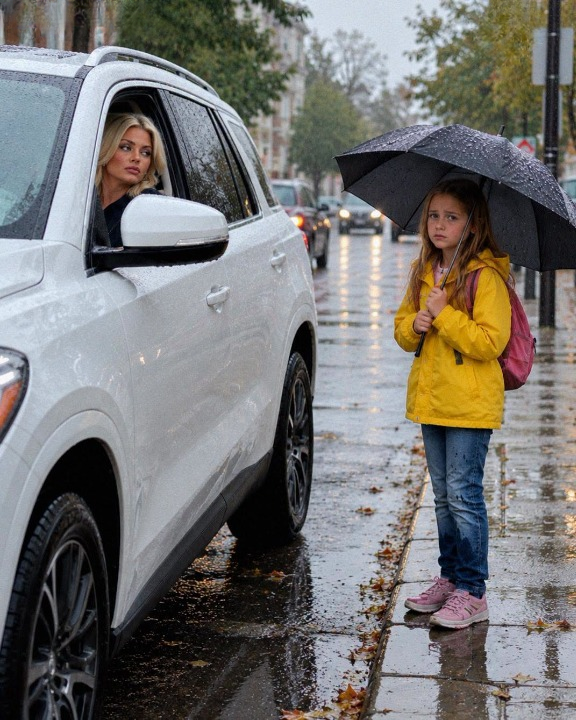
Emma grabbed her umbrella, and we walked outside.
Unfortunately, the rain had become even heavier.
Within seconds, the wind was pushing the rain sideways. Emma’s shoes became damp, and the bottoms of her jeans were wet from the puddles.
We stood near the curb and waited.
A few minutes later, Vanessa’s new SUV pulled up.
I walked Emma toward the vehicle.
Vanessa lowered the window.
Instead of greeting Emma, she immediately looked down at my daughter’s shoes.
Her expression changed.
“Oh, no.”
I thought she was concerned about the weather.
“What happened?” I asked.
She pointed toward the SUV.
“She’s wet.”
I looked at Emma.
“Everyone is wet. It’s pouring.”
Vanessa glanced at her new seats.
“I just don’t want the inside of the car getting dirty.”
I was confused.
“We can put a towel underneath her. It’ll be fine.”
Vanessa shook her head.
“I really don’t think that’s a good idea.”
Emma had heard everything.
She quietly looked down at her shoes.
I could see the embarrassment on her face.
I tried one more time.
“Vanessa, it’s only a five-minute drive. I’ll clean everything if there’s any mess.”
She sighed.
“I’ve spent a lot of money on this car. I don’t want muddy water getting on the seats.”
For a moment, I couldn’t believe what I was hearing.
For almost two years, I’d driven her daughter to school through rain, snow, cold mornings, and hot afternoons.
I’d never complained when Sophie accidentally dropped food in the back seat.
I’d never asked Vanessa for gas money.
I’d never told her that her daughter wasn’t welcome in my car because she might make a mess.
And now, when my daughter needed a ride one single morning, Vanessa couldn’t bring herself to let her sit in the passenger seat because her shoes were wet.
I looked at Emma.
“Come on, sweetheart.”
Emma nodded.
As we walked back toward the house, she whispered, “It’s okay, Mom.”
But I knew it wasn’t okay.
Not because we couldn’t find another way to school.
We could.
It was the way Vanessa had made my daughter feel.
Like she was somehow a problem.
I ordered a rideshare for Emma and paid the fare even though it wasn’t part of my budget that week.
Emma arrived at school a little late.
That evening, my car was repaired.
I thought about sending Vanessa a message to tell her everything was back to normal.
Then my phone buzzed.
It was Vanessa.
“Glad your car is fixed! Can you pick up Sophie tomorrow morning like usual?”
I stared at the message for several seconds.
I didn’t know whether to laugh or cry.
After everything that had happened that morning, she apparently expected me to simply continue as though nothing had changed.
I didn’t respond.
The next morning, I drove Emma to school.
I did not pick up Sophie.
I wasn’t angry.
I simply decided that our arrangement was over.
If Vanessa wanted to protect her new vehicle, she had every right to do so.
But I also had the right to stop providing a service that she clearly didn’t appreciate.
For the next several days, things were quiet.
Then, one morning, just before seven, someone began knocking repeatedly on my front door.
I opened it.
Vanessa was standing outside.
She looked exhausted and unusually worried.
“Can I talk to you?”
“Of course.”
She stepped onto the porch.
Then she pointed toward the street.
“There’s a problem.”
I followed her gaze.
Her new SUV was parked near the curb.
Something had clearly gone wrong.
One of the tires was completely flat, and the vehicle was sitting at an awkward angle.
Vanessa looked at me.
“I need to get Sophie to school, and I can’t move the car.”
I waited.
Then she said something I never expected.
“Could you please help me?”
I almost smiled.
Not because I was happy that she was having trouble.
I wasn’t.
But because the situation had changed so quickly.
A week earlier, she had refused to give my daughter a short ride because she was worried about dirtying her expensive seats.
Now she was standing at my door asking me for help.
I could have reminded her of what happened.
I could have told her that she had made her own choice.
Instead, I took a breath.
“Of course I’ll help Sophie get to school.”
Vanessa looked relieved.
“Thank you.”
I nodded.
“But things are going to be different from now on.”
She looked at me.
“What do you mean?”
“I won’t be able to drive Sophie every day anymore. I’m happy to help in an emergency, just like you helped me that morning. But the regular arrangement is over.”
Vanessa lowered her eyes.
For several seconds, neither of us spoke.
Finally, she said quietly, “I understand.”
Then she surprised me.
“I’m sorry.”
I wasn’t expecting an apology.
She continued.
“I was so worried about keeping the new car clean that morning that I didn’t think about how my behavior would make Emma feel.”
That was the first time I heard her acknowledge what had actually happened.
“She was embarrassed,” I said.
“I know,” Vanessa replied. “Sophie told me later. She said Emma looked really hurt.”
I appreciated her honesty.
“I don’t expect you to give up your car or ignore your concerns. But children shouldn’t be made to feel like they’re less important than someone’s belongings.”
Vanessa nodded.
“You’re right.”
That morning, I drove Sophie and Emma to school.
The girls sat in the back seat, chatting about a school project as though nothing unusual had happened.
When we arrived, Sophie leaned forward.
“Thank you.”
I smiled.
“You’re welcome.”
After school, Vanessa picked Sophie up herself.
And that was the beginning of a new arrangement.
We weren’t enemies.
We didn’t have a dramatic argument.
We simply stopped taking each other’s help for granted.
A few weeks later, Vanessa invited Emma and me over for coffee.
She showed me the SUV and laughed.
“I’ve realized something.”
“What?”
“Cars can be cleaned.”
I smiled.
“That’s true.”
She looked embarrassed.
“I was so focused on protecting something expensive that I forgot what was actually important.”
I appreciated that.
Because sometimes the biggest lessons don’t come from dramatic confrontations.
They come from ordinary moments when we realize our priorities were wrong.
Vanessa’s new SUV was still beautiful.
She still took good care of it.
But she no longer treated it as though a little rain or mud was more important than someone’s feelings.
And I learned something too.
Being generous is wonderful, but generosity shouldn’t mean allowing someone to take your kindness for granted.
For almost two years, I had helped another family because it was convenient and because I genuinely cared about the children.
I don’t regret that.
But I also don’t regret setting a boundary afterward.
Helping people should come from kindness, not obligation.
And respect has to go both ways.
That rainy morning taught both of us a lesson.
For Vanessa, it was that a clean car can be washed.
For me, it was that saying “no” doesn’t make you unkind.
Sometimes, it simply means you’ve finally learned to value your own kindness too.