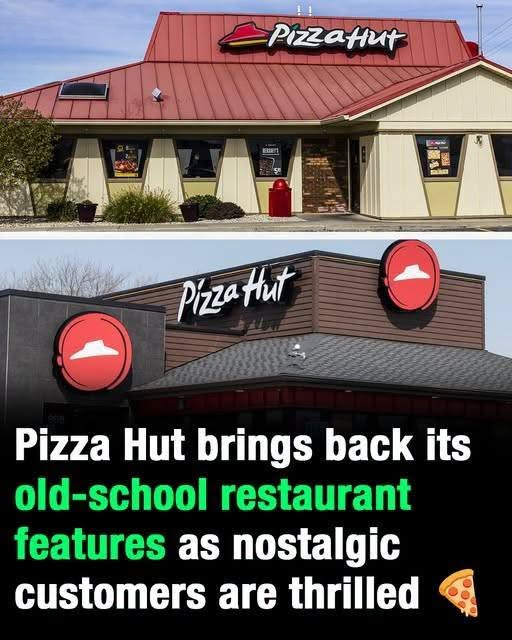
For many people, a restaurant is about much more than what appears on the menu.
Certain places become connected to childhood memories, family traditions, birthday celebrations, weekend outings, and special occasions. The furniture, lighting, signs, music, table settings, and even the way a restaurant smells can become part of those memories.
That is one reason the return of a classic Pizza Hut-inspired restaurant style has generated so much interest.
For longtime customers, the familiar design brings back memories of a different era of dining. For younger visitors, meanwhile, the retro atmosphere offers something that feels completely different from the minimalist restaurant interiors that have become common today.
The idea is simple: instead of treating an old-fashioned restaurant design as something that belongs entirely in the past, elements of it can be reintroduced in a way that feels enjoyable and relevant today.
And for many people, that experience begins before the first slice of pizza reaches the table.
A Restaurant Was Once Part of the Experience
Today, many restaurants are designed around speed and convenience.
Customers order from their phones, pick up food through dedicated counters, or have meals delivered directly to their homes.
Those options are convenient, but they can remove some of the atmosphere that people once associated with eating out.
Older Pizza Hut locations were often designed differently.
They weren’t simply places where customers stopped to collect dinner.
For many families, visiting the restaurant was an event.
People sat around tables.
Children looked around the room.
Families talked while waiting for their food.
Friends gathered after school.
Birthdays were celebrated.
The restaurant itself became part of the occasion.
That distinction is important when considering why classic restaurant designs continue to attract attention.
The appeal isn’t necessarily about recreating every detail of the past.
It’s about recreating a feeling.
Why Nostalgia Matters
Nostalgia is powerful because it connects physical surroundings with personal memories.
A particular color combination can remind someone of childhood.
A familiar sign can bring back memories of family dinners.
A certain style of table or booth can make someone remember sitting with their parents decades earlier.
These associations are often stronger than people realize.
That is why retro design has appeared across many industries.
Automakers have revisited classic styling.
Fashion brands have reintroduced older trends.
Entertainment companies have brought back familiar characters and franchises.
Restaurants have also discovered that older visual identities can create emotional connections with customers.
Pizza Hut is especially interesting in this context because its restaurants once had a distinctive visual identity that many customers immediately recognized.
The Classic Pizza Hut Look
For longtime customers, the traditional Pizza Hut restaurant was easy to recognize.
Many locations featured distinctive architecture, warm interiors, booths, table seating, prominent signage, and visual details that made the restaurants feel different from ordinary fast-food locations.
The atmosphere encouraged customers to stay.
People weren’t necessarily rushing through their meals.
They could sit down with friends or family and spend time together.
That kind of dining experience has become less common as restaurant businesses have increasingly emphasized convenience and efficiency.
The renewed interest in the classic style therefore represents more than a design choice.
It reflects a broader interest in making restaurants feel like destinations again.
Bringing the Past Into the Present
Recreating a historic restaurant isn’t as simple as copying an old photograph.
A successful revival has to balance familiarity with modern expectations.
Customers today expect comfortable seating, updated technology, efficient service, clean interiors, and contemporary accessibility standards.
Simply reproducing an old restaurant exactly as it looked decades ago wouldn’t necessarily create the best experience.
Instead, designers can select the elements people remember most.
That might include familiar colors.
Retro-inspired signs.
Classic booth arrangements.
Warm lighting.
Distinctive architectural features.
Vintage-inspired graphics.
The result can feel nostalgic without becoming a museum.
A New Generation Is Discovering Retro Design
Interestingly, nostalgia isn’t limited to people who actually remember older Pizza Hut restaurants.
Younger customers can also be attracted to retro design.
For someone who grew up surrounded by modern minimalist interiors, a restaurant with a strong vintage identity can feel fresh and unusual.
This creates an interesting reversal.
A design that once represented everyday life for older customers can appear completely new to younger visitors.
Social media has also helped accelerate this trend.
Photogenic restaurants can become destinations in their own right.
A distinctive interior gives visitors something to photograph and share.
A classic restaurant design can therefore serve two audiences at once:
People returning to something familiar.
And people discovering something that feels new.
The Emotional Side of Dining
Food has always been closely connected to memory.
People often remember meals because of who they shared them with rather than exactly what they ate.
A birthday dinner might be remembered because a parent was there.
A family outing might remain memorable because everyone laughed together.
A school celebration might become a lifelong memory.
The restaurant becomes the setting for those moments.
This is why recreating an old environment can have such a strong emotional impact.
A customer may walk into a familiar-looking restaurant and suddenly remember being a child sitting at a booth with their family.
That emotional response can be difficult for a completely new restaurant concept to reproduce.
Why the Booth Matters
One of the most recognizable features of traditional family restaurants was the booth.
Booths provided a sense of privacy while still allowing families and groups to sit together.
They also encouraged people to stay longer.
For children, the booth itself could become part of the experience.
For parents, it offered a practical place for an entire family to sit together.
Modern restaurant layouts often prioritize maximizing the number of customers who can be seated.
Older layouts sometimes emphasized comfort and atmosphere instead.
Bringing back elements of that approach can make a restaurant feel more relaxed.
The Difference Between Delivery and Dining Out
Pizza delivery is incredibly convenient.
Customers can enjoy a meal without leaving home.
But convenience and experience are not the same thing.
Dining at a restaurant provides something delivery cannot completely reproduce.
There is the journey to the restaurant.
The anticipation.
The atmosphere.
The conversation.
The sounds around you.
The presentation of the food.
The experience of sitting together.
For families, those details can matter.
A restaurant with a recognizable identity can make the decision to eat out feel more meaningful.
Why Classic Brands Are Revisiting Their Past
Many established brands eventually face the same question:
How do you remain relevant without losing the identity that made people love you in the first place?
Completely abandoning a traditional identity can make a brand feel unfamiliar.
But refusing to change can make it feel outdated.
The middle ground is often a selective return to the past.
Brands can identify the elements customers remember most and reinterpret them for modern audiences.
For Pizza Hut, restaurant design provides an especially interesting opportunity because the company’s physical locations were historically a major part of its identity.
More Than Just Decoration
A nostalgic restaurant shouldn’t rely entirely on decorations.
The experience needs to support the atmosphere.
If the restaurant looks vintage but feels rushed and impersonal, the effect may not work.
Customers notice how they are treated.
They notice whether the seating is comfortable.
They notice cleanliness.
They notice service.
They notice how long they wait.
That means the most successful retro restaurant concept combines visual nostalgia with a modern customer experience.
The goal isn’t to pretend that it’s still decades ago.
The goal is to capture some of what made the experience special while keeping the conveniences people expect today.
The Appeal of Family Restaurants
Family restaurants once occupied a distinctive place in American culture.
They were informal enough for children but comfortable enough for adults.
Families could celebrate birthdays without needing a formal dining environment.
Friends could meet without spending an enormous amount of money.
Parents could bring their children somewhere that felt special.
Pizza was particularly well suited to this model.
A single pizza could be shared among an entire group.
That naturally encouraged conversation.
It created a social experience rather than an individual meal.
The restaurant environment reinforced that idea.
A Different Kind of Restaurant Marketing
Traditional advertising often focuses on products.
A restaurant may promote a new menu item, a discount, or a limited-time offer.
Nostalgia marketing takes a different approach.
Instead of saying, “Come try this product,” it can communicate:
“Remember how this used to feel?”
That message can be incredibly effective because customers supply their own memories.
One person might remember birthday parties.
Another might remember going out with their parents.
Someone else might remember meeting friends after school.
The brand doesn’t have to create the memory.
It simply provides the setting that helps customers remember it.
Why Younger Customers May Love It Too
There is an assumption that nostalgia marketing only works on older generations.
That’s not necessarily true.
Younger customers often enjoy retro aesthetics even when they never experienced the original era.
Part of the attraction comes from visual contrast.
Modern restaurants often feature neutral colors, exposed materials, simple furniture, and minimalist signage.
A bold retro interior stands out.
It feels distinctive.
It provides a stronger visual identity.
That can make the restaurant more memorable.
In an age where customers frequently photograph their surroundings, distinctive design can also become part of the marketing.
The Social Media Effect
Restaurants today exist in two spaces simultaneously.
There is the physical restaurant.
And there is the digital version customers share online.
A distinctive interior can become an important part of that digital identity.
Customers may photograph signs, booths, walls, menus, or architectural details.
Those images can reach people who have never visited the location.
This creates a feedback loop.
People see photographs online.
They become curious.
They visit the restaurant.
They take their own photographs.
Those photographs reach another audience.
A strong visual identity can therefore become an important part of a restaurant’s modern appeal.
Nostalgia Without Pretending the Past Was Perfect
There is also an important distinction between nostalgia and historical accuracy.
People tend to remember positive moments.
They may remember family dinners and birthday celebrations while forgetting inconvenient parts of the experience.
A modern revival doesn’t need to reproduce every aspect of an older restaurant.
It can preserve the enjoyable elements while improving things that customers expect to be different today.
Comfort can improve.
Accessibility can improve.
Technology can improve.
Service can improve.
The restaurant can still look and feel familiar while functioning as a modern business.
What This Means for Pizza Hut
The renewed attention surrounding classic Pizza Hut-style restaurants demonstrates something larger than a simple design trend.
It shows that customers can develop emotional relationships with places.
A brand isn’t always remembered because of its logo or product.
Sometimes it is remembered because of where people experienced it.
For many longtime customers, the restaurant itself was part of the Pizza Hut identity.
That makes a return to classic design especially meaningful.
It allows customers to reconnect with memories while introducing younger generations to a style of dining that feels increasingly unusual.
The Restaurant as a Memory
Imagine walking into a restaurant years after visiting one as a child.
The colors are familiar.
The seating feels familiar.
The atmosphere reminds you of family trips.
Suddenly, you’re not thinking about the restaurant’s business strategy.
You’re thinking about your childhood.
That’s the power of environmental memory.
Places can become containers for personal experiences.
A restaurant can remind someone of a parent who is no longer around.
A friend they haven’t spoken to in years.
A birthday they had forgotten.
A family tradition that disappeared.
A simple meal can become connected to an entire chapter of someone’s life.
Why This Trend Could Continue
The renewed interest in retro design isn’t limited to one restaurant chain.
Across different industries, consumers are showing interest in recognizable styles from earlier decades.
Part of this may be a response to an increasingly digital world.
People spend more time interacting with screens and less time gathering in physical spaces.
A restaurant that provides a strong sense of place can therefore feel valuable.
It gives people somewhere to go rather than simply something to order.
That distinction may become increasingly important.
A Place to Gather Again
At its best, the classic family restaurant represented more than food.
It represented gathering.
Parents brought children.
Friends met after school.
Families celebrated milestones.
People sat together and talked.
Those experiences don’t necessarily require a particular decade.
They require a place that encourages people to stay.
That may be the most important lesson behind the renewed interest in classic restaurant design.
The past itself isn’t necessarily what customers want.
They want the feeling associated with it.
They want connection.
They want atmosphere.
They want memorable experiences.
And sometimes, they simply want to sit around a table with people they care about.
The Future of Nostalgic Dining
The future of restaurant design may not be entirely modern or entirely retro.
Instead, we may see more businesses combining both.
Classic visual elements can be paired with modern ordering systems.
Vintage-inspired architecture can exist alongside contemporary kitchens.
Traditional seating can coexist with digital conveniences.
Old memories can meet new experiences.
That combination allows brands to appeal to multiple generations at once.
Older customers can reconnect with something familiar.
Younger customers can discover something new.
And everyone can share the same space.
Final Thoughts
The renewed interest in classic Pizza Hut restaurant design is a reminder that restaurants can become much more than places to eat.
They can become part of people’s personal histories.
A certain booth can remind someone of childhood.
A familiar sign can bring back memories of family celebrations.
A restaurant’s atmosphere can transport someone to a completely different period of life.
That’s why nostalgia remains such a powerful force.
The most successful revival isn’t necessarily the one that copies the past perfectly.
It’s the one that understands why people remember the past in the first place.
For many customers, the classic restaurant experience represented family, friendship, celebration and time spent together.
Those ideas never really become outdated.
And perhaps that’s why a familiar restaurant design can still attract attention decades later.
The furniture may change.
The technology may change.
The way people order food may change.
But the desire to sit down with people we care about, share a meal and create a memory remains remarkably timeless.