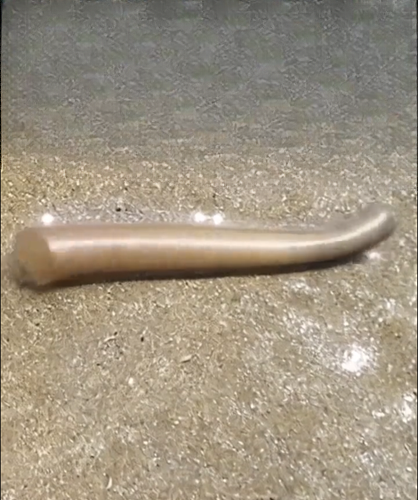
Nature’s Tiny Architects: Exploring the Secret Lives of Sand-Dwelling Worms
“I didn’t know that!” It is a simple expression, but it captures one of the most rewarding experiences of exploring the natural world: discovering something unexpected in a place we thought we already understood.
For many people, some of their earliest memories of nature involve small discoveries made outdoors. A strange pattern in the sand, an unusual shell beneath a rock, or a tiny creature moving through shallow water can transform an ordinary afternoon into an unforgettable experience. These moments often stay with us long after childhood because they combine curiosity, surprise, and the excitement of learning something new.
Beaches and coastal environments are especially rich in these opportunities. At first glance, a sandy shoreline may seem relatively simple. Waves move back and forth, seabirds search for food, and small shells collect along the water’s edge. Yet beneath the surface lies a complicated environment filled with organisms that have developed remarkable ways to survive.
Among these organisms are marine worms that live in sediment, build protective tubes, or create distinctive structures around their burrows. Their homes may look unusual to someone encountering them for the first time, but they often serve practical purposes connected to shelter, feeding, and survival.
The phrase “trumpet worm nests” can refer to unusual tube-like or funnel-shaped structures people notice in sandy or muddy environments. However, identifying a particular structure accurately requires more information about its shape, location, and the species that created it. Different marine worms construct different types of homes, and not every unusual formation in the sand belongs to a worm.
Understanding these small structures offers an opportunity to explore marine biology, animal behavior, and the many ways living organisms interact with their surroundings.
It also reminds us that nature does not need to be large or dramatic to be fascinating. Sometimes, the most interesting discoveries begin with a small mark in the sand and a simple question: What made that?
1. The Childhood Wonder of Discovering Something Unfamiliar
Childhood curiosity often begins with noticing details that adults overlook.
A child walking along a beach may stop because a patch of sand has an unusual pattern. Another might become fascinated by a shell with an unfamiliar shape or by a small opening surrounded by tiny grains of sediment.
The discovery may seem insignificant to someone passing by, but to the child, it can open an entirely new world of questions.
Who made the structure? Is something living inside it? How long did it take to form? Does the creature return to the same place every day?
These questions are an important part of learning. Instead of accepting the beach as a flat stretch of sand, the child begins to recognize it as a living environment containing organisms with different needs and behaviors.
The natural world encourages this kind of observation because it is constantly changing. A structure visible during one visit may disappear after a tide, while another may emerge following a period of calm weather.
Even familiar places can reveal new details when examined closely.
Childhood memories of these discoveries may become especially vivid because they combine sensory experiences with strong emotions. The sound of waves, the feeling of damp sand, the smell of saltwater, and the surprise of finding something unexpected can all become part of the memory.
Years later, a similar discovery may bring back those feelings.
This is one reason nature education can be so effective when it begins with observation rather than memorization. People are often more interested in learning about a creature after they have encountered evidence of its existence themselves.
An unfamiliar tube in the sand can become the starting point for a lesson about animal anatomy, habitat, and adaptation.
The important thing is not to know every answer immediately. It is to remain curious enough to investigate.
2. What Are Marine Worms?
Marine worms are not a single, uniform group of animals. The term describes several groups of soft-bodied invertebrates that live in oceans, estuaries, tidal flats, and other aquatic environments.
Many marine worms belong to the phylum Annelida, which includes segmented worms. This group contains a remarkable variety of species, from small organisms living between grains of sediment to larger marine worms that occupy burrows or build protective tubes.
Other animals commonly described as worms belong to entirely different groups. Their bodies, feeding methods, and habitats can vary considerably.
Some marine worms live freely on the seafloor. Others burrow into sand or mud, while certain species build tubes from secreted materials, sediment particles, shell fragments, or other substances available in their surroundings.
These tubes can serve as protective homes. Depending on the species, a worm may remain inside much of the time, extending part of its body to collect food from the surrounding water.
Other species feed on organic material within the sediment. Their activities can contribute to the movement and processing of material on the seafloor.
Marine worms are often overlooked because many are small, hidden, or active when people are not paying attention. Nevertheless, they play important roles in coastal ecosystems.
Their presence can influence sediment structure, nutrient cycling, and the availability of food for other animals.
Some fish and crustaceans feed on marine worms, making them part of the food web that supports life in coastal waters.
Learning about these organisms helps reveal that a beach is not merely a place where sand meets the ocean. It is a habitat containing many interconnected forms of life.
3. Understanding the Idea of a Trumpet-Shaped Nest
The word “trumpet” suggests a structure with a narrow base and a wider opening, resembling the bell of a musical instrument.
When people use this description for a marine structure, they may be referring to a tube, funnel, or opening that widens toward the top. However, the appearance alone is not enough to determine which animal created it.
Marine worms construct several kinds of structures, and their designs reflect different environmental conditions and biological requirements.
Some species produce tubes that project above the surrounding sediment. Others create openings at the surface of a burrow, while some build more elaborate structures using particles collected from the seabed.
In certain environments, the entrance to an animal’s home may become wider or more noticeable because of water movement, sediment accumulation, or repeated activity by the animal.
A trumpet-like shape could therefore describe the visible appearance of a structure without establishing its precise biological origin.
Accurate identification requires careful observation.
The structure’s dimensions, material, location, and relationship to the surrounding sediment can provide useful clues. It also matters whether the formation appears in dry sand, wet intertidal sediment, shallow water, or a deeper marine environment.
Photographs taken from different angles may help reveal whether the structure is a tube, a burrow opening, a collection of sediment particles, or something created by another organism.
If the exact species is unknown, it is better to describe the formation as a possible marine-worm structure rather than confidently assigning it to a particular animal.
This approach does not make the discovery less interesting. Instead, it demonstrates how scientific investigation works: observations provide the starting point, while evidence helps determine the explanation.
4. Why Do Some Marine Worms Build Tubes?
For animals living in an environment where predators, waves, and changing conditions can threaten their survival, shelter can be extremely valuable.
Tube-building is one solution that certain marine worms have developed.
A protective tube can help an animal remain in a stable position while reducing exposure to some external threats. Depending on its construction, the tube may also help prevent the animal’s surroundings from collapsing around it.
Different species use different materials.
Some marine worms produce tubes from substances secreted by their bodies. Others incorporate sand grains, small shell fragments, or other particles into the structure.
The materials and construction methods vary with the species and habitat.
A tube may also provide a useful position from which the worm can feed. Some tube-dwelling worms extend specialized feeding structures into the water to capture suspended particles or other food sources.
Other worms use their burrows while feeding on organic material within the sediment.
These behaviors demonstrate that animal-built structures are not simply decorative formations. They are functional parts of an organism’s relationship with its environment.
A tube’s shape may reflect the balance between protection, feeding, water movement, and the physical properties of the surrounding sediment.
The structure is also exposed to environmental forces. Strong currents, waves, storms, and shifting sand can damage or bury it.
For this reason, different marine animals have developed different approaches to constructing and maintaining shelter.
Some build relatively simple