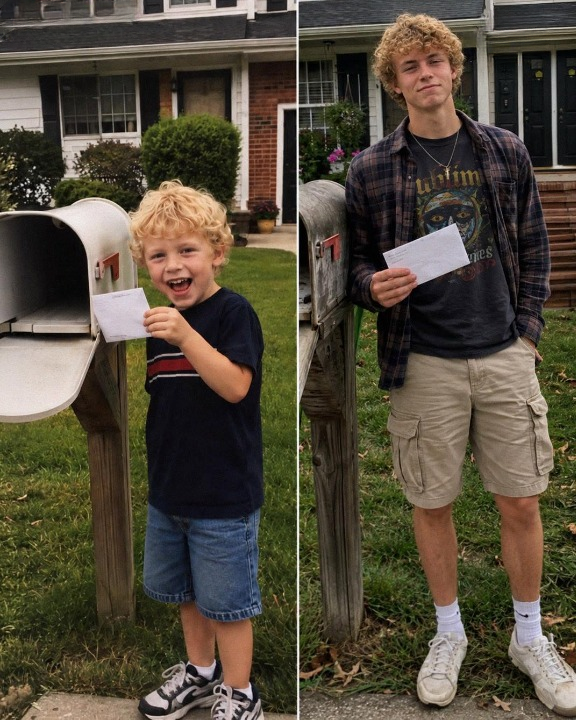
Every year on my son Adrian’s birthday, a plain white envelope appeared in our mailbox.
The first one arrived when he was only a year old. It contained a simple birthday card with a cheerful picture of balloons on the front and a five-dollar bill tucked inside. There was no signature, personal message, or recognizable return address.
At the time, I assumed one of our relatives had forgotten to sign the card. With a one-year-old in the house and a birthday gathering to organize, I did not give it much thought.
Then another envelope arrived the following year.
This one contained a card decorated with a cartoon train and another five-dollar bill. Once again, there was no name.
By the third year, I knew it was not an accident.
The envelopes always arrived shortly before Adrian’s birthday. They were the same size, addressed in the same careful handwriting, and contained a simple card with a small amount of money. Sometimes it was five dollars, sometimes ten, and once there was a twenty-dollar bill.
The money was never enough to suggest that a wealthy stranger was secretly preparing Adrian for the future. It was simply a small birthday gift—the kind someone might send to show that a child had not been forgotten.
When Adrian was young, he cared more about the money than the mystery. On his sixth birthday, he ran into the kitchen waving a ten-dollar bill as though he had discovered buried treasure.
“I can buy anything I want!” he announced.
I laughed and explained that ten dollars might not purchase everything he could imagine, but it was enough for a small toy. We drove to the store, where he spent nearly an hour choosing between a plastic dinosaur and a remote-controlled car that required more money than he had.
He eventually selected the dinosaur and named it Envelopes.
As Adrian grew older, the annual card became one of his favorite birthday traditions. A few days before each birthday, he began checking the mailbox.
“Do you think it will come this year?” he would ask.
“It always has,” I would answer.
And somehow, it always did.
I tried several times to identify the sender. I compared the handwriting with old holiday cards from relatives and friends. I studied the postmarks, but they were often faint or difficult to read. The return addresses were either incomplete or belonged to postal centers rather than private homes.
The cards offered no useful clues. They contained ordinary printed greetings with no memories, inside jokes, or references to our family.
I asked my parents, siblings, cousins, and close friends. Everyone denied sending them.
Some relatives thought it was charming. Others warned me to be cautious.
I understood their concern, but the sender never asked Adrian to respond or keep secrets. There were no inappropriate messages and no effort to contact him privately. The envelopes contained only a birthday card and a modest gift.
Still, not knowing bothered me.
When Adrian turned thirteen, he opened that year’s envelope at the kitchen table. After reading the card, he looked at me with narrowed eyes.
“Mom, are you doing this?”
“Doing what?”
“Sending the cards.”
I laughed at first, but he remained serious.
“Maybe you mail them to make my birthday more interesting,” he said. “You could be pretending not to know.”
“I promise it isn’t me,” I replied. “I wish I had thought of something that clever, but I’m just as curious as you are.”
He studied my face, apparently deciding whether to believe me.
Then he asked the question I had hoped to avoid.
“Could they be from my father?”
The room suddenly felt very quiet.
Adrian’s father, Marcus, had left before Adrian was born. We had been young and unprepared when I learned I was pregnant. I was frightened, but I believed we could face the situation together.
Marcus did not feel the same way.
At first, he promised to remain involved. Then he stopped answering my calls. He moved away without giving me his new address and made it clear through a mutual friend that he did not want the responsibilities of parenthood.
Adrian had never met him. Marcus had never called, attended a school event, or sent a birthday present. As far as I knew, he did not even know where we lived.
Remembering Adrian’s birthday every year did not fit with the person I remembered.
“I don’t think the cards are from him,” I said carefully.
“Why not?”
“He never had this address.”
Adrian nodded, but I could see the disappointment in his expression.
I wanted to protect him, but there was no gentle way to explain why a parent might choose not to participate in a child’s life. I had spent years making sure Adrian understood that his father’s absence was not his fault.
“You were always wanted by me,” I reminded him. “Nothing about his choices changes how valuable you are.”
“I know,” Adrian said.
He smiled, but the sadness in his eyes remained.
After that conversation, we largely stopped investigating the envelopes. They became a familiar mystery—something unusual but strangely comforting.
Someone remembered Adrian every year.
Someone cared enough to select a card, place money inside, write his address, and make sure it arrived near his birthday.
Last week, Adrian turned eighteen.
The milestone affected me more than I expected. It felt as though only a few months had passed since he needed help tying his shoes and asked me to remove the crusts from his sandwiches. Suddenly, he was taller than I was, driving himself to school, applying to colleges, and talking about the life he wanted to build.
On the morning of his birthday, we ate pancakes in the kitchen. I had taken the day off work, even though Adrian insisted he was too old to need an entire day of celebration.
Just after breakfast, the mail arrived.
Adrian brought the familiar white envelope inside and held it up with a smile.
“There it is,” he said.
The handwriting looked exactly the same, although it seemed slightly less steady than it had in previous years.
Adrian sat at the kitchen table and opened the envelope carefully. I remained near the counter, pretending to organize the breakfast dishes while watching him.
I expected another printed birthday card and perhaps a ten-dollar bill.
Instead, Adrian removed a folded sheet of paper and an old photograph.
His expression changed as soon as he began reading. His smile disappeared, and he became completely still.
He read the entire letter once, then returned to the beginning and read it again.
“Adrian?” I asked. “What does it say?”
He did not answer immediately.
He stared at the photograph before looking up at me. His face had lost its color.
“Mom,” he said quietly, “it isn’t a birthday card.”
I walked toward the table, but he held the letter close to his chest for a moment, as if he needed time to understand it.
Then he placed the photograph in front of me.
It showed a teenage boy standing beside an older woman. The picture had faded, but I recognized the boy immediately.
It was Marcus.
He could not have been much older than Adrian was now. The resemblance between them was unmistakable. They had the same eyes, the same dark hair, and even the same uneven smile.
On the back of the photograph, someone had written: “Marcus and Evelyn, summer of 1989.”
“Who is Evelyn?” Adrian asked.
I shook my head. Marcus had told me that his mother had died when he was young. I had never met anyone from his family.
Adrian unfolded the letter again and began reading aloud.
“Dear Adrian,” he said. “My name is Evelyn Carter, and I am your grandmother.”
He paused and looked at me.
The letter explained that Evelyn was Marcus’s mother. She had learned about Adrian shortly after his first birthday when she found a photograph of him inside Marcus’s apartment. Marcus initially refused to explain, but he eventually admitted that he had a son.
Evelyn had been shocked. Marcus had told me she was no longer alive, while telling her that I had chosen to move away and wanted no contact with his family.
She later discovered that neither story was true.
Evelyn wrote that she had argued with Marcus and urged him to accept responsibility. He refused. He would not give her my telephone number, but she eventually found our mailing address through a friend who remembered my last name and knew the town where I lived.
She had wanted to introduce herself, but she was afraid that appearing unexpectedly would create more confusion and pain. She did not know what Marcus had told me, and she worried that I might view her contact as interference.
So she made a choice that she now admitted had been too cautious.
She began sending Adrian an anonymous birthday card every year.
“I told myself that a small card was better than nothing,” she wrote. “But the truth is that I was afraid. I was ashamed of my son’s behavior, and I did not know how to explain why I had waited so long to contact you.”
The cards were simple because she did not want to claim a place in Adrian’s life that she had not earned. The money was modest because the purpose was never to impress him. She only wanted him to receive proof, however small, that someone from his father’s family remembered the day he was born.
Evelyn had promised herself that when Adrian turned eighteen, she would tell him the truth and allow him to decide whether he wanted contact.
At the bottom of the letter, she had included her telephone number and address.
The final lines were the ones that left Adrian silent.
“You do not owe me forgiveness, a meeting, or even a reply,” she had written. “I only want you to know that your father’s absence never meant you were forgotten. I have thought about you on every birthday and on countless ordinary days in between.”
For several minutes, neither of us spoke.
I experienced a mixture of shock, anger, relief, and sadness. Marcus had lied to both of us, denying Adrian the opportunity to know a grandmother who had cared about him from a distance.
At the same time, I wondered why Evelyn had not simply written to me years earlier.
“She could have told us,” Adrian said, as if reading my thoughts.
“Yes,” I replied. “She could have.”
“Are you angry?”
“I’m angry about the lies and the years that were lost,” I admitted. “But the decision about whether to contact her belongs to you.”
Adrian spent most of his birthday carrying the letter. He read it several times and compared his face with the photograph of his father.
That evening, after his friends had left and the cake had been put away, he came into the living room holding his phone.
“I think I want to call her,” he said.
I sat beside him while he dialed the number.
A woman answered after the second ring.
“Hello?”
Adrian took a deep breath.
“My name is Adrian,” he said.
There was a long silence on the other end.
Then I heard the woman begin to cry.
“You received my letter,” she whispered.
They spoke for nearly an hour.
Evelyn answered every question she could. She did not defend Marcus or make excuses for his absence. She admitted that she should have been braver and contacted us openly. She apologized to both Adrian and me.
She also told him that she had kept a copy of every birthday card she sent. Alongside those copies, she had written longer letters that she never mailed—letters describing her life, her hopes for him, and the family history she thought he might one day want to know.
A week later, we met Evelyn at a quiet café.
She was in her seventies and walked with a cane. When Adrian entered, she covered her mouth with both hands. For a moment, she simply stared at him.
“You look so much like him,” she said. Then she quickly added, “But I hope you know that you are your own person.”
Adrian hugged her.
The meeting did not erase eighteen years of distance. It did not answer every question, and it did not suddenly make us a perfect extended family.
But it created a beginning.
Adrian chose not to contact his father immediately. He said he needed time, and Evelyn respected that decision. She never pressured him or tried to make him responsible for repairing choices made by adults before he was old enough to understand them.
Over the following months, she and Adrian began speaking regularly. She showed him family photographs, taught him recipes that had belonged to his great-grandmother, and told him stories about relatives he had never known existed.
The mysterious envelopes had never contained a fortune or a dramatic secret inheritance. They held something quieter and, in many ways, more meaningful.
They were proof of remembrance.
For seventeen years, Adrian believed an unknown person cared enough to remember his birthday. On his eighteenth, he learned that the sender was a grandmother who had loved him from a distance but had taken far too long to find the courage to step closer.
Her silence had cost them time, but her final letter gave Adrian a choice.
He chose to open the door—not because the past no longer mattered, but because he wanted the future to be different.