Parenting is filled with moments you can never fully prepare for.
You teach kindness from the time your children are old enough to speak. You remind them to say “please” and “thank you.” You encourage them to include others, to be respectful, and to remember that every person deserves dignity.
You hope those lessons become part of who they are.
Sometimes they do.
And sometimes life presents a moment that shows you there is still more to teach.
One ordinary dinner with my fourteen-year-old son became exactly that kind of moment.
It’s a night neither of us has ever forgotten.
A Celebration Worth Sharing
My son, Leo, had worked incredibly hard during the school year.
His report card reflected months of dedication, improved study habits, and genuine effort.
To celebrate, I let him choose where we’d have dinner.
Without hesitation, he picked his favorite neighborhood steakhouse.
It had become something of a tradition.
Whenever our family celebrated an important milestone, we’d usually end up there.
By the time we arrived, the restaurant was comfortably busy.
Families chatted around us.
The smell of grilled food filled the dining room.
Soft music played in the background.
Everything felt relaxed.
I remember thinking it was going to be a wonderful evening.
Meeting Our Server
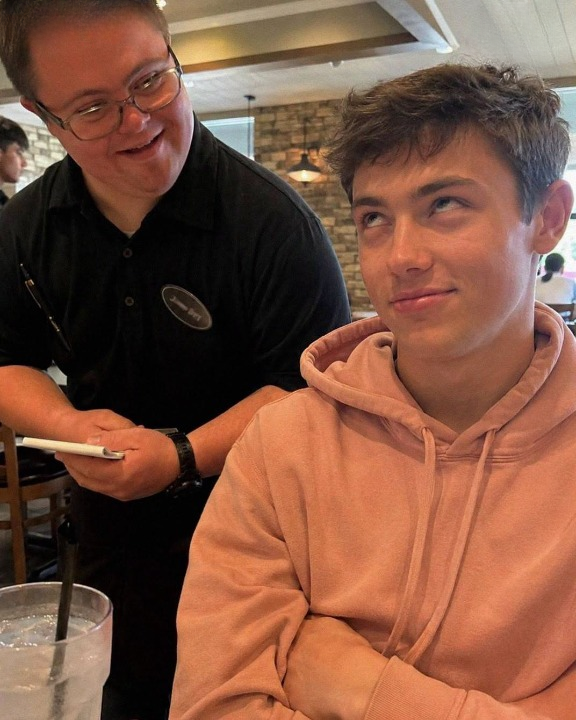
A few minutes after we sat down, a young man approached our table carrying a notepad.
His name tag read Sam.
He greeted us with a warm smile.
“Good evening,” he said.
“My name is Sam, and I’ll be taking care of you tonight.”
As he introduced himself, it became apparent that he had Down syndrome.
He spoke carefully, taking his time to ensure every word was clear.
He listened attentively while writing our drink order with remarkable concentration.
It was obvious he cared deeply about doing his job well.
A Moment That Broke My Heart
While Sam reviewed the evening specials, I noticed movement across the table.
Leo was smiling—but not in a kind way.
At first, I hoped I had misunderstood.
Then Sam paused briefly while reading one of the menu items.
Leo quietly imitated the way Sam had spoken.
He rolled his eyes.
He looked down at his phone and typed something before trying to hide a laugh.
My stomach dropped.
I gently nudged him beneath the table.
He ignored me.
Instead, he exchanged another amused glance with his screen.
I wasn’t embarrassed because another customer might have noticed.
I was heartbroken because my own son had forgotten one of the most important values we’d tried to teach him.
A Quiet Response
When Sam returned with our drinks, I thanked him sincerely.
After he walked away, I quietly placed my credit card near the edge of the table.
When he eventually brought the bill, I apologized for what had happened and thanked him for his professionalism.
He smiled kindly.
“It’s okay,” he said.
“I hope you enjoy the rest of your evening.”
His grace only made the moment feel heavier.
The Drive Home
Leo expected me to begin lecturing him immediately.
Instead, I drove home in complete silence.
The quiet inside the car said more than raised voices ever could.
After several minutes, he finally spoke.
“I was only joking.”
I kept driving.
“I didn’t mean anything by it.”
Still, I remained silent.
By the time we pulled into the driveway, the atmosphere felt completely different from the excitement we’d shared on the way to dinner.
An Old Wooden Box
Inside the house, I asked Leo to sit at the kitchen table.
He looked confused.
I walked upstairs to my bedroom.
In the back of my closet sat an old wooden box I hadn’t opened in years.
Dust covered the lid.
Inside were photographs, newspaper clippings, handwritten letters, and a small baseball glove.
When I carried the box downstairs, Leo’s curiosity replaced his frustration.
“What is that?”
I opened it carefully.
“It’s part of our family’s story.”
Your Uncle Michael
I removed an old photograph.
It showed a smiling teenage boy wearing a baseball uniform.
“This was your Uncle Michael.”
Leo had heard the name before but had never met him.
Michael was my older brother.
He was born with an intellectual disability.
Growing up wasn’t always easy for him.
People sometimes underestimated him before they even knew him.
Others laughed simply because he spoke differently.
As children, my parents worked tirelessly to teach us that every person deserves respect—not because of what they can do, but because of who they are.
Michael loved baseball.
He remembered everyone’s birthday.
He never forgot to send holiday cards.
He celebrated other people’s successes with genuine excitement.
His kindness influenced everyone fortunate enough to know him.
A Story I Had Never Shared
I showed Leo a faded newspaper clipping.
Years earlier, Michael had been recognized by our community after volunteering hundreds of hours at a local food pantry.
The article described how he greeted every visitor with a smile and remembered regular guests by name.
Many families later said Michael had brightened difficult days simply by treating everyone with warmth.
“He changed people’s lives,” I said.
“Not because he was famous.”
“Because he cared.”
Leo quietly examined the article.
Looking Beyond Differences
We spent the next hour talking.
Not about punishment.
About empathy.
About how easily people make assumptions based on appearances or speech.
About the courage it takes for many individuals with disabilities to navigate situations others rarely think twice about.
I explained that respect isn’t something reserved only for people who are similar to us.
It’s something everyone deserves.
No exceptions.
An Unexpected Suggestion
The following weekend, I asked Leo if he’d like to volunteer with me at a community center that hosted inclusive recreation programs for teenagers and young adults with different abilities.
He hesitated.
Then agreed.
At first, he seemed uncomfortable.
He didn’t know what to say.
Didn’t know how to act.
But over several visits, something changed.
He stopped noticing differences first.
He started noticing personalities.
Friendships formed naturally.
Laughter came easily.
He realized everyone shared many of the same hopes, interests, and dreams.
Returning to the Restaurant
Several weeks later, Leo asked if we could return to the same steakhouse.
When Sam greeted our table again, Leo stood before sitting down.
“I owe you an apology,” he said sincerely.
“I’m sorry for how I behaved last time.”
Sam smiled.
“Thank you.”
Then he added,
“I’m glad you came back.”
The conversation lasted less than a minute.
Yet it meant more than I can describe.
Growing Up
Teenagers don’t become compassionate adults because they never make mistakes.
They grow because someone takes time to help them learn from those mistakes.
That evening wasn’t about making Leo feel ashamed.
It was about helping him become the kind of person who notices humanity before differences.
Looking Back
Today, Leo is an adult.
He’s one of the first people to speak up when someone is treated unfairly.
Whenever people compliment his kindness, I think back to that dinner years ago.
One uncomfortable evening.
One old wooden box.
One honest conversation.
Parenting isn’t about raising children who never stumble.
It’s about helping them find the courage to stand back up with greater wisdom, empathy, and understanding.
The lesson Leo learned wasn’t really about one restaurant server.
It was about seeing people for who they truly are.
Every individual has a story.
Every person deserves respect.
And sometimes the smallest moments become the ones that shape us for the rest of our lives.