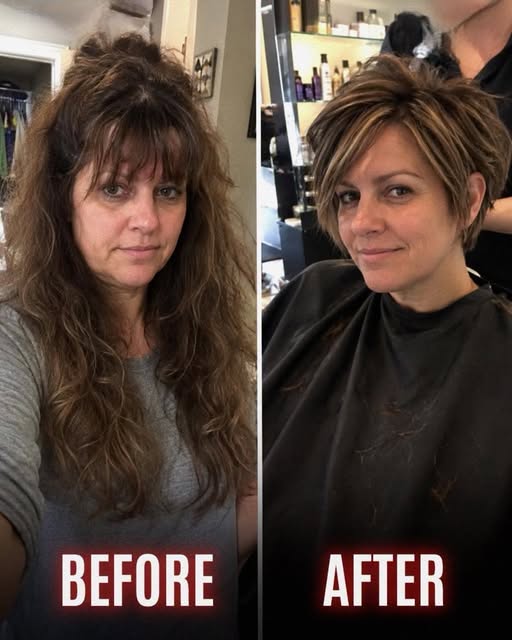
My Son-in-Law Mocked My Daughter’s New Haircut at Dinner — Then I Finally Spoke Up
For years, my daughter had talked about cutting her hair.
Not just trimming it.
Not changing the style slightly.
She wanted a completely different look.
She wanted to cut it short.
Every time she brought up the idea, however, the conversation somehow ended the same way.
Her husband, Ethan, would laugh.
“Don’t even think about it.”
Sometimes he said it jokingly.
Other times, his tone was more serious.
My daughter would usually smile and change the subject.
Whenever I asked her about it later, she would shrug.
“It’s not a big deal, Mom.”
But I knew my daughter.
And I knew when she was saying something because she truly believed it and when she was saying it because she didn’t want to create an argument.
She had worn her hair long for years.
Part of it was simply habit.
But another part of it was because Ethan liked it that way.
He had told her many times that long hair was what he preferred.
There is nothing unusual about having preferences in a relationship.
Everyone has them.
But I sometimes wondered whether my daughter had started confusing someone else’s preference with her own decision.
She had always been the kind of person who tried to keep everyone happy.
She avoided arguments.
She thought carefully before saying anything that might upset someone.
And because of that, she sometimes put her own wishes at the bottom of the list.
Then one afternoon, everything changed.
The Surprise
It was a completely ordinary day.
I was at home when I heard the doorbell.
I opened it expecting to see my daughter as usual.
Instead, I stood there for a moment without saying anything.
She had cut her hair.
Really cut it.
Her long hair was gone, replaced by a short, modern style that framed her face beautifully.
But it wasn’t only the haircut that caught my attention.
It was her expression.
She looked different.
Not because her appearance had suddenly become unrecognizable.
Because she looked happy.
She looked lighter.
She smiled as soon as she saw my reaction.
“You like it?” she asked.
There was a little nervousness in her voice.
I immediately hugged her.
“You look absolutely gorgeous.”
She laughed.
“Really?”
“Absolutely.”
She touched her hair and looked toward the mirror near the hallway.
“I finally did something just for me.”
That sentence stayed with me.
Not because there was anything extraordinary about getting a haircut.
There wasn’t.
But because of how she said it.
It sounded like someone who had finally given herself permission to make a small decision without worrying about whether somebody else approved.
I told her again that she looked wonderful.
She smiled.
For the rest of the afternoon, we talked about the haircut.
She told me she had been thinking about it for years.
She had saved pictures.
She had considered different styles.
And finally, she had walked into a salon and simply decided to do it.
“I was nervous when I sat in the chair,” she admitted.
“But once they started cutting it, I felt strangely excited.”
I could understand that.
Sometimes a small change can represent something much bigger to the person making it.
The Family Dinner
That evening, my husband was celebrating his birthday.
We had planned a family dinner at our house.
Nothing extravagant.
Just good food, conversation, cake, and the people we loved.
My daughter stayed to help me prepare.
She seemed genuinely excited about the evening.
Every once in a while, she would catch her reflection in a window or mirror and smile.
I noticed.
So did my husband.
He complimented her haircut.
A few other relatives did too.
Everything was going well.
Then Ethan arrived.
The moment he walked through the door, he saw my daughter.
He stopped.
For several seconds, he simply stared at her.
I couldn’t tell what he was thinking.
My daughter smiled nervously.
“Surprise.”
Instead of smiling, Ethan laughed.
At first, it was just a short laugh.
Then he laughed louder.
“What did you do to yourself?”
The room became noticeably quieter.
My daughter touched the ends of her hair.
“It’s just hair,” she said.
Ethan shook his head.
“No. It looks like you lost a bet.”
A couple of relatives gave uncomfortable little laughs.
I didn’t.
Neither did my husband.
My daughter’s smile faded.
She looked down.
She suddenly seemed much less confident than she had been an hour earlier.
I watched her take her seat at the table.
She picked up her fork and began moving food around her plate.
She wasn’t eating.
She was trying to disappear into the background.
That was the moment I realized this wasn’t really about a haircut.
The Comment That Changed the Mood
Ethan wasn’t finished.
He leaned back in his chair and looked at her.
“I married a woman, not my barber.”
Nobody laughed this time.
The silence was uncomfortable.
My daughter didn’t answer.
I could see that she was embarrassed.
I looked around the table.
Everyone seemed unsure what to do.
Someone changed the subject.
Another relative started talking about the birthday cake.
But the atmosphere had already changed.
My daughter’s excitement was gone.
The woman who had walked into my house earlier that afternoon smiling at her reflection was now sitting quietly, trying not to draw attention to herself.
I couldn’t ignore it.
For years, I had watched her make little compromises.
I had told myself that every marriage involved compromise.
That’s true.
Relationships require compromise.
But compromise should not mean that one person gradually stops feeling free to make ordinary choices about themselves.
There is a difference between asking your partner for their opinion and believing you need their permission.
And I suddenly realized that my daughter had spent years somewhere in between those two things.
I Finally Spoke
I looked at Ethan.
Then I looked at my daughter.
I decided I couldn’t remain silent.
I didn’t raise my voice.
I didn’t insult him.
I simply said:
“Ethan, you don’t have to like her haircut.”
Everyone looked at me.
“But you do need to respect the person wearing it.”
The room became completely silent.
Ethan stared at me.
I continued.
“She didn’t change who she is. She changed her hairstyle.”
My daughter looked up.
For the first time since Ethan had arrived, I saw a small expression of relief on her face.
Ethan crossed his arms.
“I was joking.”
I nodded.
“I understand that. But a joke stops being funny when the person you’re joking about isn’t laughing.”
He didn’t respond.
I looked at my daughter.
“You were so happy when you arrived.”
She smiled faintly.
“I was.”
“Then don’t let one person’s reaction take that away from you.”
She nodded.
What Happened Next
For several seconds, nobody said anything.
Then my husband quietly cleared his throat.
“It’s my birthday,” he said, smiling gently. “I’d like us to enjoy dinner.”
The tension eased slightly.
People began talking again.
Someone complimented the food.
Another relative asked my daughter where she had gotten her haircut.
The conversation slowly returned to normal.
But something had changed.
My daughter wasn’t hiding anymore.
She sat a little straighter.
She ran her fingers through her short hair and smiled.
Ethan remained quiet.
I didn’t know whether he was angry with me or simply embarrassed by what had happened.
At that moment, it didn’t matter.
My daughter needed to know that she wasn’t alone.
Later That Night
After dinner, everyone helped clean up.
My daughter came into the kitchen while I was washing dishes.
She stood beside me for a moment without saying anything.
Then she said:
“Thank you.”
I turned around.
“For what?”
“For saying something.”
I dried my hands.
“I should have said something sooner.”
She shook her head.
“Mom, you didn’t know.”
“Maybe not. But I should have asked more questions.”
She looked down at the floor.
“I think I got used to it.”
That sentence broke my heart.
“Used to what?”
She hesitated.
“Checking whether he would like something before deciding whether I liked it.”
I didn’t know what to say.
She continued.
“My clothes. My hair. Sometimes where we go. Even little things.”
She wasn’t saying that Ethan controlled every part of her life.
She wasn’t describing some dramatic situation.
She was talking about small decisions.
But sometimes small decisions reveal larger patterns.
I told her something my own mother had once told me.
“A relationship should give you a place to be yourself, not make you afraid to be yourself.”
She nodded.
Ethan Joins the Conversation
A few minutes later, Ethan came into the kitchen.
My daughter became quiet.
I considered leaving them alone.
But before I could step away, Ethan spoke.
“I didn’t mean to embarrass her.”
My daughter looked at him.
“You did.”
He nodded.
“I know.”
There was a long pause.
Then he said something I didn’t expect.
“I just wasn’t prepared for the change.”
My daughter frowned.
“It’s hair.”
“I know.”
He sighed.
“I’ve always liked your long hair.”
She responded calmly.
“I know you have.”
“And when I saw you with it short, I reacted without thinking.”
My daughter touched her hair.
“I understand having a preference. But you don’t get to make the decision for me.”
Ethan didn’t argue.
He simply nodded.
“I understand.”
It wasn’t a perfect conversation.
There wasn’t an instant transformation.
There was no dramatic apology that fixed everything.
Real relationships rarely work that way.
But for the first time, they were talking about the actual issue.
Not the haircut.
Respect.
The Conversation Continued
My daughter explained that she had wanted to cut her hair for years.
She told Ethan that every time she brought it up, his reaction had made her second-guess herself.
“I started thinking maybe I shouldn’t do it because you wouldn’t like it.”
Ethan looked genuinely surprised.
“I didn’t realize you felt that way.”
“That’s the problem,” she replied.
He was quiet.
Then he said:
“I should have asked how you felt instead of assuming you would keep it long.”
That was the first time I saw my daughter relax.
She wasn’t looking for him to love the haircut.
She simply wanted him to understand that it was her choice.
A Small Change With a Bigger Meaning
The next morning, my daughter called me.
“Mom?”
“Yes?”