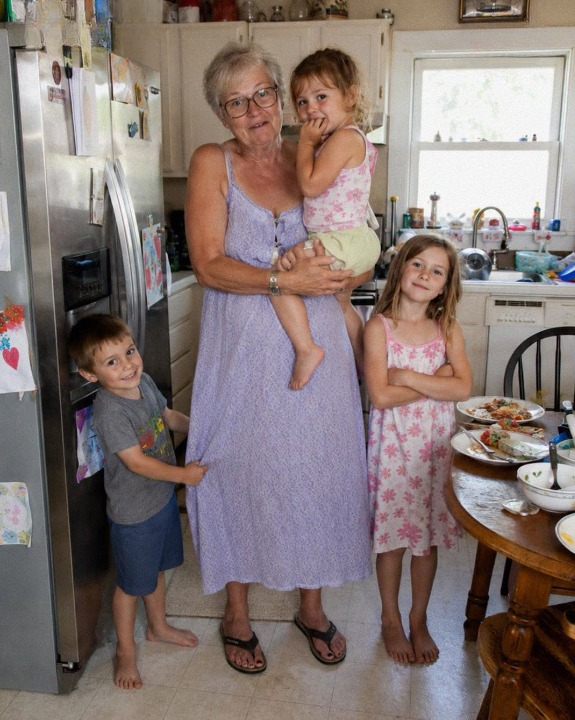
My mother happened to live in the same neighborhood as my husband’s older sister, Rachel. At first, we all thought the arrangement would be convenient. Rachel had three young children, and my mother loved being a grandmother. She enjoyed seeing the children occasionally, baking cookies with them, and listening to their stories.
But loving your grandchildren is very different from becoming their full-time babysitter without notice, permission, or appreciation.
One evening, I decided to visit my mother after work. I had called her earlier that afternoon, but she hadn’t answered. That was unusual because she normally kept her phone close. I assumed she had fallen asleep while reading or had gone for a short walk.
When I opened her front door, I immediately realized something was wrong.
The living room looked as though a small storm had passed through it. Toys covered the floor, half-eaten snacks were scattered across the coffee table, and a cartoon played loudly on television.
All three of Rachel’s children were there.
The youngest was crying because he couldn’t find his favorite stuffed animal. The middle child was asking for dinner, and the oldest was chasing the dog around the furniture.
My mother stood in the kitchen with one hand pressed against her lower back. A pot was heating on the stove, a pile of dishes filled the sink, and several spilled cups of juice needed to be cleaned.
She looked exhausted.
“Mom, why are Rachel’s children here?” I asked.
My mother glanced toward the living room before lowering her voice.
“Rachel brought them over this morning,” she explained. “She said she needed me to watch them for an hour.”
I looked at the clock. It was almost seven in the evening.
“One hour? She has been gone all day.”
My mother gave me a tired smile.
“It happens more often than I’ve told you.”
That sentence made my stomach sink.
After I turned off the stove and helped settle the children, my mother finally told me what had been happening. Rachel would appear at her door early in the morning, usually without calling first. She always claimed she had one quick errand to run.
One hour would become three. Three hours would become the entire day.
Sometimes Rachel didn’t return until after dinner.
My mother was 68 and had experienced back problems for years. She could enjoy an afternoon with the children when she had time to prepare, but looking after three energetic youngsters for ten hours was physically demanding.
“Why didn’t you tell me?” I asked.
“I didn’t want to create trouble between you and your husband’s family,” she replied. “And I love the children. None of this is their fault.”
She was right about that. The children weren’t responsible for the situation. They had simply been taken to their grandmother’s house and told they would spend the day there.
Still, I couldn’t understand why my mother had continued accepting the arrangement.
Then she admitted that Rachel rarely gave her a chance to refuse.
“She brings them inside before I can say anything,” Mom explained. “Then she says she is already late and rushes away. If I try to object, she tells me that family members are supposed to help one another.”
That evening, I stayed until Rachel finally arrived.
She walked through the door shortly after eight, carrying several shopping bags and a drink from a café. She looked relaxed and cheerful, while my mother could barely stand comfortably.
“There are my little angels,” Rachel announced. “Did you have a fun day with Grandma?”
I stepped into the hallway before she could hurry the children out.
“We need to talk.”
Rachel looked at me and sighed.
“If this is about me being late, I lost track of time.”
“You said you would be gone for an hour. You left your children here for the entire day.”
She rolled her eyes as if I were complaining about something completely insignificant.
“I sometimes ask her to watch the kids. What is the problem? We’re family.”
“You didn’t ask her to spend the whole day caring for them. You told her one hour. She has a bad back, and you didn’t even call to say you would be late.”
Rachel folded her arms.
“She’s retired. She stays home most days anyway.”
I could hardly believe what I was hearing.
“That doesn’t mean her time belongs to you.”
Rachel laughed.
“I’m not paying a family member to spend time with her own grandchildren. She sits at home and doesn’t have anything important to do. If anything, I’m giving her some company.”
My mother looked down at the floor. Rachel’s words had clearly hurt her, but she didn’t defend herself.
That was when I understood the real problem.
Rachel did not view my mother’s time as valuable. She believed retirement meant permanent availability. She didn’t see the appointments my mother postponed, the friends she stopped meeting, or the pain she endured after lifting and chasing three children all day.
Arguing in the hallway wasn’t going to change Rachel’s attitude. She had already decided she was entitled to whatever help she wanted.
So I took a breath and smiled.
“You know what, Rachel? Maybe you’re right. Why don’t you come to our house tomorrow evening? We’re having a family dinner.”
She gave me a suspicious look.
“What is the occasion?”
“Nothing dramatic. I think we all need to talk as a family.”
My husband knew something was wrong the moment I arrived home. I told him everything, including Rachel’s comment about my mother doing nothing.
He was quiet for several seconds.
“She actually said that?”
“Right in front of Mom.”
To my relief, he didn’t defend his sister. He had seen Rachel take advantage of people before, but he hadn’t realized how frequently she was leaving the children with my mother.
We made several phone calls that night. We invited Rachel’s husband, my husband’s parents, and two other close relatives who were familiar with the situation.
Then I called a professional babysitter.
The following evening, everyone arrived shortly before seven. The children went to the family room with the babysitter, where we had prepared dinner, games, and a movie for them.
The adults gathered around the dining table.
In the middle of the table, I had placed a large calendar, a notebook, and a folder.
Rachel walked in last.
The moment she saw the calendar, she let out a startled cry.
“What is this?” she demanded.
Every day that Rachel had left her children with my mother during the previous month was marked in red. My mother had helped me reconstruct the schedule from text messages and her personal diary.
There were 17 marked days.
Beside the calendar was a written total of the hours my mother had spent providing childcare. It came to more than 120 hours in a single month.
The folder contained estimates from three local childcare providers. I wasn’t demanding payment, and I had no intention of embarrassing Rachel with an exaggerated bill. I wanted her to see, in clear terms, the value of the labor she had been treating as meaningless.
Rachel stared at the documents.
“Are you seriously trying to charge me for Grandma spending time with the children?”
“No,” I replied calmly. “This is not an invoice. It is an explanation.”
My husband spoke next.
“You have been leaving the children with her for full days after claiming you would be gone for one hour. You have ignored her health, her schedule, and her right to say no.”
Rachel looked around the table, expecting someone to support her.
Her husband appeared more confused than anyone.
“You told me your mother volunteered to watch them,” he said.
Rachel’s face changed.
“I never said that exactly.”
“You said she enjoyed having them and kept asking you to bring them over.”
My mother finally spoke.
“I love the children,” she said gently. “But I did not volunteer to become their daily babysitter. I have medical appointments, friends, hobbies, and plans of my own. Being retired does not mean I have stopped living.”
The room became silent.
My mother opened the notebook in front of her.
“I have written down the days when I am willing to spend time with the children,” she continued. “Two afternoons a month, arranged in advance. Those visits are for me to enjoy being their grandmother. They are not a replacement for regular childcare.”
Rachel shook her head.
“So everyone gathered here to attack me?”
“No one is attacking you,” I said. “We are establishing a boundary that should have existed from the beginning.”
Her husband then asked the question that changed the entire conversation.
“Where were you going all those days?”
Rachel looked uncomfortable.
It turned out that some of her outings had been necessary. She had attended appointments, handled errands, and dealt with responsibilities that were difficult to manage with three children.
But many of the days had been spent shopping, meeting friends, and taking personal time without telling her husband or arranging childcare.
There was nothing wrong with a parent needing a break. Raising three young children was demanding, and Rachel deserved time for herself. The problem was that she had created that time by misleading and exhausting someone else.
Her husband offered a practical solution.
“We’ll make a childcare budget,” he said. “We can find a sitter for one or two days a week. If your mother offers to help, that will be her choice—not something we assume.”
Rachel remained defensive for a while. She complained that everyone was making her look selfish and insisted that she had never intended to hurt anyone.
My mother didn’t raise her voice.
“I don’t think you wanted to hurt me,” she said. “But when you said I sat at home doing nothing, you showed me that you didn’t respect my time. I need you to understand that my life still matters.”
That was the sentence Rachel couldn’t argue with.
The dinner didn’t end with a dramatic apology. Real change is rarely that immediate. Rachel left embarrassed and angry, but for the first time, she understood that the rest of the family would no longer support her behavior.
The next morning, she did not arrive at my mother’s door.
She didn’t appear the day after that either.
A week later, she called my mother and asked whether the children could visit on Saturday afternoon. She gave the exact times and waited for an answer.
My mother checked her calendar before agreeing.
It was a small change, but an important one.
Over the following months, Rachel and her husband hired a part-time babysitter. They also adjusted their schedules so the childcare responsibilities didn’t automatically fall on someone else.
My mother began attending her weekly gardening group again. She returned to physical therapy for her back and started having lunch with friends she had repeatedly canceled on.
Most importantly, she learned to say no without apologizing.
She still spent time with the grandchildren, but the visits were planned. Instead of feeling exhausted and trapped, she could enjoy being their grandmother.
Eventually, Rachel apologized.
“I didn’t realize how much I was asking of you,” she told my mother. “I think I convinced myself that because you were home, you were always available.”
My mother accepted the apology but kept her boundaries in place.
That family dinner taught all of us an important lesson: retirement does not make a person’s time worthless. Older relatives are not automatically available for unpaid childcare, errands, or household duties.
Families should help one another, but genuine help is requested honestly, accepted gratefully, and never treated as an obligation.
My mother loved her grandchildren before the confrontation, and she loved them afterward. The difference was that she could finally spend time with them because she wanted to—not because someone had decided that her life was less important.