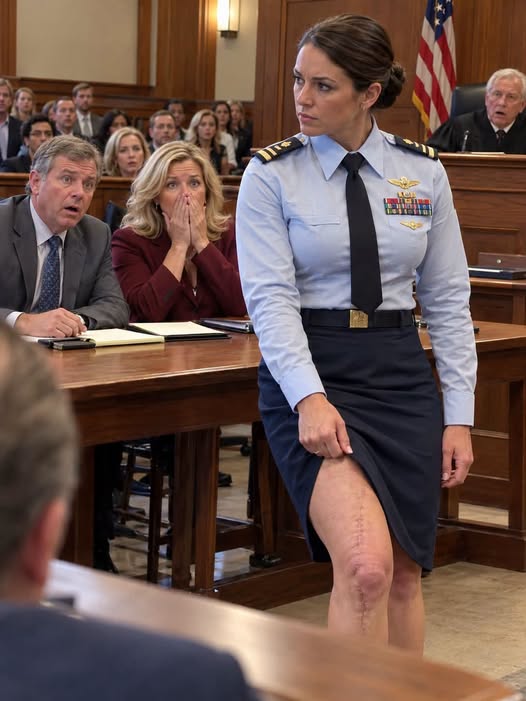
My Parents Took Me to Court Over My Grandfather’s Farmhouse — They Never Expected What the Judge Found
Walking into a Virginia courtroom wearing my Navy uniform was something I had never imagined doing. For years, my parents had treated my military career as an embarrassment, something they preferred not to discuss with relatives or friends. Now, as I stepped through the courtroom doors, I could see the same disapproval on their faces.
My father, Robert Carter, looked me up and down before letting out a short, dismissive laugh. My mother, Margaret, sat beside him, her fingers wrapped tightly around a string of pearls.
Neither of them offered a greeting.
Then Judge Simmons entered, reviewed the case file, and looked directly at me.
His eyes paused on the ribbons and decorations across my uniform.
He leaned forward slightly.
“Commander Carter,” he said, his voice suddenly more serious, “is that really you?”
For the first time that morning, my father stopped smiling.
I realized then that my parents had walked into that courtroom believing they knew exactly who I was. They saw the daughter who had disappointed them, the girl who had chosen a life they never approved of.
They had no idea how much had changed during the years we spent apart.
And they certainly didn’t understand why I had come prepared to defend the one place my grandfather had left me.
The Letter That Changed Everything
Two days before the hearing, I was trimming the azaleas outside my modest home near Norfolk when the mail carrier left a cream-colored envelope beside my front door.
At first, I assumed it was another routine bill.
I carried it inside, set my garden gloves on the kitchen counter, and opened the envelope while my dog, Knox, followed me into the room.
The first page contained the information I least expected to see.
Portsmouth Family Court.
Case number 4238B.
Carter versus Carter.
Plaintiffs: Robert and Margaret Carter.
Defendant: Evelyn Carter.
I read the names twice.
My own parents had filed a legal claim against me.
According to the documents, they alleged that I had abandoned my late grandfather’s farmhouse and failed to maintain the property. They also claimed they had paid the expenses associated with the land and were entitled to have their contributions recognized in the case.
I stood at the kitchen table, holding the papers so tightly that the edges began to bend.
For several seconds, I couldn’t think of anything to say.
Knox rested his broad head against my knee. He had learned to recognize the difference between an ordinary quiet moment and the silence that followed bad news.
I lowered one hand and rubbed behind his ears.
“Well,” I murmured, “I suppose they’ve finally found another reason to contact me.”
The words sounded almost humorous, but I wasn’t laughing.
I had spent twelve years building a life that had very little connection to my parents. I had learned to manage difficult situations, make decisions under pressure, and accept that some relationships could not be repaired simply because one person wanted them to be different.
Yet nothing had prepared me for the realization that my own family was now challenging my rights to the property my grandfather had left me.
I returned to the first page and began reading everything carefully.
Dates. Allegations. Property descriptions. References to maintenance expenses.
The more I read, the more certain I became that this wasn’t something I could ignore.
If my parents wanted a legal decision about the farmhouse, I would have to respond with evidence rather than emotion.
And I intended to do exactly that.
The Daughter They Never Understood
My relationship with my parents had been strained long before the court papers arrived.
Growing up, I was expected to follow a particular path. My father believed in tradition, appearances, and doing things the way he considered respectable. My mother placed enormous importance on what relatives and neighbors might think.
They had a clear idea of what my future should look like.
I was supposed to build a stable career, remain close to home, and make decisions that reflected well on the family.
For a while, I tried to meet those expectations.
But I had always felt drawn toward a different kind of life.
I wanted work that demanded discipline, challenged me to learn, and gave me a sense of purpose beyond maintaining appearances. The Navy represented an opportunity to build that life.
When I announced my decision, my father reacted as though I had rejected everything he had taught me.
He questioned why I would choose a demanding military career when I could pursue something closer to home. My mother worried about the risks and the embarrassment of having a daughter who would be absent for long stretches.
Their concerns might have been understandable if they had expressed them with care.
Instead, every conversation became an argument about obedience.
They spoke as though my decision were an insult directed at them.
I tried explaining that serving was something I wanted to do, not something I was choosing to hurt them.
They didn’t listen.
Eventually, I left home and began training for the life I had chosen.
When I completed the demanding preparation required for my intended military role, I hoped my parents might finally recognize that I was serious about my future.
My father didn’t attend.
My mother sent one message.
“We raised a daughter, not a soldier.”
I remember reading those words alone.
I read them once, then placed my phone on the table.
I had spent years hoping that achievement would change their minds. Perhaps they would be proud when I completed training. Perhaps they would ask about my work. Perhaps they would eventually understand that independence was not the same as rejection.
Instead, I realized that I could not build my life around waiting for their approval.
I stopped trying to convince them.
I focused on my responsibilities, my colleagues, and the people who treated me with respect.
It wasn’t an easy decision, but it was necessary.
Twelve Years of Silence
Over the years, I became accustomed to the distance between us.
My career took me far from Virginia for extended periods. I worked with people whose lives depended on preparation, communication, and sound judgment. I learned that leadership wasn’t about looking impressive. It was about accepting responsibility when decisions became difficult.
Some days were exhausting. Others were rewarding in ways I couldn’t easily explain to people who had never experienced that environment.
I didn’t tell my parents much about my work.
Part of that was practical. Military responsibilities can involve information that cannot be shared freely. Another part was personal.
I had stopped believing that anything I said would change their opinion of me.
When I returned home between assignments, I concentrated on the life I had built. I maintained friendships, cared for Knox, and tried to enjoy ordinary routines that had once seemed unimportant.
I learned to appreciate quiet mornings, a meal prepared without rushing, and a house where nobody expected me to justify my choices.
The distan