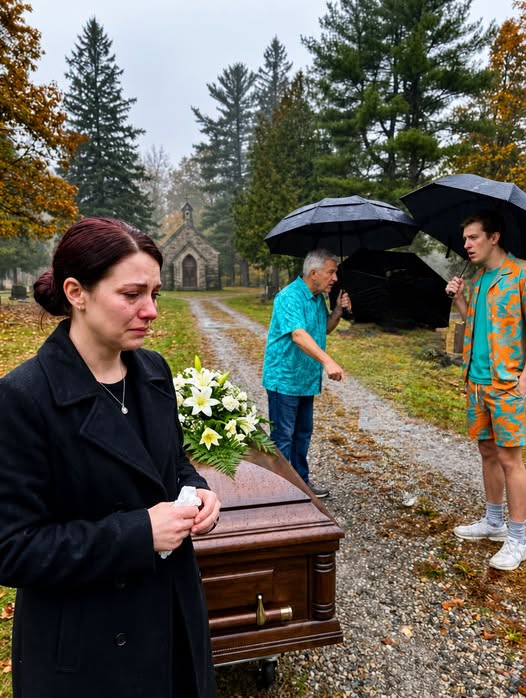
The day I buried my husband and my seven-year-old daughter was supposed to be the darkest day of my life.
It became even darker when I realized my parents had chosen not to be there.
They were on a tropical vacation with my brother.
While I stood beside two coffins beneath a cold gray sky, they were somewhere thousands of miles away, enjoying the beach.
Then, just before the funeral began, my phone vibrated.
I looked down at the screen.
It was a message from my mother.
“I’m sorry, but we can’t come. The funeral isn’t important enough to cancel Jared’s vacation.”
I stared at those words until they blurred.
For a few seconds, I couldn’t even process what I had read.
My husband, Daniel, was gone.
My little girl, Sophie, was gone.
And my parents had decided that a family vacation was more important than standing beside their grieving daughter.
I put the phone away without responding.
I couldn’t waste another breath trying to understand people who had already made their choice.
The funeral proceeded without them.
My husband was buried first.
Then my daughter.
I remember holding onto the edge of my coat because my hands wouldn’t stop shaking. I remember the minister speaking, although I couldn’t recall a single sentence afterward.
I remember looking at Sophie’s tiny coffin and thinking about how unfair the world could be.
She had been seven.
She had a pink backpack she carried everywhere.
She loved pancakes on Saturday mornings.
She still believed I could fix almost anything.
And now I couldn’t fix this.
Not for her.
Not for Daniel.
Not for myself.
My parents weren’t there.
My brother wasn’t there.
I was surrounded by a few friends, neighbors, and people from Daniel’s workplace, but the two people who were supposed to have been there no matter what had chosen somewhere else.
That evening, I opened my phone again.
I shouldn’t have.
My mother had posted photographs from the vacation.
There she was beside my father and my brother, smiling beneath a brilliant Caribbean sunset.
Three glasses were raised toward the camera.
The caption read:
“Family is everything.”
I stared at the photograph for a long time.
Then I turned the phone facedown.
Daniel had warned me about them years earlier.
“You keep expecting them to become the parents you need,” he’d once told me. “But they keep showing you who they really are.”
I had defended them every time.
I told him they were complicated.
I told him my mother was difficult but loved me.
I told him my father simply favored Jared because Jared needed more help.
I kept making excuses.
Daniel had stopped arguing with me eventually.
Now he was gone.
And his words suddenly felt painfully clear.
Three days after the funeral, someone knocked on my door.
I wasn’t expecting anyone.
The house was still filled with reminders of the two people I’d lost.
Sophie’s shoes were beside the stairs.
Daniel’s jacket was hanging behind the bedroom door.
A half-finished drawing sat on the refrigerator.
I almost didn’t answer.
Then the knocking came again.
I opened the door.
My parents were standing on the porch.
My brother Jared was behind them.
They looked remarkably comfortable for people who had missed their granddaughter’s funeral.
My mother was wearing expensive vacation clothes. My father still had the relaxed appearance of someone who had spent the previous week somewhere warm.
Jared barely looked up from his phone.
Nobody hugged me.
Nobody said they were sorry.
Nobody asked how I was surviving.
My mother looked past me into the house.
Then she said something I never expected to hear three days after burying my family.
“We need to talk about money.”
I stared at her.
“What?”
Jared finally put his phone away.
“There was a problem with the restaurant.”
My brother had owned a small restaurant for several years. It had never been particularly successful, but my parents had always protected him from the consequences.
My father stepped forward.
“We need forty thousand dollars.”
I thought I’d misunderstood.
“Forty thousand?”
“It’s temporary,” my mother said. “Your brother has some tax issues to resolve.”
I looked at Jared.
He shrugged.
“It’s complicated.”
I almost laughed.
Not because anything was funny.
Because three days earlier I had buried my husband and my child, and these people had arrived at my house expecting me to rescue my brother financially.
“You weren’t at the funeral,” I said.
My mother’s expression immediately hardened.
“We already explained that.”
“You were on vacation.”
“That wasn’t our fault.”
I stared at her.
She folded her arms.
“After everything we’ve done for you, you owe us some support.”
Something inside me changed.
Perhaps grief had finally burned away the part of me that was still desperate for their approval.
“You think I owe you?”
My father interrupted.
“Naomi, don’t make this emotional.”
Emotional.
That word almost made me smile.
My husband was dead.
My daughter was dead.
And somehow I was the one being accused of becoming emotional.
Jared stepped forward.
“Look, we’re not asking for anything unreasonable. You have the insurance money.”
I went completely still.
That was the first moment I realized this wasn’t simply an uncomfortable family visit.
They knew about the insurance.
They knew about the money.
They had come expecting it.
“How do you know about that?” I asked.
Nobody answered.
My mother looked at Jared.
Jared looked at my father.
That silence told me everything.
I closed the front door.
Then I walked toward the hallway table.
A thick black folder had been sitting there for two days.
I had almost thrown it away.
Instead, I’d kept it.
Inside were documents I’d discovered shortly after the funeral—records Daniel had left behind, copies of financial statements, correspondence, and several pieces of information that had made absolutely no sense at first.
Until that morning.
I picked up the folder.
My mother frowned.
“What is that?”
I didn’t answer.
I opened it.
The first page contained a name.
Then a date.
Then a financial transaction connecting my parents, my brother, and a company I had never heard of.
My mother’s expression changed.
Jared stopped scrolling through his phone.
My father stepped closer.
“What did you find?”
I turned the page.
There were more documents.
Bank transfers.
Corporate records.
Signatures.
And a series of payments that had apparently been hidden from me for years.
Daniel had discovered them before his death.
He had been investigating something quietly.
I had never understood why.
Now I did.
My brother’s restaurant wasn’t simply struggling with taxes.
The money problem went much deeper.
And my parents weren’t innocent bystanders trying to help their son.
They were connected to it.
I looked at the three people standing in my doorway.
For years, they had treated me as the daughter who would eventually give in.
The daughter who would forgive.
The daughter who would pay.
The daughter who would remain quiet to keep the family together.
But they had made one enormous mistake.
They assumed grief had made me weaker.
It had done the opposite.
I held the folder against my chest.
“You came here asking me for forty thousand dollars,” I said quietly.
My mother swallowed.
“Yes.”
I nodded.
“Then you should probably see what Daniel found before I give you a single cent.”
My father reached for the folder.
I pulled it away.
“No.”
The confidence disappeared from his face.
For the first time, they seemed uncertain.
And as I looked at the documents again, I realized something even more disturbing.
The records didn’t just explain my brother’s financial problems.
They raised questions about why Daniel had been investigating them in the first place—and why he had been so worried about our family’s finances shortly before he died.
That was the moment I understood.
The forty thousand dollars wasn’t the real story.
It was only the beginning.