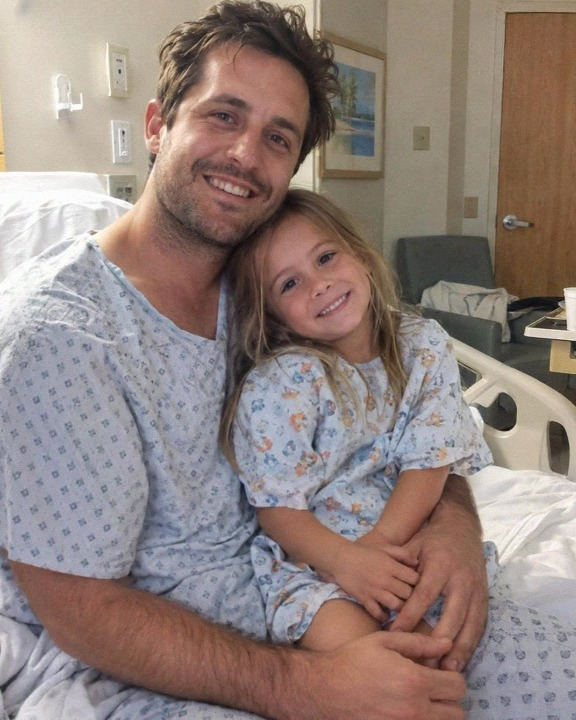
My son Ethan had always been afraid of hospitals.
He hated needles.
He hated medical appointments.
He would avoid getting blood tests whenever possible and used to joke that he could handle almost anything except the sight of a syringe.
That fear had become even stronger after his older brother died several years earlier.
Hospitals had never felt like places of healing to Ethan.
They reminded him of the hardest period our family had ever experienced.
So when he walked into my kitchen one morning and calmly said, “Mom, I’m going to donate one of my kidneys,” I honestly thought I had misunderstood him.
I put down my coffee.
“What did you just say?”
Ethan sat across from me.
“I’ve decided to become a living donor.”
I stared at him.
“For whom?”
“A little girl named Rosie.”
He reached into his backpack and pulled out a photograph.
The picture showed a five-year-old girl with a huge smile and two missing front teeth.
“She belongs to someone I went to school with,” he explained.
I looked at the photograph again.
“What happened to her?”
“Her kidneys aren’t working properly. She’s been in and out of the hospital, and none of her relatives are a suitable match.”
I shook my head.
“Ethan, you’re not a doctor.”
“I know.”
“You don’t even like hospitals.”
“I know that too.”
“Then why are you doing this?”
He looked at the photograph.
“Because she should be learning how to ride a bicycle, not spending her childhood in hospitals.”
I didn’t know what to say.
I was frightened.
Any parent would be.
The thought of my son undergoing major surgery was terrifying enough.
But there was another thought I couldn’t ignore.
There was a little girl whose life might improve because someone was willing to help her.
I asked Ethan whether he was certain.
He nodded.
“The doctors have explained everything. I’ve gone through the testing. They’re not letting me do this unless they believe it’s medically appropriate.”
Still, I worried.
I asked him to think about it again.
He smiled.
“I already have.”
Over the following weeks, I watched my son prepare.
There were appointments.
Tests.
Conversations with doctors.
Forms.
More conversations.
The medical team repeatedly explained the risks and made sure Ethan understood that he could change his mind at any point.
He never did.
Meanwhile, I met Rosie and her mother, Lauren.
Lauren had been one of Ethan’s classmates years earlier.
She was exhausted from months of caring for her daughter, but she was always focused on Rosie.
Rosie herself seemed almost impossibly cheerful.
She loved stuffed animals.
She loved drawing.
And she had a habit of asking adults very serious questions.
One afternoon, she looked at Ethan and asked:
“Are you really going to help me?”
Ethan smiled.
“I’m going to try.”
She thought about that.
“Does it hurt?”
“Maybe a little.”
She frowned.
“I don’t want you to hurt.”
Ethan laughed softly.
“Then you can promise me something.”
“What?”
“When you’re feeling better, you have to learn how to ride a bicycle.”
She nodded solemnly.
“I promise.”
The transplant eventually took place.
The doctors told us that the procedure had gone as planned.
Rosie’s condition began improving.
Her mother called me with updates.
“She has color in her cheeks again,” Lauren said one afternoon.
I cried when I heard that.
Ethan was recovering too.
He was tired, but whenever someone asked about Rosie, his face brightened.
“She’ll be okay,” he kept saying.
Then, unexpectedly, things changed.
Ethan developed a serious medical complication during his recovery.
The doctors did everything they could.
Our family spent long hours waiting for updates.
I sat beside my son and held his hand.
At one point, he looked at me.
“Mom?”
“Yes?”
“Whatever happens, don’t blame Rosie.”
I immediately shook my head.
“Don’t say that.”
He squeezed my hand.
“And don’t blame Lauren either.”
I couldn’t understand why he was saying those things.
“You’re coming home.”
He smiled.
“I hope so.”
I wanted to believe him.
I needed to believe him.
But before sunrise, my son was gone.
He was thirty years old.
My only living child.
The grief that followed was difficult to describe.
People came to the house.
Friends brought food.
Neighbors sent flowers.
Former classmates shared stories about Ethan.
Many called him courageous.
Some called him a hero.
But none of those words could fill the silence in my house.
I didn’t want anyone to call him a hero.
I wanted my son back.
I wanted to hear him complain about traffic.
I wanted to hear him laugh.
I wanted him to call me “Mom.”
That was all.
A few days later, I buried my son.
The morning after the funeral, someone knocked on my door.
I wasn’t expecting anyone.
When I opened it, I saw Lauren standing there.
Rosie was beside her.
She was holding a stuffed rabbit.
For a moment, I couldn’t speak.
Lauren’s eyes were swollen from crying.
“I’m sorry,” she whispered.
I tried to smile.
“It’s okay.”
Rosie stepped forward.
“Is this Ethan’s house?”
My heart broke.
“Yes.”
She looked down.
“I brought him a picture.”
She held up a drawing.
It showed a little girl riding a bicycle beside a tall man.
Above them, in bright colors, were the words:
“Thank you.”
I couldn’t hold back my tears.
Lauren placed a hand on Rosie’s shoulder.
Then she looked at me.
“There is something I need to tell you.”
I nodded.
She reached into her bag and pulled out a folded letter.
My name was written on the front.
I recognized the handwriting immediately.
It was Ethan’s.
My hands began to shake.
“What is this?”
Lauren took a breath.
“Your son asked me to give this to you if something happened to him.”
I stared at the envelope.
“Why didn’t you give it to me before?”
“Because he told me not to.”
I opened it carefully.
Inside was a letter.
The first line made me stop.
“Mom, if you’re reading this, I’m probably not there to explain everything myself.”
I had to pause.
Lauren looked away.
I continued.
Ethan explained that he had known more about Rosie than he had originally told me.
Years earlier, when he and Lauren were classmates, they had stayed in touch.
When Rosie was born, Ethan had occasionally visited their family.
He had watched her grow.
He had become attached to her.
But there was another reason he had volunteered to be tested.
One that he had kept from everyone.
The letter explained that shortly before Ethan began the donor process, he had learned something about his own health.
His doctors had discovered that he carried a genetic marker that could potentially be relevant to his future health.
It wasn’t an immediate danger.
But it had changed the way he thought about life.
He realized how uncertain the future could be.
And instead of becoming frightened by that uncertainty, he wanted to use the opportunity he had been given to help someone else.
Then came the sentence that made me cry.
“I know you think I did this because I’m brave. I don’t think I am. I was just lucky enough to be in a position where I could help.”
I kept reading.
“I didn’t tell you everything because I knew you’d worry. I also didn’t want Rosie to grow up thinking she owed me anything.”
The final paragraph said:
“Mom, please don’t remember me because of what I gave away. Remember me because of who I was before any of this happened. Remember the boy who hated needles. Remember the terrible jokes. Remember Sunday breakfasts. Remember that I loved you.”
I couldn’t continue.
I pressed the letter against my chest.
Lauren was crying too.
“I didn’t know he had written that,” she said.
I looked at her.
“Why didn’t he tell me about his health concerns?”
“Because he didn’t want you to be afraid.”
I looked at Rosie.
She was still holding the drawing.
“What happens now?”
Lauren smiled sadly.
“Rosie is doing well.”
I closed my eyes.
That was the first piece of good news I’d heard in days.
“She asks about Ethan all the time,” Lauren continued.
I looked at the little girl.
“What do you tell her?”
“I tell her he was kind.”
Rosie looked up.
“He was my helper.”
I smiled through my tears.
“That sounds like him.”
She walked over and handed me her drawing.
“I want you to have this.”
I accepted it.
“Thank you.”
Then she asked:
“Can I still learn to ride a bike?”
I laughed through my tears.
“Yes.”
She smiled.
“I promised him.”
I looked at Lauren.
“We should make sure she does.”
Lauren nodded.
And that was how Ethan’s final promise became something we could carry forward.
Over the next few months, Rosie continued getting stronger.
I stayed in touch with Lauren.
Eventually, I watched Rosie take her first bicycle ride.
She wobbled.
She stopped.
She nearly fell.
Then she laughed.
I stood at the end of the driveway cheering for her.
For one brief moment, I could almost imagine Ethan standing beside me.
I realized something that day.
My son hadn’t wanted to be remembered as a hero.
He had wanted to be remembered as a person who cared.
His decision hadn’t erased the pain of losing him.
Nothing could.
But knowing that someone else’s childhood had a chance to continue gave his final act a meaning I could hold onto.
I still miss him every day.
There are mornings when I instinctively reach for my phone because I want to call him.
There are birthdays when I still expect him to walk through the door.
Grief doesn’t disappear simply because time passes.
But neither does love.
Years later, I still keep Ethan’s letter in a drawer beside the photograph of him and Rosie.
And whenever I read it, I remember the last thing he asked me to do.
Not to think of him only because of the kidney donation.
Not to turn him into a symbol.
Just to remember him.
My son.
The boy who hated needles.
The man who loved his family.
The friend who cared about a little girl.
And the person who believed that when you have the chance to make someone’s life a little better, sometimes the most meaningful thing you can do is simply choose to help.
Rosie eventually learned to ride her bicycle.
Her first successful ride lasted less than a minute.
But afterward, she came running toward me with the biggest smile I’d ever seen.
“I did it!”
I smiled.
“Yes, you did.”
She looked at me.
“I think Ethan would be happy.”
I looked toward the sky.
“I think so too.”
And for the first time since losing my son, the tears I cried weren’t only tears of sorrow.
They were tears of gratitude.
Because although Ethan’s story ended far sooner than anyone wanted, the kindness he left behind continued through someone else’s life.
And perhaps that is one of the most lasting things any person can leave behind—not a possession, not a title, and not even a photograph, but a reminder that compassion can continue long after we are gone.