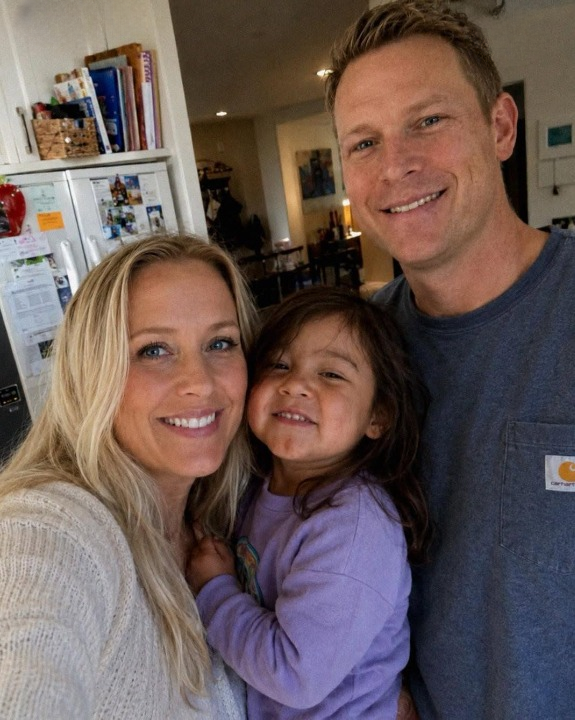
The first time I held my newborn daughter, I experienced two powerful emotions at once.
The first was love.
The second was confusion.
Mia was beautiful. She had tiny fingers, soft cheeks, and a serious expression that made her look as though she were already studying the world around her.
But she looked nothing like me or my wife, Rachel.
Mia was born with thick black hair, dark eyes, a broad little nose, and features that didn’t appear to resemble either of us. Rachel had blonde hair, green eyes, high cheekbones, and a delicate jaw. I was fair-haired and blue-eyed.
Placed between us, Mia looked as though she belonged to a completely different family.
I immediately felt ashamed for noticing.
She was my daughter, and I loved her. Nothing about her appearance should have changed that. I reminded myself that newborn babies often change considerably during their first year.
Hair can fall out and grow back in another color. Eye color can shift. Facial features can come from grandparents or distant relatives no one has thought about in decades.
For the first few days, I told myself it meant nothing.
Then our relatives began making comments.
My mother stared into the bassinet during her first visit.
“Where did all that dark hair come from?” she asked.
“I had dark hair when I was born,” I replied, even though I didn’t know whether that was true.
Later, Rachel’s younger sister, Emily, studied Mia’s face and laughed awkwardly.
“She really doesn’t look like either of you.”
Rachel’s expression changed immediately.
“She’s four days old,” she said sharply. “Can everyone please stop analyzing her face?”
The room became silent.
I understood why Rachel was annoyed. She had just gone through an exhausting delivery and was still recovering. The last thing she needed was a room full of people examining our baby like a puzzle.
Still, her reaction stayed with me.
During the following two weeks, Mia’s dark features became more noticeable. Every time someone mentioned them, Rachel became defensive.
One evening, while we were sitting beside Mia’s crib, I tried asking a gentle question.
“Did anyone in your family look like Mia as a baby?”
Rachel kept folding a small blanket without looking at me.
“Maybe my grandmother.”
“Your mother’s mother?”
“I don’t remember. Genetics can be unpredictable.”
Her answer was vague, but I didn’t push.
I wanted to trust her.
Rachel and I had been married for four years. We had met at a friend’s birthday celebration and became inseparable soon afterward. She was thoughtful, intelligent, and normally very honest.
Before Mia’s birth, I had never had a serious reason to doubt her.
But exhaustion can create dangerous thoughts, especially when questions remain unanswered. As the days passed, I began wondering whether there was something Rachel wasn’t telling me.
I hated myself for it.
The turning point came during a visit to Rachel’s mother, Margaret.
Margaret had invited us for lunch and offered to watch Mia while Rachel and I rested. Shortly after we arrived, Rachel took the baby upstairs to feed her.
While waiting in the living room, I noticed an old photo album beneath the coffee table.
I began turning the pages without much thought.
The first section contained photographs of Rachel at college. There were pictures from her early twenties, followed by images from the years after we met.
Then the album jumped back in time.
There were dozens of childhood photographs of Emily—first birthdays, school performances, family vacations, and holiday celebrations.
But there were almost no photographs of Rachel as a child.
Even stranger, several pictures had been damaged.
Some were cut in half. In others, it appeared that someone had carefully removed a child from the image.
I stared at the empty spaces.
Why would anyone remove Rachel from her own family photographs?
I continued searching until a loose picture slipped from between two pages and landed face down on the floor.
I picked it up.
The moment I turned it over, my breath caught.
The photograph showed a little girl around six years old standing beside a rose garden. She had thick black hair, dark heavy-lidded eyes, a broad nose, and a serious expression.
She looked almost exactly like Mia.
For a few seconds, I couldn’t understand what I was seeing.
The girl didn’t resemble the childhood photographs Rachel had shown me during our marriage. Those pictures showed a fair-haired child with light eyes.
I turned the photograph over.
Written on the back were three words:
“Rachel, summer 1994.”
My hands began shaking.
Before I could examine it further, Margaret walked into the room.
When she saw the photograph, her face lost its color.
“Where did you find that?” she asked.
“It fell out of the album.”
She quickly reached for it, but I pulled it closer.
“This says it’s Rachel.”
Margaret looked toward the staircase.
“You shouldn’t be going through private photographs.”
“It was under your coffee table. Why does this girl look exactly like my daughter?”
Margaret didn’t answer.
“Who is she?”
Before Margaret could respond, Rachel entered the room.
She was carrying Mia against her shoulder.
The instant she saw the photograph, she froze.
“What are you doing?” she asked.
“I found this in the album.”
Rachel’s eyes filled with fear.
I held up the picture.
“Is this you?”
She didn’t answer.
“Rachel, please tell me the truth.”
She handed Mia to her mother and sat down.
“Yes,” she whispered. “That’s me.”
I stared at my wife, trying to understand how the dark-haired child in the photograph could be the same person sitting across from me.
“Why do all your other childhood pictures look different?”
Rachel covered her face with both hands.
“Because they aren’t pictures of me.”
The room became painfully quiet.
Rachel explained that the childhood photographs she had shown me throughout our relationship were actually pictures of Emily. They looked similar enough as adults that I had never questioned them.
I felt as if the floor had shifted beneath me.
“Why would you lie about something like that?”
Rachel looked at her mother, but Margaret avoided her eyes.
Then Rachel began telling me the story she had hidden for most of her life.
Margaret and her husband were not Rachel’s biological parents.
They were her aunt and uncle.
Rachel’s biological mother was Margaret’s older sister, Olivia. Olivia had fallen in love with a man named Marcus while attending university abroad. They married, and Rachel was born two years later.
Marcus came from a mixed cultural background and had dark hair, dark eyes, and features Rachel strongly resembled as a child.
Margaret’s parents disapproved of Olivia’s marriage and cut off contact with her.
When Rachel was six, Olivia and Marcus died during a severe winter storm while traveling. Margaret and her husband took Rachel into their home.
They eventually became her legal guardians.
Instead of telling Rachel to be proud of where she came from, Margaret tried to erase that part of her identity.
She removed photographs of Olivia and Marcus from the house. She cut Rachel out of family pictures taken before the adoption so that visitors wouldn’t ask questions.
As Rachel grew older, Margaret encouraged her to change her appearance.
Rachel began straightening and coloring her hair as a teenager. She started wearing green contact lenses in college. Years later, she had a minor cosmetic procedure that changed the shape of her nose.
None of this had been medically necessary.
It had been part of a lifelong attempt to distance herself from the child in the photograph.
“I didn’t know your eyes were naturally dark,” I said.
Rachel removed one of her contact lenses.
Beneath it was the same deep brown eye I had seen in the photograph—and in our daughter.
“Why didn’t you tell me?” I asked.
“I was afraid.”
“Afraid of what?”
“That you would see me differently.”
She explained that Margaret had spent years warning her not to discuss her biological parents. According to Margaret, people judged families with complicated histories. She encouraged Rachel to present herself as their biological daughter and never mention the past.
By the time Rachel met me, the lie had become part of her life.
Each year made it more difficult to reveal the truth.
Then Rachel became pregnant.
She knew the baby might inherit traits from Marcus, the grandfather I never knew existed.
“Is that why you became defensive whenever anyone mentioned Mia’s appearance?” I asked.
Rachel nodded as tears ran down her face.
“I knew this could happen. I kept telling myself she might look like you or like the version of me you knew. When she was born looking so much like my father, I realized I couldn’t hide it anymore.”
“But you still didn’t tell me.”
“I didn’t know how.”
I looked at Margaret.
“You encouraged this?”
Margaret’s expression became defensive.
“I was trying to protect her.”
“Protect her from what? Knowing her own family?”
“You don’t understand what things were like then.”
“No,” I replied. “But I understand what this secrecy has done to her now.”
Rachel began crying harder.
I wanted to comfort her, but I was also deeply hurt. Her past explained the lie, yet it didn’t erase the fact that she had deceived me throughout our entire relationship.
Then I looked at Mia sleeping peacefully in Margaret’s arms.
The suspicions I had carried for two weeks disappeared. Our daughter did resemble her parents.
She looked like the person Rachel had been taught to hide.
I asked Margaret to give us the room.
When she left, I sat beside my wife.
“Were you ever unfaithful to me?” I asked.
“No,” she answered immediately. “Never.”
“Is there anything else I should know?”
Rachel hesitated before admitting that she had a box of photographs and letters from her biological parents. Margaret had wanted to destroy them, but Rachel secretly saved them.
“I want to see everything,” I said. “Not because I’m investigating you. Because that history belongs to Mia too.”
Rachel agreed.
The following months were difficult.
We attended marriage counseling, and Rachel began working with a therapist on her own. She stopped wearing colored contact lenses and gradually returned her hair to its natural dark color.
These choices were hers. I never asked her to change her appearance. I only wanted her to feel free from the shame imposed on her as a child.
We also opened the hidden box.
Inside were photographs of Olivia and Marcus, birthday cards, letters, and a small family tree. One photograph showed Marcus holding six-year-old Rachel on his shoulders.
Mia had his eyes.
Rachel began telling me stories about her biological parents. At first, the memories came slowly. Then, as she stopped being afraid of them, she remembered more.
Margaret eventually apologized, although repairing that relationship took time. She admitted that her decisions had been influenced by family pressure, fear, and prejudice.
Rachel told her that an apology would only matter if the secrecy ended completely.
Today, Mia is almost two years old.
Her hair is still dark, and her eyes look just like her grandfather’s. She also has my smile and Rachel’s determined personality.
One day, when she is old enough, we will show her the photograph that slipped from the album. We will tell her about Olivia, Marcus, and the mother she resembled from the moment she was born.
My marriage nearly collapsed because of an old photograph.
But the photograph didn’t reveal that Mia belonged to someone else.
It revealed that my wife had spent most of her life pretending to be someone else.
What Rachel did was wrong, and rebuilding trust required honesty, patience, and professional support. Still, I came to understand that her lie had not begun as an attempt to deceive me.
It began with a frightened child who was taught to feel ashamed of her own face.
Our daughter’s arrival finally ended that cycle.
Mia didn’t expose something shameful about our family. She returned a missing piece of it.
And when I look at her now, I no longer wonder why she looks different from us.
I see my wife’s real childhood face, her grandfather’s eyes, my smile, and a family history that will never again be hidden.