-
My husband, Daniel, passed away just twelve days before the apple harvest.
For our family, those twelve days felt like a lifetime.
Daniel had spent years caring for the fruit trees behind our house. The oldest apple trees had been planted decades ago, long before our children were born. He pruned them carefully each winter, watered them during the hottest months, and kept notes about when each variety would be ready to pick.
Our son, Ben, had learned much of it from him.
Daniel had taught him how to gently turn an apple instead of pulling it from the branch. He showed him how to recognize fruit that was ready and explained why some apples needed another week or two before they were sweet enough to eat.
One evening, while they were working together, Daniel had smiled at Ben and said something I would never forget.
“These trees will keep feeding you, even when I’m gone.”
At the time, I didn’t understand how soon those words would become meaningful.
Daniel’s death left our entire family struggling to adjust.
Our three-year-old daughter didn’t fully understand why Daddy wasn’t coming home.
Ben understood much more.
He had begun carrying his father’s old baseball cap everywhere, almost as if keeping it close could somehow keep part of his father close too.
I was trying to hold everything together while preparing for the harvest Daniel had spent an entire year planning.
Then, shortly after we returned from the funeral, I discovered something I never expected to see.
It was late afternoon.
I was carrying our sleeping daughter inside while Ben walked beside me, still wearing Daniel’s old cap.
We had barely reached the backyard when I heard a sharp crack.
I turned toward the sound.
At first, I thought one of the tree branches had broken under the weight of the fruit.
Then I saw someone climbing over the fence.
It was our neighbor, Monica.
She was halfway into our yard, struggling to free her blouse from a nail in the wooden fence.
Two large bags sat on the ground beside her.
Both were filled with apples and pears from our trees.
For several seconds, I simply stared.
I couldn’t believe what I was seeing.
“Monica?”
She looked toward me.
Instead of appearing embarrassed, she seemed irritated that I’d caught her.
“What are you doing?” I asked.
She glanced at the bags.
“I’m taking some fruit.”
“Some?”
I looked at the overflowing bags.
“That is not some fruit. You’ve been picking our harvest.”
She shrugged.
“I need the money.”
I couldn’t believe the words I was hearing.
“These trees belong to us,” I said. “Daniel spent years caring for them.”
Monica rolled her eyes.
“I know.”
“Then why are you taking the fruit?”
She sighed as though I was making an unreasonable argument.
“Claire, you have more fruit than you could possibly use. I’m only taking what would otherwise go to waste.”
I looked at Ben.
He was staring at the bags.
I could see the confusion on his face.
“These are Dad’s trees,” he whispered.
That sentence changed the atmosphere completely.
I stepped toward Monica.
“My children eat this fruit. Their father grew these trees, and he worked incredibly hard to keep them healthy.”
Monica’s expression remained cold.
“He isn’t here anymore.”
The words hit me harder than I expected.
For a moment, I couldn’t speak.
Then I calmly told her to leave.
“These trees are on my property. You don’t have permission to take anything from them. Please leave.”
She climbed back over the fence, muttering that grief had made me overly emotional.
I watched her disappear toward her house.
I wanted to believe that would be the end of it.
I was wrong.
The next morning, Ben woke me before sunrise.
“Mom?”
I opened my eyes.
He stood in the doorway holding his father’s cap.
“What is it?”
“I heard something outside.”
His voice sounded nervous.
I immediately got up.
We walked downstairs together.
As soon as I opened the back door, I stopped.
I couldn’t believe what I was seeing.
Almost every tree was bare.
The branches that had been heavy with fruit the previous evening were empty.
Broken twigs were scattered across the grass.
Daniel’s old wooden ladder was lying beside the fence.
Several pieces of fruit had been left crushed on the ground.
My heart sank.
I walked from tree to tree, looking at the damage.
This wasn’t someone casually picking a few apples.
Someone had taken a huge portion of our harvest.
And judging by the broken branches and the ladder, they hadn’t been careful.
Ben stood beside me.
“Mom, where did all the apples go?”
I didn’t know what to tell him.
I looked toward Monica’s house.
The lights were already on.
At that moment, I realized that simply asking her to stop wasn’t going to solve the problem.
But I also knew that I didn’t want a shouting match.
I didn’t want revenge.
I wanted my children to understand something their father had taught them.
When someone treats you unfairly, you don’t have to become unfair yourself.
So I decided to handle the situation differently.
First, I documented everything.
I photographed the trees, the broken branches, the ladder, the footprints near the fence, and the remaining fruit.
Then I checked the security camera that Daniel had installed near the back door several months earlier.
The footage showed exactly what I had suspected.
Monica had entered our yard more than once.
She wasn’t simply taking a few pieces of fruit.
She had returned repeatedly and filled several containers.
I saved the recordings.
Then I contacted the other homeowners on our street.
What happened next surprised me.
Several neighbors told me they had experienced similar problems.
One woman said Monica had taken flowers from her front garden.
Another said she had discovered vegetables missing from her backyard.
Someone else mentioned that garden tools had disappeared and later been seen near Monica’s property.
Suddenly, the situation looked very different.
It wasn’t simply a disagreement between two neighbors.
There appeared to be a pattern of behavior.
Instead of confronting Monica contacted our homeowners’ association because the properties were governed by neighborhood rules concerning fences, alone, I decided to involve the appropriate people.
I contacted local authorities and provided the photographs and security footage.
I also contacted our homeowners’ association because the properties were governed by neighborhood rules concerning fences, property boundaries, and unauthorized access.
I didn’t threaten Monica.
I didn’t damage her property.
I didn’t touch anything belonging to her.
I simply documented what had happened and allowed the proper channels to handle the dispute.
But I still wanted to do something for my children.
Daniel had always believed that the fruit trees were more than a source of food.
They were part of our family history.
So I invited our neighbors to help us organize a community harvest.
Within a few hours, people began arriving with baskets and boxes.
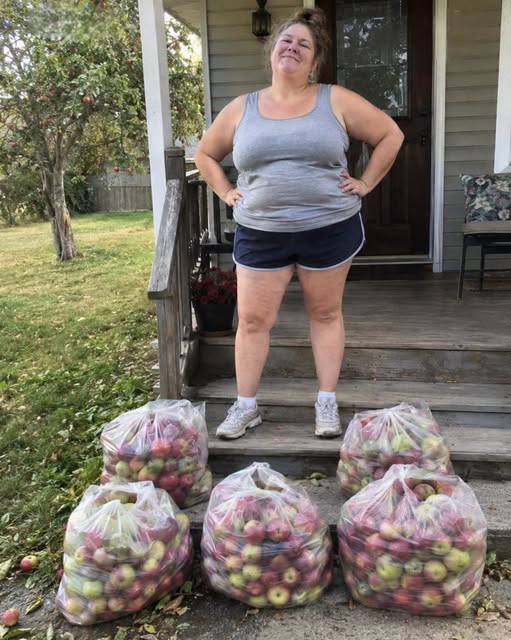
Ben helped me collect the remaining apples.
He wore his father’s old cap the entire time.
Our daughter sat nearby in a small wagon, happily eating slices of fruit.
Something unexpected happened.
One neighbor brought homemade apple pies.
Another brought jars for making applesauce.
Someone else offered to help repair the damaged branches.
Before long, our backyard looked completely different.
What had started as a painful reminder of what we’d lost became a day where people came together.
The remaining fruit was sorted.
Some went to our family.
Some was donated to a local food pantry.
And some was used by neighbors who had helped with the cleanup.
Ben watched everything carefully.
That evening, he asked me a question.
“Mom, are we going to cut down Dad’s trees?”
I knelt beside him.
“No.”
“Even though they got damaged?”
“Especially because they got damaged.”
He looked at the branches.
“Dad would fix them?”
“Yes,” I said.
“He’d probably tell us to be patient.”
Ben smiled.
“Then we’ll fix them.”
That was exactly what we did.
Over the following weeks, we carefully removed the damaged branches and protected the remaining trees.
A local gardener showed us how to care for the trees after the unexpected loss of fruit.
Ben learned more than he ever had before.
He learned how to prune.
He learned how to protect young branches.
He learned how to check for damage.
And he learned that taking care of something requires patience.
Meanwhile, the situation with Monica was handled separately.
Once the authorities became involved and the evidence was reviewed, the dispute was no longer simply a matter of one neighbor accusing another.
There was documentation.
There were photographs.
There was video.
There were witnesses.
And there were clear property boundaries.
I never needed to humiliate Monica or create a public confrontation.
The facts were enough.
Several days later, Monica approached me.
She looked uncomfortable.
“I didn’t think you’d make such a big issue out of the fruit,” she said.
I looked at her.
“It wasn’t just about the fruit.”
She didn’t respond.
“It was about coming onto our property without permission,” I continued. “And it was about the fact that my husband spent years caring for those trees.”
She looked toward the backyard.
“I understand.”
I didn’t know whether she truly did.
But I didn’t need an apology to move forward.
What mattered was that the boundary had been made clear.
From then on, she stayed on her side of the fence.
Months passed.
Winter arrived.
The trees stood bare against the cold sky.
Ben and I continued taking care of them.
Every weekend, we’d walk outside together and check the branches.
Sometimes he would wear Daniel’s old cap.
Sometimes he’d carry the pruning tools his father had taught him to use.
And every time we worked in the garden, I thought about the lesson Daniel had left us.
The trees were still there.
The family was still there.
And despite everything that had happened, the garden was still capable of producing something good.
The following autumn, the harvest wasn’t as large as it had been before.
Some of the trees needed more time to recover.
But there were apples.
Not as many.
Not perfect.
But enough.
Ben picked the first one himself.
He carefully twisted it from the branch and held it up.
“Dad would like this one,” he said.
I smiled.
“I think he would.”
We sat beneath the trees and shared the apple.
It wasn’t a dramatic moment.
There were no crowds.
No arguments.
No shouting.
Just my son, my daughter, and the memory of their father.
Looking back, I realized that Monica hadn’t taken the most important thing from us.
She had taken fruit.
She had damaged some branches.
She had created a painful situation during an already difficult time.
But she couldn’t take Daniel’s lessons away.
She couldn’t take the memories away.
And she certainly couldn’t take the future away from our children.
The garden eventually recovered.
So did we.
And every year when the apples begin to turn red, Ben still remembers what his father taught him.
Take care of what you have.
Share when you can.
Protect what matters.
And when someone crosses a boundary, stand up for yourself without becoming the kind of person you don’t want to be.
That became the real lesson from the garden.
Not revenge.
Not humiliation.
Not anger.
Just the decision to protect our family, preserve Daniel’s memory, and turn a painful situation into something that ultimately brought our neighbors closer together.