I’ve had many different neighbors throughout my life, but I never imagined that someone living just a few steps away could make ordinary days so stressful.
My name is Margaret, and my husband and I have lived in our house for more than twenty years. We are retired, enjoy gardening, and generally prefer a peaceful life.
We’ve always tried to maintain friendly relationships with the people around us. We believe that being a good neighbor means respecting other people’s property, offering help when needed, and understanding that everyone deserves a little privacy.
Unfortunately, our newest neighbor, Denise, seemed to have a very different understanding of those principles.
She moved into the house next door several months ago, and at first, we welcomed her warmly.
I even brought her a homemade pie when she arrived.
She thanked me, smiled, and said she was looking forward to getting to know everyone.
I thought we would get along wonderfully.
However, it didn’t take long for me to realize that Denise had a habit of treating other people’s belongings as though they were available for her personal use.
It started with small things.
One afternoon, I noticed her walking into our garage while the door was open.
She picked up our garden hose, carried it outside, and began using it in her yard.
I assumed she might have misunderstood something, so I politely asked whether she needed help finding her own equipment.
She laughed.
“Oh, I just borrowed yours. I hope you don’t mind.”
I explained that she should ask before taking anything.
She nodded, but the same situation happened again.
Over the following weeks, I discovered that several other items had also disappeared from our garage.
Our lawn mower was missing one morning.
A pair of gardening gloves had turned up in her yard.
Even one of our flowerpots was sitting beside her front steps.
Whenever I asked about something, Denise gave me the same answer.
“I’ll bring it back later.”
Unfortunately, later rarely seemed to arrive.
I often had to visit her house and remind her that the items belonged to us.
Then came the incident with our outdoor faucet.
One afternoon, I noticed that our water bill seemed unusually high. When I investigated, I discovered that Denise had connected her garden hose to our outdoor faucet.
She was using our water to fill a small swimming pool in her backyard.
I walked over and politely explained that she needed to use her own water supply.
She looked surprised.
“What’s the problem? It’s only water.”
I calmly explained that it was our property and that we were responsible for the bill.
She eventually disconnected the hose, but I could tell she wasn’t particularly pleased.
There were other incidents, too.
She once cut several roses from my garden because she wanted to take samples to grow similar flowers.
Another time, she borrowed our gardening tools without asking.
I repeatedly tried to handle everything politely.
I didn’t want arguments, uncomfortable conversations, or unnecessary tension between our households.
But Denise seemed to interpret my patience as permission to continue.
The problem with the trash cans
Eventually, her attention turned toward our garbage bins.
At first, I didn’t notice anything unusual.
Then I began finding my trash cans nearly full even when we had barely used them.
One morning, I happened to look outside just as Denise was carrying two large black bags toward our driveway.
She opened the lid of our garbage bin and dropped both bags inside.
I walked outside.
“Denise, could I ask you something?”
She turned around.
“Sure. What’s up?”
“Would you mind using your own trash cans? Ours are getting full.”
She shrugged.
“Mine are always overflowing, and yours are practically empty.”
I tried to explain that we needed our bins for our own household waste.
She looked at me as though I had said something unreasonable.
“You’re retired. How much trash can two people possibly produce?”
I took a breath.
“If you need more space, perhaps you could request another bin from the collection service.”
She rolled her eyes.
“And pay extra? No, thank you. Why spend money when there’s perfectly good space in yours?”
I couldn’t believe what I was hearing.
“Denise, that’s not really the point. We need to be able to use our own bins.”
She waved her hand.
“You’re making a big deal out of nothing.”
I decided not to continue the argument.
However, the problem didn’t stop.
Over the following weeks, I caught her using our garbage bins several more times.
Sometimes she brought ordinary household rubbish. Other times, she left bags filled with garden waste and packaging.
I considered putting a note on the bins, but I hoped she would eventually understand that she needed to respect our property.
Then Thanksgiving arrived.
And that was when the situation became much more serious.
The Thanksgiving disaster
My husband and I had invited several family members to our house for Thanksgiving dinner.
I had spent most of the morning preparing food.
The kitchen was busy, the dining table was decorated, and the smell of freshly baked bread filled the house.
We were looking forward to enjoying a peaceful afternoon with our children and grandchildren.
Meanwhile, Denise was hosting a large gathering of her own.
Several cars were parked outside her house, and I could hear people talking and laughing in her backyard.
She had apparently decided to prepare part of the meal using a charcoal grill.
Around midday, I picked up a bag of kitchen rubbish and walked outside to put it in our garbage bin.
But the moment I reached the driveway, I stopped.
Something was terribly wrong.
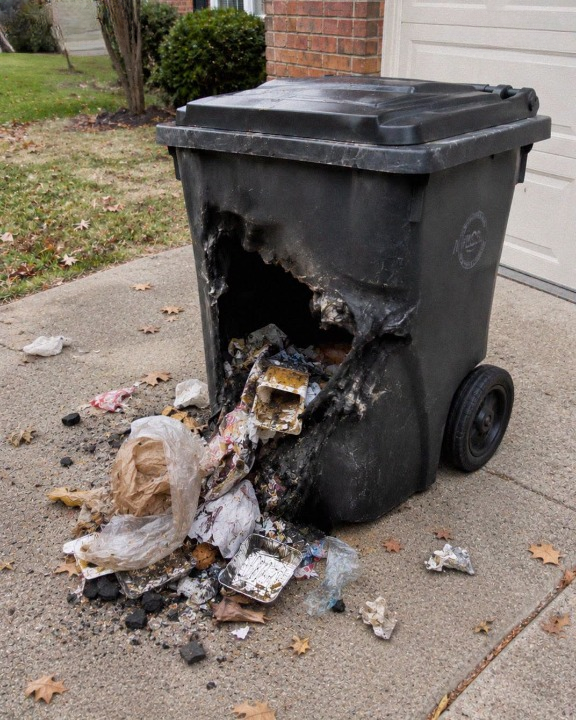
Our large plastic trash can had been damaged.
One entire side had melted inward, and the lid was badly warped.
There were pieces of rubbish scattered across the driveway.
I looked inside and immediately noticed a collection of gray ash and black chunks of charcoal.
It didn’t take long to understand what had happened.
Someone had emptied the contents of a charcoal grill into our plastic garbage bin before the coals had completely cooled.
The heat had damaged the container.
I stood there, completely stunned.
This wasn’t just another borrowed garden tool or an extra bag of rubbish.
It was property damage that could have been avoided with basic care.
I looked toward Denise’s house.
The grill was still visible in her backyard.
I took a few photographs of the damaged bin and carefully moved away from the area.
Then I walked over to speak with her.
Denise’s response
Denise opened the door with a cheerful expression.
Behind her, I could hear guests enjoying their Thanksgiving celebration.
“Hello, Margaret! What’s going on?”
I pointed toward the driveway.
“Denise, did you put the remains of your charcoal grill into our trash can?”
She glanced at the damaged container.
“Oh, that thing?”
“Yes. Look at what happened to it.”
She examined it briefly before shrugging.
“I cleaned out the grill. I thought everything had cooled down.”
I stared at her.
“You should never put warm charcoal into a plastic garbage bin. It needs to be completely cold before disposal.”
She sighed.
“Well, it’s already done. Just get another one.”
I couldn’t believe how casually she was treating the situation.
“Denise, you were using our bins without permission in the first place. Now you’ve damaged one. I expect you to replace it.”
She laughed.
“Seriously? You’re asking me to buy you another trash can?”
“Yes. You damaged it, and replacing it is your responsibility.”
She shook her head.
“I’m not spending my money on that. You and your husband can afford another one.”
I tried to remain calm.
“This has nothing to do with whether we can afford it. It’s about taking responsibility for something you’ve damaged.”
She crossed her arms.
“Honestly, Margaret, it’s Thanksgiving. I have guests waiting, and I don’t have time for this conversation.”
Before I could respond, she closed the door.
I stood on her porch for a moment.
Then I turned around and walked home.
My husband was waiting in the kitchen.
He took one look at my expression and immediately asked what had happened.
I explained everything.
He was just as disappointed as I was.
“That’s enough,” he said. “We need to handle this properly.”
I nodded.
And then I had an idea.
It wasn’t going to involve an argument, a public confrontation, or anything that would spoil our family’s holiday.
Instead, I decided to prepare something that Denise would not be expecting.
The unexpected Thanksgiving delivery
That evening, while our family was enjoying dinner, I gathered the photographs I had taken of the damaged garbage bin.
I also found the receipt for the original container.
Then I contacted the local waste collection service to ask about replacement options and the proper disposal of damaged bins.
They explained the process and provided information about the replacement cost.
I printed the details.
I also included a short written note explaining that the damaged container needed to be replaced because of the improper disposal of hot charcoal.
Then I placed everything neatly on a large serving platter.
I covered it with a decorative lid.
My husband watched me arrange everything.
“What exactly are you planning?”
I smiled.
“Just delivering something Denise should have received a long time ago.”
A little later, I walked across the driveway and knocked on her door.
I could hear music and conversation inside.
When Denise opened the door, she looked surprised to see me holding a covered platter.
“Margaret? Is everything all right?”
I smiled politely.
“Absolutely. I brought you something for Thanksgiving.”
Her expression softened.
“Well, that’s nice of you.”
She opened the door a little wider.
I lifted the decorative lid.
Instead of a homemade dessert or a traditional holiday dish, she found the photographs of her damaged trash bin, the replacement receipt, and a neatly written letter.
Her smile slowly disappeared.
She picked up the photographs and examined them.
“What is all this?”
I remained calm.
“It’s the documentation for the damage to our garbage bin, along with the replacement information.”
She looked at the papers again.
Then she looked at me.
“Are you serious?”
“Completely. I thought it would be easier to give you everything together so there would be no confusion.”
Her expression changed.
“You’re asking me to pay for this?”
“I’m asking you to take responsibility for the damage.”
She glanced toward the guests inside.
A couple of people had noticed our conversation and were looking in our direction.
Denise lowered her voice.
“Could we talk about this another time?”
I nodded.
“Of course. You can contact me tomorrow. I don’t want to interrupt your Thanksgiving dinner.”
Then I smiled, thanked her for her time, and walked home.
For the first time since she had moved in, Denise didn’t have a quick answer.
A conversation that finally changed things
The following morning, my husband and I were having coffee when someone knocked on our front door.
It was Denise.
She looked considerably less confident than she had the previous evening.
“Margaret, could we talk for a minute?”
I invited her inside.
She sat down and placed the photographs on the table.
“I spoke with my husband about what happened,” she began. “He says we should replace your trash can.”
I nodded.
“That would be appreciated.”
She hesitated.
“I also wanted to apologize. I shouldn’t have been using your bins without asking. And I certainly shouldn’t have dismissed your concerns.”
I appreciated hearing those words.
I didn’t expect her to become my closest friend overnight, but an apology was a reasonable beginning.
She continued.
“We’ve been producing more rubbish than usual, especially when we have guests. I should have arranged an additional bin instead of using yours.”
“That would have prevented most of these problems,” I replied.
She agreed.
A few days later, Denise arranged for the replacement container to be paid for.
She also stopped using our garbage bins without permission.
More importantly, she began asking before borrowing anything.
Our relationship wasn’t suddenly perfect, but there was a noticeable improvement.
What Thanksgiving taught me
When I think about that Thanksgiving, I don’t remember the damaged trash can as much as I remember how easily a simple problem can become a bigger disagreement when people refuse to respect one another.
I never expected Denise to be perfect.
Everyone makes mistakes.
But there is a difference between making an honest mistake and refusing to take responsibility when your actions affect someone else.
My husband and I have always believed that good neighbors should treat one another with consideration.
That means asking before borrowing something, respecting shared spaces, and taking responsibility when an accident happens.
We didn’t need an argument to make that point.
Sometimes, a calm conversation and a little documentation are much more effective.
As for Denise, she eventually became a much more considerate neighbor.
And whenever I see her taking out her garbage, I can’t help smiling.
She now has her own bins, her own gardening equipment, and a much better understanding of personal boundaries.
I suppose that Thanksgiving gave all of us a lesson.
And the best part?
I didn’t have to prepare another turkey to deliver it.