For weeks, I couldn’t understand why my electricity bill had suddenly increased.
Nothing about my routine had changed.
I hadn’t bought a new appliance. I wasn’t using the heating or air conditioning any differently. There hadn’t been any major changes in the house that could explain the extra electricity.
Yet the latest bill was almost twice what I normally paid.
At first, I assumed there had been a billing mistake.
Then, one sleepless night, I discovered something I never expected to see.
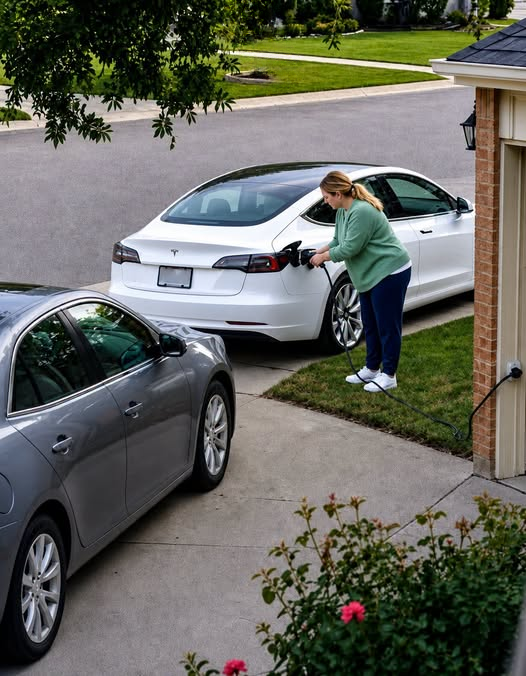
My neighbor had been using an outdoor electrical outlet attached to my garage.
And she wasn’t using it for a few minutes.
She had apparently been connecting her electric vehicle there for extended periods.
The surprising part wasn’t simply that she had used my electricity.
It was the way she reacted when I confronted her.
Instead of apologizing, she acted as though I were unreasonable for objecting.
That conversation changed how I handled the entire situation.
A Quiet Life With Predictable Bills
I’m sixty years old and live alone in a quiet suburban neighborhood.
My life is fairly routine.
I know roughly how much electricity I use every month, and my utility bills have generally stayed within a narrow range.
That’s why the unusually high bill immediately caught my attention.
I looked at the previous statements.
The difference wasn’t enormous in dollar terms, but it was significant compared with my normal usage.
I started thinking through everything I had done differently.
Had I left something running?
Had an appliance developed a problem?
Was an outdoor light staying on?
Could there have been an issue with the heating or cooling system?
I checked what I could.
Nothing seemed unusual.
I decided to monitor the situation for another billing period before jumping to conclusions.
Then something happened that gave me an answer.
The Strange Noise Outside
One night, I couldn’t sleep.
It was sometime after midnight.
The house was completely quiet, but I heard movement outside.
At first, I ignored it.
Then I heard another noise.
I got out of bed and walked toward the window.
When I looked outside, I noticed a vehicle parked near my driveway.
It belonged to my neighbor, Monica.
At first, I wondered why she was there so late.
Then I noticed something attached to the side of my garage.
A charging cable was connected to one of my outdoor electrical outlets.
The other end was connected to her vehicle.
I stared for several seconds.
Suddenly, the unusually high electricity bill made sense.
Someone had been using my electricity.
And that someone was my neighbor.
I Went Outside to Ask Her
I put on some clothes and walked outside.
“Monica, what are you doing?”
She turned around.
She didn’t look particularly surprised to see me.
Instead, she looked at me as though I had interrupted something completely ordinary.
“I’m charging my car,” she said.
I looked at the cable.
Then I looked back at her.
“You’re using my outlet.”
She shrugged.
“Yes.”
There was no hesitation.
No apology.
No explanation about why she had assumed it was acceptable.
Just a casual acknowledgment.
I told her that the electricity belonged to my household and that I had noticed my bill had increased.
Her response surprised me.
“It’s Not That Much”
Monica acted as though I was making a much bigger issue out of the situation than necessary.
She suggested that the amount of electricity couldn’t possibly matter that much.
I explained that I had never given her permission to use the outlet.
She responded by pointing out that I lived alone.
She said I probably didn’t use much electricity anyway.
That argument bothered me.
It wasn’t about whether I could afford the electricity.
It was about permission.
If someone takes something that belongs to you without asking, the value doesn’t determine whether the behavior is acceptable.
A neighbor can’t simply decide that your property is available because they believe you aren’t using it enough.
This Wasn’t the First Time
As I stood there, I started thinking about other incidents.
Monica had a history of treating boundaries rather casually.
On one occasion, she had borrowed my lawn equipment without asking first.
She later returned it as though nothing unusual had happened.
Another time, she took a small garden decoration from my property because she thought it would look better in her yard.
None of these incidents seemed important enough individually to create a major neighborhood conflict.
So I had let them go.
I tried to be patient.
I didn’t want to become the person who complained about every little thing.
But looking back, I realized that those small incidents had something in common.
Monica seemed to assume that if something was convenient for her, it was probably acceptable.
I Explained the Problem Clearly
I told her that I wasn’t interested in arguing.
I simply wanted her to stop using the outlet without permission.
I also explained that the increased electricity bill had made the situation impossible for me to ignore.
She still didn’t seem particularly concerned.
She suggested that the cost was probably minimal.
That wasn’t the point.
I didn’t know exactly how much electricity her vehicle had consumed, and I wasn’t going to make an exaggerated claim.
What I knew was simple:
The outlet was on my property.
The electricity was being billed to me.
And I had never agreed to provide her with charging services.
I Didn’t Want a Neighborhood War
I could have immediately called the police.
I could have started a public argument.
I could have confronted her family.
I could have posted about it online.
But none of those options appealed to me.
I wanted the situation resolved without turning a neighborhood disagreement into something much larger.
So I decided to handle it calmly.
I told Monica that she could no longer use my outlet.
Then I went back inside.
I didn’t threaten her.
I didn’t damage her vehicle.
I didn’t interfere with her charging equipment.
I simply made my position clear.
The Next Morning, I Made a Change
The following day, I inspected the outdoor outlet.
I realized that the problem wasn’t only Monica.
The outlet was easily accessible.
There was nothing preventing someone from connecting a cable.
That meant I needed to secure my property better.
Rather than attempting anything dangerous or improvising with the electrical system, I decided to use a proper weather-resistant lockable outlet cover and have the installation checked appropriately.
My goal wasn’t revenge.
It was prevention.
If someone had been able to use the outlet without permission, I needed to make sure that couldn’t continue.
That Evening, Monica Returned
Later that evening, Monica came back.
She parked near the same area.
Then she walked toward my garage.
I watched from inside.
She approached the outlet.
For a moment, she appeared to expect everything to be exactly as it had been.
Then she discovered that the outlet was no longer freely accessible.
She stood there looking at it.
She tried to figure out what had changed.
Eventually, she looked toward my house.
I opened the door.
She immediately asked what I had done.
I explained that the outlet was private and that I had secured it because I didn’t want anyone using it without permission.
Her Reaction Was Completely Different
This time, Monica wasn’t laughing.
She was angry.
She complained that she needed somewhere to charge her vehicle.
I told her that I understood her situation, but my property wasn’t the solution.
There are many legitimate ways for an electric-vehicle owner to charge a vehicle.
A homeowner can install an appropriate charging setup.
A driver can use public charging infrastructure.
And neighbors can make private arrangements if both parties agree.
What isn’t reasonable is simply assuming someone else’s electrical service is available for personal use.
The Conversation Became a Lesson in Boundaries
Monica argued that I was making things unnecessarily difficult.
I disagreed.
I told her that this could have been avoided with one simple question.
If she had asked me whether she could occasionally use the outlet, I could have decided whether I was comfortable with that arrangement.
Maybe I would have said yes.
Maybe I would have said no.
Either answer would have been my choice.
Instead, she made the decision for me.
That’s what bothered me most.
I Asked Her to Calculate the Difference
I didn’t want to guess how much electricity she had used.
So I suggested that we approach the issue reasonably.
If we wanted to discuss reimbursement, we could look at the utility records and estimate the additional consumption rather than inventing a number.
I wasn’t interested in charging her for imaginary expenses.
I wanted the actual situation documented.
That seemed to change the tone of the conversation.
Once the discussion became about records rather than accusations, there wasn’t much room for exaggeration.
The Utility Bill Told Part of the Story
I reviewed my electricity usage carefully.
The higher consumption didn’t necessarily prove exactly how much electricity Monica had used.
There can be many reasons for changes in household electricity consumption.
However, the timing of the increase and what I had witnessed gave me a reasonable explanation for at least part of the difference.
That was enough for me.
I didn’t need to turn the situation into a dramatic accusation.
I had seen her using the outlet.
She had admitted she was charging her vehicle.
And I had never given permission.
I Also Started Keeping Records
From that point forward, I began documenting the incidents.
I saved my electricity statements.
I wrote down dates when I noticed unauthorized use.
I kept photographs of the outlet and its condition.
I documented conversations when necessary.
The purpose wasn’t to build some elaborate case against my neighbor.
It was simply to make sure that if the situation continued, I wouldn’t have to rely on memory.
Good documentation can prevent misunderstandings.
And if a dispute eventually becomes a legal matter, accurate records are much more useful than emotional recollections.
I Never Touched Her Vehicle
One thing I was especially careful about was her car.
I didn’t touch it.
I didn’t unplug anything while it was charging.
I didn’t move it.
I didn’t interfere with her equipment.
I didn’t want my attempt to protect my property to create a new problem.
Electrical equipment and electric vehicles can involve significant safety considerations.
If something needs to be disconnected or modified, the safest approach is to use the appropriate controls or have qualified professionals handle electrical work.
There was no reason for me to take risks.
The Online Advice Was All Over the Place
After the story circulated, people had plenty of opinions.
Some suggested simply turning off the circuit.
Others suggested installing a lockable cover.
Some people recommended involving law enforcement.
Others suggested pursuing reimbursement through civil channels.
There were also people questioning whether the story was realistic.
That variety of reactions taught me something.
When a situation involves electricity, property rights, or potential financial disputes, random online advice isn’t necessarily the best guide.
What works in one location may not be appropriate in another.
Electrical systems also vary.
And property laws differ depending on where someone lives.
The Better Solution Was Simpler
I didn’t need a dramatic confrontation.
I needed a boundary.
The solution was straightforward:
My neighbor could charge her vehicle somewhere else.
My outdoor outlet was for my household.
If she wanted to use it in the future, she would have to ask first.
That was it.
Sometimes people make conflicts complicated because they believe every disagreement needs a winner and a loser.
I didn’t see it that way.
I wanted the behavior to stop.
Eventually, Monica Understood
After several conversations, Monica finally acknowledged that she should have asked before using the outlet.
She didn’t suddenly become my best friend.
We weren’t suddenly having coffee together every morning.
But the situation became less hostile.
She stopped using the outlet without permission.
And my electricity usage returned closer to its normal range.
That was all I wanted.
The Electricity Wasn’t Really the Issue
Looking back, the money wasn’t what upset me most.
It was the assumption behind the behavior.
Monica had decided that because I lived alone, my resources were somehow less important.
She believed that because I might not use much electricity, she could use it.
That logic is dangerous.
A person’s property doesn’t become public simply because it appears underused.
Someone who lives alone has exactly the same right to privacy and property as a family of five.
Someone with a large house doesn’t automatically have more rights than someone in a small one.
And someone who owns an expensive vehicle doesn’t gain permission to use someone else’s resources.
One Simple Question Would Have Changed Everything
If Monica had knocked on my door and said:
“Would you mind if I occasionally charged my vehicle using your outdoor outlet? I’ll pay for the electricity.”
I might have considered it.
We could have discussed how long she would use it, how often, and how the cost would be handled.
Perhaps I would have agreed.
Perhaps I wouldn’t have.
But at least it would have been a respectful conversation.
Instead, she made the decision herself.
That was the real mistake.
I Also Learned to Pay Attention to Small Patterns
The lawn mower.
The garden decoration.
The electrical outlet.
Each incident seemed minor.
Together, however, they revealed a pattern.
When someone repeatedly crosses small boundaries, it can eventually create a much larger problem.
That doesn’t mean every small disagreement requires confrontation.
But it does mean that people should communicate clearly when something bothers them.
If you continually ignore behavior that makes you uncomfortable, the other person may assume that you don’t object.
Sometimes saying “please don’t do that” early is far easier than dealing with a major conflict later.
My House Became My Responsibility Again
After I secured the outlet, I also reviewed the rest of the exterior of my home.
I checked other accessible equipment.
I made sure storage areas were secured.
I looked at outdoor lighting and cameras.
I wasn’t becoming paranoid.
I was simply paying more attention.
Living in a friendly neighborhood doesn’t mean you should ignore basic property security.
Most neighbors are respectful.
But reasonable precautions can prevent misunderstandings.
The Neighborhood Eventually Moved On
A few days later, the story wasn’t nearly as dramatic.
People stopped talking about it.
Life returned to normal.
Monica continued living next door.
I continued living in my house.
There was no dramatic showdown.
No police cars.
No courtroom spectacle.
No public humiliation.
Just a boundary that was finally respected.
And honestly, that was a much better outcome than anything I could have imagined.
What I Would Do Differently
If I could go back, I would have addressed the first incident immediately.
When Monica borrowed my lawn equipment without asking, I should have told her clearly that she needed permission.
When she took the garden decoration, I should have explained that she couldn’t remove things from my property.
Those incidents seemed too small to worry about.
But small boundaries matter.
It’s easier to prevent a pattern than to correct one after it becomes established.
A Practical Lesson for Homeowners
If you discover that someone is using your property without permission, don’t immediately assume you need to retaliate.
Start by documenting what is happening.
Determine whether there could be an innocent explanation.
Communicate clearly.
Secure your property appropriately.
If money or legal rights are involved, keep records and consider professional advice.
And when electricity is involved, don’t experiment with wiring or electrical components unless you’re qualified to do so.
A small neighborhood disagreement isn’t worth creating a dangerous electrical situation.
Respect Works Both Ways
Neighbors don’t have to be best friends.
They don’t even have to agree on everything.
But there should be a basic level of respect.
You don’t take someone’s equipment without asking.
You don’t remove decorations from another person’s property.
You don’t use someone else’s electricity without permission.
And you don’t dismiss their concerns simply because you think the financial cost is small.
Respect isn’t measured in dollars.
It’s measured by whether you recognize another person’s right to make decisions about their own property.
The Final Conversation
Several weeks later, Monica and I happened to speak while we were both outside.
She mentioned that she had arranged a different charging solution.
Then she apologized for using my outlet without asking.
I accepted the apology.
I didn’t bring up every previous disagreement.
There was no reason to.
The situation had been resolved.
Sometimes the best ending isn’t humiliating the other person.
Sometimes it’s simply getting the behavior to stop and moving forward.
The Lesson I Took Away
That strange night taught me something I should have understood much earlier.
Being a good neighbor doesn’t mean allowing someone to ignore your boundaries.
I had tried to be patient.
I had tried not to make small things into major disputes.
But patience should not be confused with permission.
My electricity belonged to me.
My outdoor outlet belonged to me.
And I had every right to decide how those resources were used.
The solution didn’t require revenge.
It didn’t require damaging anyone’s property.
It didn’t require a dramatic confrontation.
It required communication, documentation, reasonable security measures, and a clear boundary.
Today, my electricity bills are back within their normal range.
My outdoor outlet is secured.
And my relationship with my neighbor is at least civil.
That’s enough for me.
Because the real lesson wasn’t about an electric vehicle or an unusually high utility bill.
It was about something much more ordinary:
If you want to use something that belongs to someone else, ask first.
One simple question could have prevented the entire situation.
And sometimes, the simplest solution is also the most effective one.