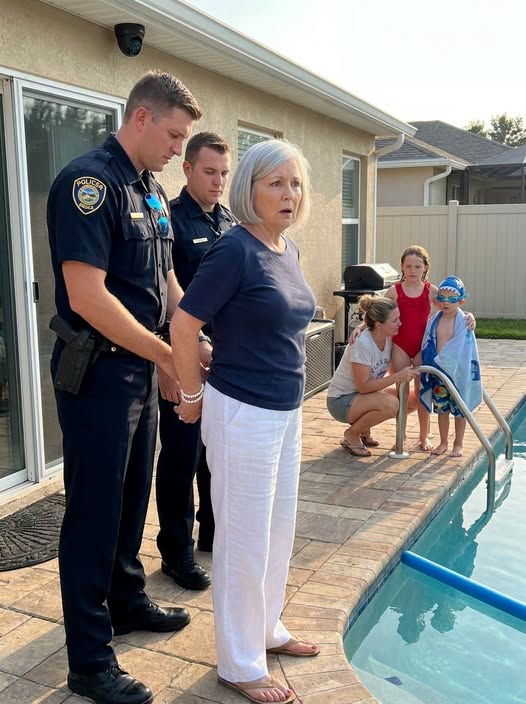
My Neighbor Called 911 Because My Kids Were Swimming—Then the Backyard Camera Changed Everything
The first thing I noticed when I came around the side of my house was my nine-year-old daughter’s red swimsuit clenched in Beverly Haskins’ hand.
For several seconds, I simply stood there trying to understand what I was seeing.
The afternoon sun had heated the patio stones beneath my bare feet. The air smelled of chlorine, sunscreen, and the hamburgers I had been preparing for lunch.
In the shallow end of our backyard pool, my six-year-old son, Noah, stood completely still.
His blue shark goggles were still covering his eyes.
The water moved gently around his legs.
Everything should have felt ordinary.
It had been an ordinary Saturday afternoon just moments earlier.
Lily and Noah had been laughing in the pool under the warm North Carolina sun. Lily had been teaching her little brother how to hold his breath, while Noah had been using a pool noodle as an imaginary sword.
I had gone inside for what I expected to be a very quick bathroom break.
The patio door was still partially open.
The kitchen timer was running because I still needed to put lunch on the grill.
I was gone for perhaps two minutes.
When I came back outside, my neighbor was standing inside our fenced backyard.
And she was holding my daughter’s swimsuit.
“Get out!”
Beverly shouted as she stood near the pool.
“I said get out of that pool right now!”
Lily’s face had gone pale.
Noah was gripping the pool noodle with both hands.
“Mom!”
Hearing my daughter call for me changed everything.
I rushed toward them.
“What are you doing to my daughter?”
Beverly turned toward me as if I were the one causing the disturbance.
She was sixty-two and usually presented herself as the picture of composure. At neighborhood meetings, she always arrived carefully dressed and spoke in a calm, confident voice.
That afternoon, however, she looked furious.
“These children are trespassing,” she said.
I stared at her.
“Trespassing? Beverly, this is my backyard.”
She pointed toward Lily and Noah.
“They don’t belong in this pool.”
“My children live here.”
“No,” she replied. “This house belongs to people who understand this neighborhood.”
I looked past her and noticed something immediately.
The side gate was open.
I had locked it earlier that morning.
Beverly had apparently opened the gate, walked down the side path, entered our fenced backyard, and approached my children without asking permission.
“Step away from my children,” I said.
Lily moved toward the pool ladder.
Beverly immediately stretched out an arm.
“Don’t move. The police are coming.”
Noah began to cry.
I could feel my anger rising, but I knew losing my temper would only make the situation worse.
I took a breath.
“Beverly, please leave my property.”
Instead of leaving, she pulled out her phone.
“Oh, I’m already calling the police.”
She tapped the screen.
Then her voice changed.
“Yes, 911? I need officers at 1847 Magnolia Bend immediately. There are unsupervised children in a private pool, and I believe they’re trespassing. The mother is becoming aggressive.”
I stared at her.
The mother is becoming aggressive.
That was how she was describing me.
Not the woman who had entered my backyard.
Not the person who had confronted my children.
Me.
I glanced toward the small black camera mounted above the patio door.
My husband, Daniel, had installed it several months earlier after packages disappeared from several homes in the neighborhood.
The camera covered much of the patio and the area around the pool.
Beverly knew it was there.
She had even complained about it at an HOA meeting, saying cameras made the neighborhood feel unnecessarily monitored.
Now, that same camera was recording the entire confrontation.
“Okay,” I said quietly.
Beverly looked at me.
“What?”
“Call them.”
I didn’t argue.
I didn’t shout.
I didn’t touch her.
I simply stood between her and my children.
At that point, I realized that whatever happened next would be easier to explain if I remained calm.
“Lily, Noah, come here.”
“They need to stay where they are,” Beverly said.
I looked directly at her.
“They’re children, Beverly. They’re coming with me.”
Lily climbed out of the pool first.
She was trembling.
I wrapped a towel around her shoulders and pulled her close.
Noah followed.
His foot slipped slightly on the pool ladder, and I caught him.
He pressed his wet face against me.
“Are we going to jail?” he whispered.
My heart sank.
“No, sweetheart,” I told him. “You’re not going anywhere.”
Beverly continued talking to the dispatcher.
“Yes, I’m the HOA board secretary. I know what belongs in this neighborhood. No, I don’t feel safe.”
She paused.
Then she added:
“She is filming me.”
I hadn’t taken out my phone.
But the camera above the patio door was still recording.
Then Beverly said something that made everyone nearby go quiet.
“I want those children removed before this becomes a bigger problem for property values.”
Lily heard her.
Noah heard her.
I heard her.
And the camera heard her too.
The Police Arrive
A few minutes later, a police cruiser pulled into our driveway.
Beverly immediately changed her posture.
She seemed relieved.
She walked toward the officers before they had even finished getting out of the vehicle.
“Thank goodness you’re here,” she said. “I’m Beverly Haskins. I made the call.”
One of the officers looked around the backyard.
He glanced toward the pool, then toward Lily and Noah, who were standing beside the patio chairs wrapped in towels.
Beverly continued.
“These children were swimming in a pool that doesn’t belong to them.”
The officer looked at her.
“Whose property are we on?”
Beverly pointed toward me.
“That woman claims it’s hers.”
I stepped forward.
“My name is Sarah Whitaker. My husband and I purchased this house last September. Those are my children.”
I paused.
“She entered our fenced backyard without permission and grabbed my daughter.”
Beverly immediately objected.
“I barely touched her.”
The officer looked toward Lily.
His partner moved closer to my daughter and spoke gently.
“Did she touch you?”
Lily looked at me.
I nodded.
“She pulled my swimsuit,” Lily said quietly. “And she said we didn’t belong here.”
Beverly shook her head.
“Children don’t always remember things correctly.”
Noah had been quiet until then.
He wiped his nose with the corner of his towel.
Then he pointed toward the patio door.
“Daddy’s camera saw it.”
Beverly followed his finger.
She looked directly at the camera.
For the first time since I had come outside, her expression changed.
The officer noticed.
He looked at the camera.
Then he looked back at Beverly.
“Mrs. Haskins,” he said calmly, “I’d like to ask you a few questions.”
She crossed her arms.
“Of course.”
“Did you enter this property?”
“I entered the backyard because I was concerned about the children.”
“Did you have permission to enter?”
She hesitated.
“I was trying to help.”
“That wasn’t my question.”
Beverly looked toward me.
Then toward the officers.
Then back at the camera.
“I didn’t do anything wrong.”
The officer remained calm.
“That’s something we’ll determine after we understand what happened.”
The Camera Becomes Important
My husband had installed the camera primarily for security.
We had never imagined that its most important recording would involve a dispute with a neighbor.
The camera captured the patio, part of the pool area, and the side entrance.
It also recorded audio.
I had never paid much attention to the recordings unless we needed to check whether a package had been delivered.
That afternoon, however, the footage became important.
The officer asked whether we could show him the recording.
I nodded.
My phone was connected to the camera system, so I opened the app.
The recording showed Lily and Noah playing in the pool.
A short time later, Beverly appeared at the side gate.
She opened it.
She entered the backyard.
She approached the pool.
And then the confrontation began.
The officer watched quietly.
Beverly stood nearby.
As the footage continued, her expression became increasingly tense.
The recording showed her reaching toward Lily.
It showed Lily stepping back.
It showed Noah standing near the shallow end.
And it captured the conversation.
There was no argument about what the children had been doing.
They had been swimming in their own backyard.
There was no mystery about how Beverly entered.
The camera showed it clearly.
A Different Kind of Conversation
After watching the footage, the officers stepped away from the children and spoke privately for several moments.
Beverly remained near the patio.
She appeared far less confident than she had when the police first arrived.
Eventually, one of the officers returned.
“Mrs. Haskins, I need you to remain here while we finish documenting what happened.”
Beverly frowned.
“I called you because there were children in a pool without supervision.”
The officer looked toward the pool.
Then toward me.
Then back at Beverly.
“We’re aware of what you reported.”
“But I was trying to protect them.”
“I understand that’s what you’re saying.”
She seemed frustrated.
“What happens now?”
The officer explained that they needed to document the circumstances, including how she entered the property and what occurred during the confrontation.
Beverly glanced toward the camera again.
I could tell she understood that the situation was no longer simply her word against mine.
There was a recording.
What I Remember Most
Looking back, the part that stays with me isn’t the police arriving.
It isn’t even the argument with Beverly.
It’s the moment Noah asked whether he was going to jail.
He was six years old.
He had been playing with his sister in the pool.
A few minutes earlier, his biggest concern had been whether he could hold his breath longer than Lily.
Then suddenly he was worried that he had done something so serious that police officers might take him away.
That was the moment I realized how frightening the confrontation had been for my children.
Adults sometimes forget how quickly an ordinary disagreement can become overwhelming for a child.
A raised voice.
A stranger entering their space.
An unfamiliar authority figure.
Even a simple misunderstanding can feel enormous when you’re six or nine years old.
I wanted my children to understand that they were safe.
What Happened Afterward
The officers eventually finished speaking with everyone involved.
They documented the situation and reviewed the available information.
Beverly was no longer speaking with the same confidence she had shown when she first called 911.
Whatever she had expected when the police arrived, the situation had clearly become more complicated.
For our family, the rest of the afternoon was quiet.
The hamburgers I had planned to grill were forgotten for a while.
The pool was empty.
Lily changed into dry clothes and sat beside me on the patio.
Noah eventually stopped crying.
Daniel came home later and watched the camera footage himself.
Neither of us had expected our security system to become part of a neighborhood dispute.
But that day taught us something important.
Security cameras aren’t only about protecting property.
Sometimes they provide a record of events when people’s memories or explanations don’t match.
A Lesson About Boundaries
The incident also changed the way I thought about boundaries with neighbors.
Living in a neighborhood means sharing space.
People have different opinions about noise, fences, landscaping, parking, children, pets, and property maintenance.
Those disagreements can usually be handled through conversation.
But there is a major difference between expressing a concern and entering someone else’s private space without permission.
There is also a difference between being concerned about a child’s safety and taking control of someone else’s child.
Those boundaries matter.
If Beverly had knocked on our front door and said she was worried about the children, we could have had a conversation.
If she believed the pool violated an HOA rule, she could have raised the issue through the appropriate process.
Instead, she entered our fenced backyard and confronted two young children while their mother was briefly inside.
That choice turned a neighborhood disagreement into something much more serious.
The Camera Told the Story
The most surprising part of the entire afternoon was how quickly the situation changed once the recording was reviewed.
Before the footage was shown, there were competing descriptions of what had happened.
Afterward, there was an objective record of much of the interaction.
The camera couldn’t explain why Beverly made the decisions she did.
It couldn’t tell us what she was thinking.
But it could show what happened.
Sometimes that’s all you need.
The following morning, Daniel checked the security system again.
The camera was still pointed toward the pool.
The backyard looked completely normal.
Sunlight covered the patio.
The pool water was still.
The children’s pool toys were floating near the shallow end.
It was difficult to believe that the day before, police officers had stood in that same spot while we tried to explain what had happened.
Lily walked outside beside me.
She looked toward the gate.
“Is she going to come back?”
I put my arm around her.
“I don’t know,” I said honestly.
“But if anything happens, we’ll handle it together.”
She nodded.
Then she looked toward the pool.
“Can we swim today?”
I smiled.
“Maybe after lunch.”
She smiled back.
And for the first time since the previous afternoon, the backyard felt like our backyard again.
The pool was still there.
The camera was still there.
And the side gate was firmly locked.