My Mother-in-Law Took Our Wedding Cards Before the Reception Was Over — Then My Mom Invited Her to Dinner
My wedding day was supposed to be one of the happiest days of my life.
After months of planning, phone calls, appointments, seating charts, decorations, menu decisions, and more conversations about flowers than I ever expected to have, the day had finally arrived.
The room was full of people we loved.
Family members had traveled from different cities. Friends were laughing near the dance floor. Children were running between tables. Someone was taking pictures near the cake, while the music played quietly in the background.
My husband and I had spent most of the evening moving from table to table, thanking people for coming and trying to speak with everyone before the night ended.
I remember thinking that everything had gone beautifully.
At least, I thought it had.
Until my cousin quietly walked over to me.
She leaned toward me near the bar and lowered her voice.
“Can I ask you something?”
“Sure.”
She glanced toward the gift table.
“Is your mother-in-law supposed to be taking the envelopes?”
I stared at her.
“What?”
She didn’t answer immediately. She simply nodded toward the corner of the room.
I followed her gaze.
And there she was.
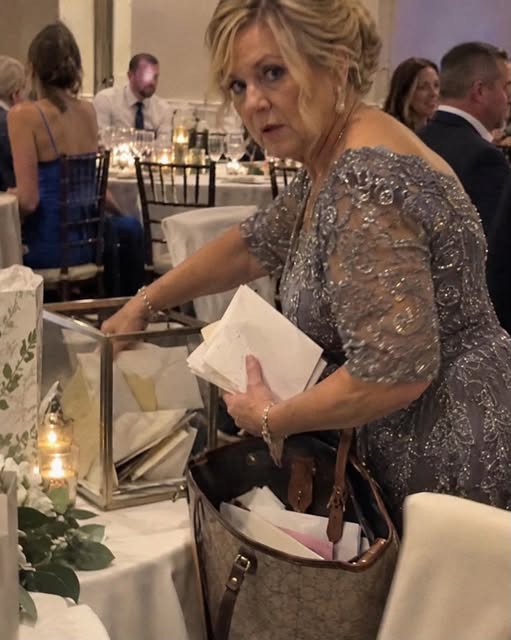
Linda, my husband’s mother, was standing beside the card box.
She had brought a large tote bag with her. It was sitting open on a nearby chair.
At first, I couldn’t understand what I was seeing.
Then I realized what she was doing.
She was taking the cards from our wedding box.
One handful at a time.
She wasn’t opening the cards in front of everyone. She wasn’t reading the messages. She was simply removing the envelopes and placing them inside her bag.
I stood there for a moment, completely confused.
Maybe there was an explanation.
Maybe someone had asked her to move them.
Maybe there was something I didn’t know.
So I walked over.
I was still wearing my wedding dress, and somehow I remember feeling strangely calm.
“Linda, what are you doing?”
She looked at me as though I had asked an unnecessary question.
“Oh, sweetheart, don’t worry about it.”
She placed another group of envelopes into the bag.
“I’m just putting these somewhere safe.”
I looked at the card box.
“They’re already safe.”
She smiled.
Then she gave a small laugh.
“Honey, we paid for half of this wedding. I’m just holding on to our share.”
Our share.
Those words stayed with me.
She seemed to believe that the money guests had placed inside their cards somehow belonged to her because she had contributed to the wedding expenses.
But those cards weren’t invoices.
They weren’t reimbursements.
They were gifts given to us by people who had traveled, celebrated with us, and wanted to help us begin our married life.
My aunt had driven four hours to attend.
One of my husband’s childhood friends had flown in from another state.
Several relatives had rearranged work schedules and family commitments just to be there.
And now, before the reception had even ended, Linda was collecting their cards as though she were settling an account.
I looked around the room.
People were still laughing.
The music was still playing.
Nobody seemed to have noticed what was happening.
Or maybe they had noticed and simply didn’t know what to do.
I didn’t either.
For a moment, I wanted to take the bag from her.
I wanted to tell her that she had no right.
I wanted to call my husband over and make him deal with it.
But before I could say anything else, I saw my mother.
She was standing near the doors.
And she had seen everything.
She looked at me.
I looked at her.
She didn’t say a word.
She simply shook her head very slightly.
Don’t.
Not here.
Not tonight.
I understood.
So I took a breath.
“Okay,” I said quietly.
Linda smiled as though the matter had been settled.
“Good. I’ll make sure everything is taken care of.”
I walked away.
But I didn’t forget.
The Drive Home
The reception continued.
People danced.
The photographer took more pictures.
We cut the cake.
We said goodbye to relatives.
I smiled for photographs and thanked people for coming.
But underneath all of it, I kept thinking about the envelopes in Linda’s bag.
My husband noticed that something was wrong.
“You okay?”
“I’m fine.”
“You don’t look fine.”
I looked at him.
“Your mom took the cards.”
He frowned.
“What cards?”
“The wedding envelopes.”
He seemed genuinely confused.
“I thought she was just moving them.”
“She put them in her bag.”
He paused.
“Why?”
I almost laughed.
“I asked her. She said she was keeping her half.”
He stared at me.
“What does that mean?”
“I don’t know.”
And that was the strangest part.
I didn’t know whether he understood his mother’s thinking.
I didn’t know whether this was something they had discussed before.
I didn’t know whether he had expected her to do it.
The rest of the night passed quickly.
Eventually, we said our final goodbyes and left.
On the drive home, neither of us talked much.
I was too tired to argue.
He was too uncomfortable to explain something he apparently hadn’t anticipated.
When we got home, I took off my shoes, changed out of my dress, and sat on the edge of the bed.
It was supposed to be the beginning of our married life.
Instead, I was thinking about a box of envelopes.
The Morning After
The next morning, I woke up angry.
Not disappointed.
Not embarrassed.
Angry.
I wanted to call Linda immediately.
I wanted to tell her exactly what I thought.
I wanted my husband to call her and ask her to return every envelope.
I wanted someone to acknowledge how inappropriate the situation had been.
Instead, I drove to my mother’s house.
She opened the door before I even knocked twice.
She looked at me.
“You look exhausted.”
“I am.”
“Coffee?”
“Please.”
She poured me a cup and sat across from me at the kitchen table.
I told her everything.
She listened without interrupting.
When I finished, I expected her to become angry.
Instead, she calmly reached across the table and took my phone.
She placed it in front of me.
“No.”
I looked at her.
“No what?”
“No calling her while you’re angry.”
“Mom—”
“No.”
“But she took our cards.”
“I know.”
“She basically said the money belonged to her.”
“I heard you.”
“So what am I supposed to do?”
My mother took a sip of coffee.
“You’re going to invite her to dinner.”
I thought I had misunderstood her.
“What?”
“Invite Linda to dinner.”
“Why?”
“Because you’re going to be married to her son for a long time.”
I stared at her.
She continued.
“You don’t fix every family problem by creating another family problem.”
“So we just let her keep everything?”
“Absolutely not.”
That answer came immediately.
My mother leaned forward.
“You can be firm without turning this into a public fight. You can make your position clear without humiliating anyone. And you can establish boundaries without spending the next twenty years bringing up what happened at your wedding.”
I was quiet.
Then she added:
“Call her.”
I looked at my phone.
“What do I say?”
“Tell her I’m cooking dinner tomorrow.”
I couldn’t believe what I was hearing.
“You’re inviting her here?”
“Yes.”
“After what she did?”
My mother smiled.
“Especially after what she did.”
The Dinner Invitation
I called Linda that afternoon.
She answered cheerfully.
“Hello, sweetheart.”
I almost changed my mind.
Instead, I said, “My mom would like to invite you to dinner tomorrow.”
There was a short pause.
“Really?”
“Yes.”
“Of course. I’d love that.”
My mother had heard enough of the conversation to know the invitation had been accepted.
She simply nodded.
The next evening, Linda arrived carrying a bottle of wine and a small dessert.
She behaved as though nothing unusual had happened.
My husband arrived shortly afterward.
We sat around the dining table.
For the first twenty minutes, we talked about ordinary things.
The weather.
The wedding.
Guests who had stayed late.
The cake.
The music.
Then my mother put down her fork.
“Linda,” she said calmly, “I’d like to talk about the wedding cards.”
The room became quiet.
Linda looked at her.
“Of course.”
My mother continued.
“I understand that you contributed significantly to the wedding expenses.”
Linda nodded.
“We did.”
“And I understand that you felt entitled to recover some of that money from the cards.”
Linda looked slightly uncomfortable.
“I wasn’t trying to cause a problem.”
“I know.”
My mother wasn’t angry.
That seemed to make the conversation more serious.
She continued.
“But those gifts weren’t given to you. They were given to the bride and groom.”
Linda looked at me.
“I thought we had agreed that we would split everything.”
I shook my head.
“Mom and I paid for our half of the wedding. You and your family paid for yours. But nobody agreed that the cards from our guests would be divided afterward.”
Linda folded her hands.
“I just thought it was fair.”
My mother nodded.
“Fairness is important. So is clarity.”
She paused.
“What happened yesterday wasn’t clear.”
Linda didn’t answer.
My mother continued.
“You collected the cards while the reception was still happening. You put them into your own bag. You did it without asking the couple.”
Linda looked down.
“I suppose I should have asked.”
“Yes,” my mother said.
There was no anger in her voice.
Just certainty.
The Conversation Changed Everything
My husband finally spoke.
“Mom, I didn’t know you were going to do that.”
Linda looked surprised.
“You didn’t?”
“No.”
He looked at me.
“I should have handled it at the wedding.”
I appreciated hearing those words.
Not because I wanted him to take sides.
But because I needed him to understand that the issue wasn’t simply about money.
It was about boundaries.
My mother explained that the wedding gifts were meant for us to use as we began our life together.
“They aren’t automatically a refund for wedding expenses,” she said.
Linda nodded slowly.
“I understand.”
Then she surprised all of us.
“I was embarrassed.”
My husband looked at her.
“About what?”
She sighed.
“I felt like I had spent so much money on the wedding, and then everyone kept talking about how much the couple had received. I suppose I started thinking about the expenses instead of what the day was actually about.”
Nobody spoke for several seconds.
It wasn’t an excuse.
But it was an explanation.
And sometimes understanding why someone acted badly doesn’t mean you have to pretend the behavior was acceptable.
My mother said exactly that.
“I can understand why you were thinking about the expenses. But I don’t want this to become a pattern.”
Linda nodded.
“It won’t.”
My husband looked at his mother.
“Where are the cards?”
She answered honestly.
“They’re at home.”
My heart sank slightly.
Then she added:
“I’ll bring them tomorrow.”
The Return
The following afternoon, Linda came to our house.
She carried the same large tote bag.
This time, however, she handed it directly to me.
Inside were the envelopes.
Every single one.
I sat at the table and carefully counted them.
Nothing was missing.
I looked up.
“Thank you.”
She nodded.
“I’m sorry.”
It was the first time she had said it.
Not “I was trying to help.”
Not “I thought it was fair.”
Not “I misunderstood.”
Just:
“I’m sorry.”
I accepted the apology.
But I also knew that trust isn’t rebuilt in one conversation.
It takes time.
What My Mother Was Really Teaching Me
A few days later, I went back to my mother’s house.
I asked her why she hadn’t confronted Linda at the wedding.
She smiled.
“Because it wasn’t my wedding.”
I laughed.
“You could have stopped her.”
“I could have.”
“Then why didn’t you?”
“Because you needed to learn something.”
“What?”
“Not every boundary has to be enforced with a battle.”
She explained that there would probably be disagreements throughout our marriage.
Some would involve money.
Some would involve holidays.
Some would involve children.
Some would involve family traditions.
And if every disagreement became a major confrontation, eventually everyone would stop listening.
“But,” she added, “being calm doesn’t mean being passive.”
That sentence stayed with me.
Being calm doesn’t mean accepting everything.
Being polite doesn’t mean surrendering your boundaries.
And avoiding a public argument doesn’t mean pretending nothing happened.
Sometimes the strongest response is simply choosing the right time and place to address something.
A Different Kind of Beginning
Looking back, I sometimes think about how different the evening could have been.
My mother could have walked across the room.
She could have confronted Linda in front of two hundred guests.
I could have taken the bag away from her.
My husband could have gotten involved.
Someone could have raised their voice.
The photographer might have captured the entire scene.
Our wedding could have become a family story for all the wrong reasons.
Instead, my mother gave me a different option.
She allowed the celebration to continue.
Then, the next day, she created a space where the adults involved could talk privately.
That conversation didn’t magically solve every future disagreement.
But it established something important.
We were going to communicate clearly.
We were going to respect one another.
And financial contributions to a family event didn’t give anyone ownership over gifts intended for the people getting married.
Years later, I still remember that dinner.
Not because it was dramatic.
It wasn’t.
There were no shouting matches.
No doors slammed.
Nobody stormed out.
In fact, it was surprisingly ordinary.
And maybe that’s what made it effective.
My mother didn’t try to embarrass Linda.
She didn’t insult her.
She didn’t make the conversation about winning.
She simply made the boundary unmistakable.
Linda was part of our family.
But being family didn’t mean she could make decisions on our behalf without asking.
What Happened Afterward
Our relationship with Linda became more comfortable over time.
There were still disagreements.
Of course there were.
Families rarely become completely conflict-free simply because one difficult conversation goes well.
But something changed.
When money came up, we discussed it beforehand.
When someone wanted to make a decision involving us, they asked first.
And when misunderstandings happened, we tried to address them before they grew into resentment.
The wedding cards eventually became nothing more than a strange memory.
We used the gifts to help furnish our first home, pay for some early expenses, and build a small savings cushion.
Every time I saw something we had purchased with that money, I thought about the people who had given it to us.
The aunt who had driven four hours.
The friends who had traveled across the country.
The relatives who had written personal messages inside those envelopes.
The gifts weren’t really about the money.
They represented support.
They represented people saying, in their own way, “We’re happy for you.”
And that was something I didn’t want to lose sight of.
The Lesson I Took With Me
My wedding taught me something I hadn’t expected.
Sometimes family conflicts aren’t really about the object at the center of the disagreement.
The wedding cards weren’t the real issue.
The real issue was expectations.
One person believed that contributing money gave her a certain level of control.
Another person believed the gifts belonged to the couple.
Neither side had clearly discussed those expectations beforehand.
And that lack of communication created a problem that could easily have become much bigger.
My mother’s approach taught me that boundaries work best when they’re clear, calm, and consistent.
She didn’t tell me to ignore what happened.
She didn’t tell me to forgive immediately.
She didn’t tell me that family members could do whatever they wanted simply because they were family.
She told me to handle the situation thoughtfully.
Years later, I understand why.
A wedding lasts one day.
A marriage, hopefully, lasts much longer.
And when two families become connected, there will inevitably be moments when expectations collide.
The goal isn’t to avoid every disagreement.
That’s impossible.
The goal is to learn how to handle disagreements without allowing one difficult moment to define every relationship that follows.
I still remember standing in that reception hall in my wedding dress, watching Linda place those envelopes into her bag.
At the time, I thought that moment would always represent the worst part of my wedding.
But when I look back now, I remember something else.
I remember my mother’s quiet glance from across the room.
I remember the way she told me not to react while I was emotional.
I remember the dinner she organized the next evening.
And most importantly, I remember what she taught me:
You can stand up for yourself without losing your composure.
You can set a boundary without humiliating someone.
And sometimes, the best way to protect your peace is not to win an argument in front of everyone.
It’s to have the right conversation when the room is quiet.