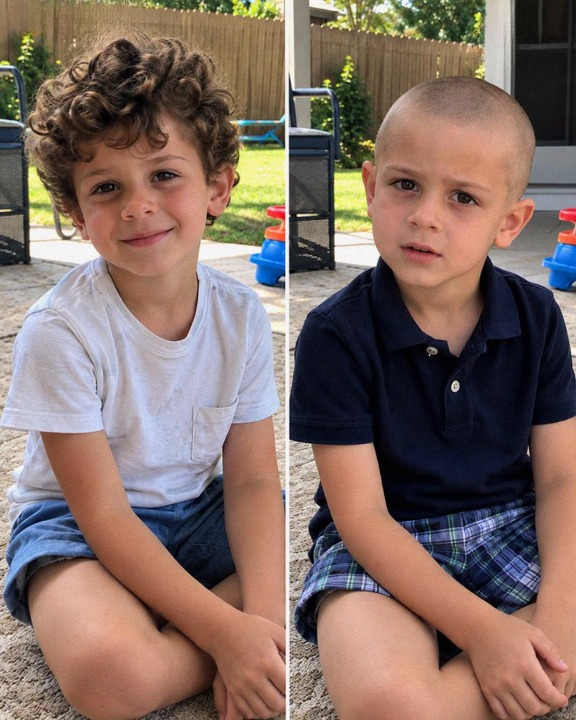
My five-year-old son, Leo, had the kind of curls people noticed the moment they met him.
They were thick, dark, soft, and naturally full of life. Every morning, I carefully washed them, used a little conditioner, and gently shaped them with my fingers. Leo loved his hair, too. Sometimes he’d stand in front of the mirror and make funny faces while his curls bounced around his forehead.
To me, they were simply part of what made him look like himself.
Unfortunately, my mother-in-law, Brenda, had never felt the same way.
From the moment Leo’s hair started getting longer, Brenda had something to say about it.
“Why don’t you cut it?”
“He’d look so much neater with short hair.”
“Those curls make him look messy.”
“He needs a proper haircut.”
At first, I tried to laugh it off.
“Leo likes his hair,” I’d tell her.
She would shrug.
“He’s five. He doesn’t know what’s best for him.”
That sentence bothered me more every time I heard it.
I understood that Brenda was Leo’s grandmother, and I wanted him to have a loving relationship with her. But being his grandmother didn’t mean she got to make decisions that belonged to his parents.
Eventually, I had a direct conversation with her.
“Brenda, I don’t mind you having an opinion about his hair. But please don’t cut it, trim it, or change it without asking me and my husband first.”
She waved her hand dismissively.
“I wouldn’t do anything without permission.”
“Good,” I said. “Because I mean it.”
I thought that settled the matter.
I was wrong.
A few weeks later, we were preparing for Leo’s kindergarten celebration.
We had planned a backyard gathering with some of his classmates, relatives, food, decorations, and a cake we’d ordered especially for him.
Leo was thrilled.
He had been talking about the celebration for days.
He picked out his clothes himself and spent the morning running around the house asking when everyone would arrive.
About two hours before the guests were supposed to come, I realized I had forgotten to pick up the cake.
I immediately started searching for my car keys.
Brenda was visiting that afternoon.
“I can watch Leo while you get the cake,” she offered.
I hesitated.
It would only take twenty minutes.
Leo was already comfortable with his grandmother, and there was no reason I thought I needed to worry.
“Okay,” I said. “I’ll be right back.”
Before leaving, I looked at Brenda.
“Please keep an eye on him. And remember what I said about his hair.”
She smiled.
“Yes, yes. I remember.”
I left.
The bakery was busier than expected, so the trip took slightly longer than planned.
When I finally returned home, I carried the cake carefully through the front door.
“Leo!” I called.
I expected to hear his footsteps.
Instead, there was silence.
Then he appeared from the hallway.
And I froze.
His curls were gone.
Completely gone.
His head had been cut extremely short, with uneven patches around the sides.
For several seconds, I couldn’t process what I was seeing.
Leo looked at me nervously.
“Mom?”
I put the cake down.
“What happened to your hair?”
Before Leo could answer, Brenda walked into the kitchen.
She was holding a dustpan filled with pieces of my son’s hair.
She looked completely satisfied.
“I gave him a haircut.”
I stared at her.
“You did what?”
“He needed it.”
I could hardly believe what I was hearing.
“Brenda, I specifically told you not to touch his hair.”
She sighed.
“I know, but I was helping.”
“You didn’t help. You ignored what I asked you not to do.”
She rolled her eyes.
“It’s only hair. It’ll grow back.”
Then she added something that made me realize she had convinced herself she had done us a favor.
“I’ve always heard that shaving hair makes it grow back thicker.”
I took a breath.
“That’s a common myth. Cutting or shaving hair doesn’t change how thick it grows.”
She shrugged.
“Well, either way, he looks much neater now.”
I looked at Leo.
His eyes were beginning to fill with tears.
“Do you like your haircut, sweetheart?”
He looked down.
“No.”
That one word broke my heart.
Not because his haircut was short.
Hair grows back.
What hurt was that an adult he trusted had made a decision about his body after his parents had clearly said no.
And Leo had no say in it.
I knelt beside him.
“You didn’t do anything wrong.”
He nodded.
Then he quietly asked:
“Are people still coming to my party?”
“Of course they are.”
“Are they going to laugh at me?”
“No.”
I hugged him.
“Your hair doesn’t change who you are. And you don’t have to be embarrassed.”
Behind me, Brenda sighed.
“I think you’re making this much bigger than it needs to be.”
I stood up.
“No. You are the one who made this bigger.”
She looked surprised.
“I gave him a haircut.”
“You gave him a haircut after I specifically told you not to.”
“He’ll survive.”
“This isn’t about whether he’ll survive a haircut.”
My voice remained calm, but I could feel how angry I was.
“It’s about trust.”
Brenda crossed her arms.
“I’ve raised children. I know what I’m doing.”
“And I am Leo’s mother.”
The room went silent.
“You may have raised your children,” I continued, “but that doesn’t give you permission to override me with mine.”
Brenda looked toward the cake.
“So what exactly do you want me to do? Glue his curls back on?”
I didn’t answer immediately.
Instead, I picked up my phone.
I called my husband.
When he answered, I said:
“You need to come home.”
He immediately knew something was wrong.
“What happened?”
“Your mother cut Leo’s hair.”
There was a pause.
“What?”
“She cut it after I specifically told her not to.”
My husband was silent for a moment.
Then he asked to speak with Leo.
Leo told him what happened in his own words.
After the call ended, my husband came home.
Brenda immediately began defending herself.
“I was only trying to make him look presentable.”
My husband looked at Leo.
Then he looked at his mother.
“Mom, we told you not to cut his hair.”
She sighed.
“I thought you were being unreasonable.”
“That’s not your decision.”
Her expression hardened.
“So I’m not allowed to do anything for my grandson?”
“That’s not what anyone said.”
My husband took a breath.
“You’re allowed to love him, play with him, read to him, take him to the park, and spend time with him. But when his parents give you a clear instruction about something involving him, you need to respect it.”
Brenda looked at me.
“So this is all her doing?”
“No,” my husband said. “This is about what you did.”
That seemed to be the moment she realized neither of us was going to back down.
She muttered something about everyone being too sensitive and walked into the living room.
I didn’t argue with her.
Instead, I focused on Leo.
We finished getting ready for his celebration.
I found a soft little cap he liked and asked if he wanted to wear it.
He shook his head.
“I don’t want it.”
“That’s okay.”
He looked at himself in the mirror.
“I think I want to show everybody.”
I smiled.
“Then that’s exactly what we’ll do.”
When the guests arrived, Leo ran outside.
His classmates greeted him excitedly.
Nobody laughed.
Nobody cared.
They were much more interested in the cake, games, balloons, and presents.
One of his friends even touched his short hair and said:
“Cool haircut.”
Leo grinned.
By the end of the afternoon, he was running around the yard as happily as he had been before.
But I knew the issue with Brenda wasn’t over.
That evening, after the guests left, I sat down with my husband.
“We need new rules.”
He agreed.
“We do.”
We decided that Brenda would no longer be left alone with Leo for the time being.
It wasn’t meant as revenge.
It was about rebuilding trust.
If she couldn’t respect something as simple as a parent’s instruction about a child’s haircut, we couldn’t assume she would respect other boundaries.
A few days later, Brenda called.
I expected another argument.
Instead, she surprised me.
“I owe you an apology.”
I didn’t say anything.
She continued.
“I shouldn’t have cut his hair. You told me not to, and I ignored you.”
Then she added:
“I also shouldn’t have dismissed how upset he was.”
That mattered more to me than an apology for the haircut itself.
“Thank you for saying that.”
There was a pause.
“Will you let me see him?”
“Yes. But we’re going to take things slowly.”
“I understand.”
When Leo came into the room, Brenda apologized directly to him.
“I’m sorry I cut your hair without asking your mom and dad.”
Leo looked at her.
“Are you going to cut it again?”
She smiled sadly.
“No.”
“Promise?”
“I promise.”
Leo seemed satisfied.
Then he asked if she wanted to see the toy he’d gotten at his party.
She nodded.
And just like that, the tension began to soften.
His curls eventually grew back.
It took time, but one morning, Leo looked in the mirror and announced:
“My curls are coming back!”
I laughed.
“They are.”
He touched one of the small curls forming near his forehead.
“Grandma won’t cut them, right?”
“No,” I said. “Grandma understands now.”
The experience taught me something I wish I hadn’t needed to learn.
Family relationships require more than love.
They require respect.
A grandparent can have opinions. A relative can disagree with parenting choices. Even people who genuinely believe they’re helping can sometimes make mistakes.
But when a parent clearly says no, that boundary matters.
And when a child says they don’t want something done to them, their feelings matter too.
I didn’t need to punish Brenda.
I didn’t need to humiliate her or create a family feud.
I simply needed to make the boundary clear and follow through with reasonable consequences when she crossed it.
Leo’s haircut was temporary.
His curls grew back.
But the lesson about trust was much more important.
From that day forward, Brenda understood something she should have understood from the beginning:
She could be Leo’s grandmother without trying to become his parent.
And I could protect my son’s boundaries without turning every disagreement into a family war.
Sometimes the strongest response isn’t shouting.
Sometimes it’s simply standing firm, protecting your child, and making it clear that love and respect have to go hand in hand.