For four years, my husband, Thomas, and I had quietly hoped that we would become parents.
What began as an ordinary dream gradually became one of the most difficult experiences of our marriage. There were appointments, medications, injections, procedures, and conversations that seemed to revolve around medical possibilities and disappointing results.
We went through two unsuccessful rounds of IVF. Each attempt brought a mixture of hope and anxiety, followed by another painful disappointment.
Eventually, after years of trying, a specialist gave us news that was incredibly difficult to accept. Carrying a child would be extremely unlikely for me.
It was not something I wanted to discuss at every family gathering. It was not something I wanted people turning into casual conversation. Most importantly, it was not something I wanted anyone making jokes about.
Thomas understood that.
His mother, Susan, did not seem to understand—or perhaps she simply chose not to.
At first, I tried to ignore her comments.
Whenever someone announced a pregnancy, Susan sometimes looked in my direction and made remarks about how fortunate some women were. She would occasionally make comments that reminded me of something I was already struggling to accept.
I tried to tell myself that she did not understand how deeply those words affected me.
Thomas did not share that view.
Whenever his mother crossed a line, he would tell her to stop.
Susan usually dismissed his concerns.
“She knows I don’t mean anything by it,” she would say.
But intent does not always erase the effect of someone’s words.
I began avoiding certain gatherings because I did not want to spend an entire evening wondering whether another comment was coming.
For a while, I even stopped attending baby showers.
It was not because I was unhappy for other people. I genuinely wanted friends and relatives to experience happiness. But sometimes, being surrounded by conversations about pregnancy and newborns was simply too difficult.
Thomas never pressured me.
He supported me in the quiet ways that mattered most.
Then came my thirty-fifth birthday.
Thomas arranged a small dinner with family. I knew Susan would be there, but I tried not to let that overshadow the evening.
When she arrived carrying a small velvet jewelry box, I was surprised.
For a brief moment, I wondered whether perhaps she was finally trying to make amends.
She smiled and handed it to me.
“I had this made especially for you,” she said.
Everyone at the table became curious.
I thanked her and opened the box.
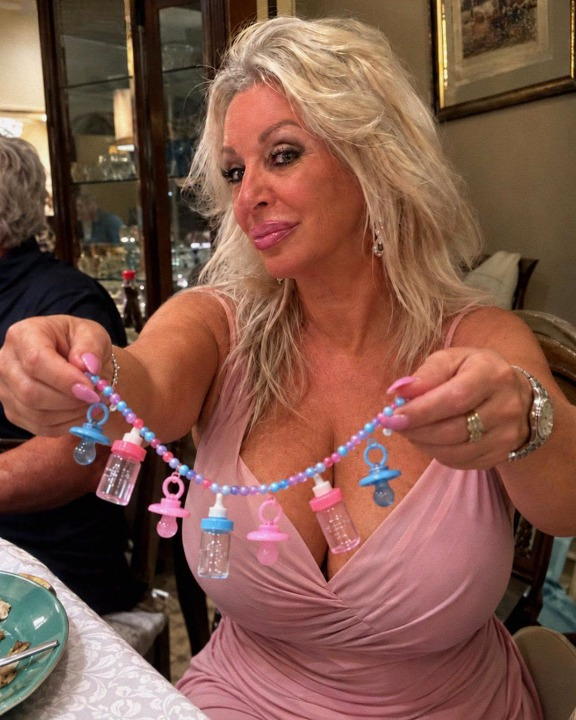
Inside was a necklace decorated with tiny pink and blue baby bottles and miniature pacifiers.
I stared at it without saying anything.
For a moment, I genuinely could not understand why she had chosen that particular gift.
Then Susan laughed.
“Come on,” she said. “It’s cute.”
No one else laughed.
I looked around the table.
The room had suddenly become uncomfortable and quiet.
Susan picked up one of the tiny decorations and examined it as though she had given me something thoughtful.
“Since you won’t be needing the real ones,” she said, “I thought you could at least wear these.”
The words immediately changed the atmosphere.
I felt my face grow warm.
I wanted to disappear from the room.
I had spent years trying to process something deeply personal, and now the subject had been turned into a birthday joke in front of everyone.
Thomas pushed his chair back.
“Mom, what are you doing?”
Susan looked at him with irritation.
“It’s a joke.”
Thomas shook his head.
“No. It’s not.”
She looked toward me.
“She’s always been sensitive about this.”
That sentence hurt almost as much as the gift itself.
It suggested that the problem was my reaction rather than what she had said.
I had spent years trying to become comfortable with something I never expected to face. I had learned to accept that some parts of life would not unfold the way I had imagined.
I did not need everyone to understand what I was feeling.
I only needed them to respect it.
I looked down at the necklace.
I could hear the faint sound of plates and glasses as everyone sat silently.
Then my father-in-law, Matthew, put down his fork.
For years, whenever Susan said something inappropriate, Matthew had usually taken a passive approach.
Sometimes he would tell her that she was simply being herself.
Other times, he would encourage everyone to move on.
I had never expected him to become involved in an argument between Susan and me.
But this time was different.
Matthew reached toward the jewelry box.
“You had this made?” he asked Susan.
She smiled.
“Yes. It took me forever to find those little bottles.”
Matthew looked at the necklace for several seconds.
Then he looked at Susan.
“So you had plenty of time to think about what you were doing.”
Her expression changed.
“Matthew…”
He did not raise his voice.
That somehow made his words even more serious.
“You knew what she had been through,” he said. “You knew about the treatments. You knew about the failed attempts. You knew what the doctors told her.”
Susan became defensive.
“I didn’t mean anything by it.”
Matthew shook his head.
“You don’t get to decide that something doesn’t hurt someone simply because you call it a joke.”
The table remained completely silent.
Thomas looked at his father, apparently surprised.
Matthew continued.
“There are things you don’t joke about. Someone’s inability to have children is one of them.”
Susan looked embarrassed.
“I was trying to make her laugh.”
“No,” Matthew replied. “You were making yourself laugh.”
Nobody spoke.
I could feel tears forming, but this time they were not only tears of hurt.
There was also relief.
For years, I had wondered whether I was overreacting when Susan made comments about my infertility.
Now someone else was saying clearly that the behavior was inappropriate.
Matthew placed the necklace back inside the box.
Then he turned to me.
“I’m sorry,” he said. “I should have spoken up much earlier.”
That apology affected me more than I expected.
I had never asked him to take sides.
I had never expected him to fix the situation.
But hearing someone acknowledge that the behavior had gone too far meant something.
Susan looked at him in disbelief.
“You’re seriously doing this now?”
Matthew nodded.
“Yes. I’m doing it now because I should have done it before.”
The room remained quiet.
Thomas reached across the table and took my hand.
His support had never been in doubt, but having his father finally recognize what had been happening made the moment different.
Susan eventually sat down.
Nobody continued eating for several minutes.
The birthday dinner had changed completely.
What was supposed to be a celebration had become a conversation about boundaries, respect, and the consequences of turning someone’s personal struggle into entertainment.
I did not want an argument.
I did not want Susan humiliated.
I simply wanted her to understand that my infertility was not a punchline.
It was a deeply personal experience that had already taken an emotional toll on me.
I had spent years going through treatments and procedures while trying to remain hopeful.
There were days when I felt strong.
There were other days when I struggled.
That did not make me overly sensitive.
It made me human.
Eventually, I spoke.
“I don’t expect you to understand exactly how I feel,” I told Susan. “But I need you to respect it. You don’t have to know what to say. You just have to stop making jokes about it.”
She did not answer immediately.
For once, she did not have a quick response.
Matthew looked at her.
Thomas continued holding my hand.
And for the first time in years, I felt that the family had finally acknowledged the seriousness of what I had been experiencing.
The necklace itself was only a small object.
But what it represented was much bigger.
It represented years of painful memories being reduced to a joke.
It represented the difference between someone saying they care and actually respecting another person’s boundaries.
Most importantly, it reminded me that I did not have to pretend something was harmless simply because another person called it a joke.
That night taught me something I wish I had understood much earlier: sometimes, setting a boundary is not about starting a conflict.
Sometimes, it is about making it clear that certain parts of your life deserve dignity.
My fertility journey had already changed me.
I had learned patience.
I had learned how to deal with disappointment.
I had learned that other people’s milestones could be celebrated without requiring me to ignore my own emotions.
And on that birthday, I learned something else.
I did not have to remain silent simply to keep everyone else comfortable.
Thomas had stood beside me throughout the hardest years.
And when his father finally spoke up, the family was forced to confront something that had been ignored for far too long.
The necklace was eventually put away.
I never wore it.
But I also stopped allowing it to define that night.
My birthday had begun with an uncomfortable gift and an unexpected insult.
It ended with something I had needed for a long time: recognition that my feelings mattered and that certain boundaries deserved to be respected.
Sometimes the most meaningful support does not come in the form of a grand gesture.
Sometimes it is simply someone finally saying, “That was wrong,” when everyone else has been too uncomfortable to say it.
And that was exactly what Matthew did.
He did not erase the years of hurt.
He could not change what had already happened.
But by finally speaking up, he made one thing clear: my pain was not something the family should turn into a joke.
From that point forward, I decided that I would no longer apologize for protecting my own emotional boundaries.
My journey was mine.
My feelings were valid.