Last Tuesday started like any other morning, but by the time I opened my eyes, I knew something was wrong.
I felt exhausted, my entire body ached, and even swallowing water was uncomfortable. When I checked my temperature, I discovered that I had a fever.
I had been looking forward to a normal day at home, but suddenly even getting out of bed felt like a challenge.
My husband, Nathan, took one look at me and immediately became concerned.
“You should stay in bed today,” he told me. “I’ll take care of anything I can before I leave for work.”
I assured him I would be fine, but he wasn’t convinced.
Before heading out, he reminded me to rest and not worry about cooking.
“We’ll figure out dinner later,” he said. “Your only job today is to get some rest.”
I was grateful for his concern.
Nathan and I had been married for several years, and although our lives weren’t perfect, I always appreciated the way he usually supported me when I wasn’t feeling well.
That morning, I spent most of my time in bed.
Around three o’clock, I started thinking about our children. They would be home from school soon, and I knew they would be hungry.
I didn’t have the energy to prepare a meal, so I decided to order dinner.
I chose chicken soup for myself, pasta for the children, and Nathan’s favorite meal for him. I figured that by the time he came home, everyone could simply sit down and eat.
It wasn’t an extravagant order. I just wanted something easy.
When the children came home, they checked on me before going downstairs. They were surprisingly understanding and kept their voices low because they knew I wasn’t feeling well.
For a while, everything was peaceful.
Then the doorbell rang.
I assumed it was the delivery driver.
But when I heard the front door open, I recognized another voice.
My mother-in-law, Angela, had arrived.
Angela and I had never been especially close.
She wasn’t openly hostile toward me, but she had very traditional ideas about marriage and family responsibilities. In her opinion, a wife was supposed to manage the home, prepare meals, keep everything organized, and make sure everyone else was comfortable.
Even when I was working long hours, she sometimes suggested that I should be doing more around the house.
That afternoon, I wasn’t in the mood for an argument.
I came downstairs slowly and found her standing near the kitchen.
She looked at me from head to toe.
“You’re still in bed?”
“I have a fever,” I explained.
She frowned.
“I didn’t realize it was that serious.”
“I’m just trying to rest.”
Before I could say anything else, the doorbell rang again.
The food had arrived.
I asked Angela if she could bring the bags inside because I was feeling weak.
She nodded without saying much.
I went back upstairs.
About ten minutes later, I heard movement downstairs.
Then I heard the children asking where their dinner was.
I assumed Angela was putting everything on the table.
I was wrong.
When I eventually made my way downstairs, I stopped at the bottom of the staircase.
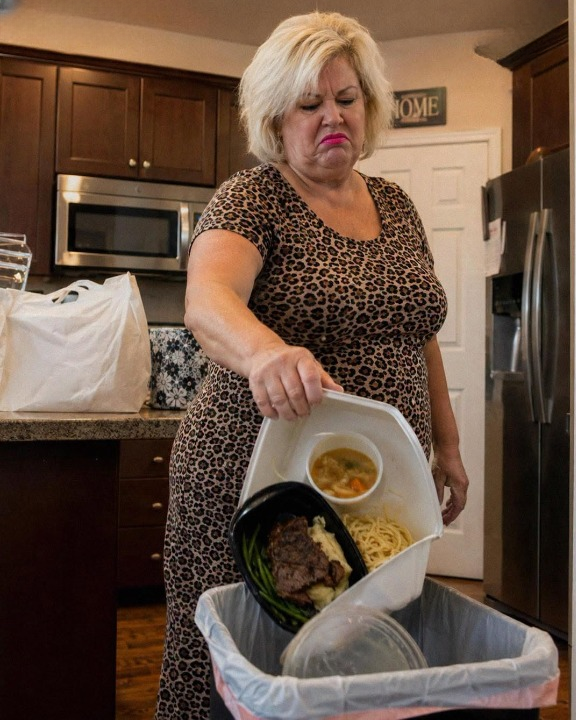
Angela was standing beside the kitchen trash can.
Inside were several sealed food containers.
The children’s pasta.
Nathan’s dinner.
Even my chicken soup.
For a moment, I couldn’t understand what I was seeing.
“Angela, why is all the food in the trash?”
She turned around.
“I didn’t think this was appropriate.”
I stared at her.
“What do you mean?”
“You ordered dinner instead of preparing it yourself.”
I reminded her that I was sick.
She responded that families should still have proper meals and that ordering food wasn’t the right solution.
I was too tired to argue.
The children stood nearby, looking confused.
I could tell they were hungry, but they also seemed uncomfortable because they didn’t want to get involved in an adult disagreement.
I tried to explain that I had ordered the food because I wasn’t feeling well and simply wanted everyone to have something to eat.
Angela disagreed.
She believed that being sick didn’t remove a person’s responsibilities at home.
That comment hurt more than I expected.
I had spent years balancing work, parenting, household responsibilities, and everything else that comes with family life.
I wasn’t asking anyone to praise me.
I simply wanted one day to recover.
Instead, I felt as though I was being judged for something completely ordinary.
By the time Nathan arrived home, I was sitting quietly at the kitchen table.
The children were eating simple snacks because the dinner I had ordered was gone.
Nathan immediately noticed the unusual atmosphere.
He looked at me.
Then he looked at the trash.
Finally, he turned toward his mother.
“Mom, what happened?”
Angela explained her version of events.
She said she believed she was helping the family by preventing everyone from relying on takeout.
Nathan listened without interrupting.
I expected him to become angry.
Instead, he remained remarkably calm.
He asked me how I was feeling.
I told him I still had a fever and felt exhausted.
He immediately told the children to stay with me while he figured out dinner.
Then he looked at his mother.
“Mom, I understand that you have your opinions about how a household should work.”
Angela nodded.
“But this is our household,” Nathan continued. “And when my wife is sick, I don’t expect her to prove anything by pushing herself.”
The room became quiet.
Angela didn’t seem prepared for that response.
Nathan then explained that ordering dinner wasn’t a failure.
It was simply a practical decision.
Sometimes families cook.
Sometimes they order food.
Sometimes one person does more because the other needs rest.
That was what partnership meant to him.
I could see Angela becoming uncomfortable.
But Nathan wasn’t finished.
He told her that he appreciated the fact that she cared about him, but caring about someone didn’t mean making decisions for them or criticizing another person when they were already struggling.
His words were respectful, but firm.
Then he did something I didn’t expect.
He picked up his phone and called a nearby restaurant.
He ordered dinner for everyone.
When he hung up, he smiled.
“Problem solved.”
The children immediately cheered.
For the first time that evening, I laughed.
Angela remained quiet.
She seemed to realize that Nathan wasn’t trying to embarrass her or start an argument. He was simply establishing a boundary.
A few minutes later, she asked if she could speak with him privately.
They stepped into the living room.
I couldn’t hear everything they discussed, and I didn’t try to listen.
When Nathan returned, he looked thoughtful.
“She’s upset,” he said.
“I figured.”
“But she understands that she crossed a line.”
I nodded.
Later that evening, Angela came upstairs.
She stood in the doorway for a moment before speaking.
“I owe you an apology.”
I wasn’t expecting that.
She admitted that she had been too focused on her own ideas about marriage and had forgotten that every family has to find its own balance.
She also acknowledged that throwing away food that someone had purchased wasn’t her decision to make.
I accepted her apology.
We didn’t suddenly become best friends, and I don’t think either of us expected that.
But something changed that evening.
There was a new understanding between us.
Angela realized that she couldn’t manage our household according to her own expectations.
And I realized that I didn’t need to defend every choice I made simply because someone disagreed with it.
The most important lesson came from Nathan.
He didn’t insult his mother.
He didn’t humiliate her.
He didn’t turn the situation into a competition between his wife and his parent.
He simply stood beside the person who was sick, explained what was acceptable in our home, and made it clear that respect had to go both ways.
The following morning, my fever was lower.
I woke up to find a tray beside my bed.
There was a glass of water, some toast, and a note from Nathan.
It said:
“Today, you rest. Everything else can wait.”
I smiled.
A few hours later, another message arrived.
This one was from Angela.
She asked how I was feeling and offered to bring over some homemade soup.
I thanked her.
This time, there was no criticism and no lecture.
Just a simple offer to help.
And that was enough.
Looking back, the argument wasn’t really about dinner.
It was about expectations, boundaries, and the difference between helping someone and trying to control them.
Families don’t always agree.
People can have different ideas about marriage, parenting, cooking, work, and household responsibilities.
But when someone is sick, kindness should come before criticism.
And sometimes the strongest response isn’t an angry confrontation.
Sometimes it’s a calm explanation, a clear boundary, and the willingness to treat everyone involved with dignity.
That evening taught me something I’ll never forget.
Being part of a family doesn’t mean everyone has to do things the same way.
It means making room for one another, especially when someone needs a little extra support.
And, occasionally, it means ordering dinner without feeling guilty about it.