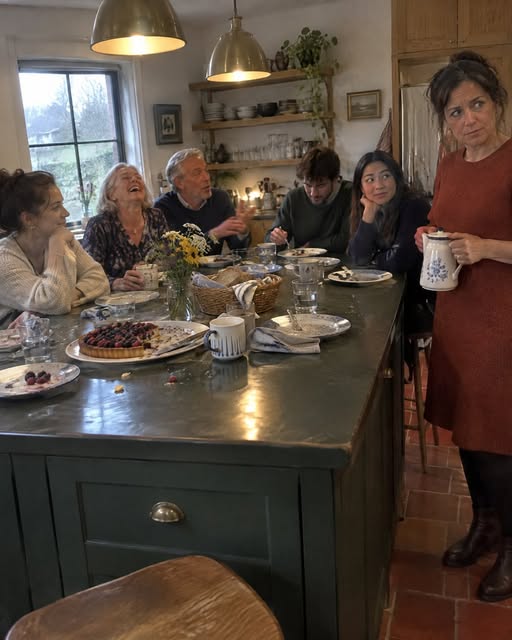
My Husband’s Family Thought I Couldn’t Understand German—Then I Heard What They Were Planning
For almost two years, I had been learning German in secret.
My husband knew I had always been interested in languages, but he had no idea how far I had taken it.
Neither did his parents.
Neither did his sister.
That was probably why they felt so comfortable speaking German around me.
They assumed their private conversations were protected by a language I couldn’t understand.
Sometimes they used it to make jokes.
Sometimes they discussed family matters.
And sometimes, I later realized, they were talking about me while I sat only a few feet away.
I had become accustomed to the little comments.
His sister Marta would occasionally look at my clothes and whisper something to his mother.
They would exchange a smile.
If I asked what they were talking about, my husband, Julian, would usually kiss my cheek and say,
“Nothing important, Claire.”
I always believed him.
At least, I tried to.
For years, I had trusted Julian completely.
We had been married for ten years, and during most of that time, I believed we were building the kind of marriage people hoped to have when they made their vows.
We had disagreements.
We had stressful periods.
We had experienced financial worries and family conflicts.
But I never believed there was another woman.
And I certainly never imagined that one Sunday evening, while sitting at his parents’ dining table, I would understand a conversation that would completely change how I saw my marriage.
It began with a name.
Sophie.
Julian’s former girlfriend.
At first, I didn’t think much of it.
People sometimes mention former relationships during family conversations. I assumed Sophie had simply come up because someone had seen her recently or heard from a mutual acquaintance.
Then Julian said something that made my stomach tighten.
“She’s almost five months along.”
The room became strangely quiet.
I was standing in the kitchen doorway, holding a serving plate.
Julian’s father, Klaus, slowly lowered his fork.
Marta looked at her brother.
His mother, Helga, leaned forward.
“Five months?” she asked.
Julian nodded.
“Almost.”
I stared at him.
Five months.
My mind immediately began calculating dates.
Only three weeks earlier, Julian and I had celebrated our tenth wedding anniversary.
He had taken me to an expensive restaurant downtown.
We had sat across from each other beneath warm lights while a pianist played quietly in the background.
He had held my hand.
He had told me that he loved me.
And he had said something else that night.
“We should keep trying,” he had told me. “I still believe we’ll have our family.”
I had believed him.
For six years, we had been trying to have a child.
There had been appointments, consultations, tests, medications and treatments.
There were months when I convinced myself that this would finally be the month.
There were other months when I couldn’t bring myself to take another pregnancy test because I already knew what the result would be.
Julian had been beside me through much of it.
Or at least I thought he had been.
He had seen me cry in our bathroom.
He had held my hand in waiting rooms.
He had told me that our marriage mattered more than whether we ever became parents.
“If it doesn’t happen,” he once said, “we’ll still have each other.”
Those words had meant everything to me.
Now they felt completely different.
Because sitting in his parents’ home, I was hearing that another woman was nearly five months pregnant with what Julian believed was his child.
And his entire family already knew.
The realization was almost impossible to process.
I quietly stepped back into the kitchen.
I needed a few seconds to breathe.
The cheesecake was still waiting on the counter.
I had prepared it that afternoon because Helga had once mentioned that it was Julian’s favorite dessert.
My hands were shaking as I cut the slices.
Then I heard Marta’s voice from the dining room.
“What are you going to tell Claire?”
I froze.
Julian answered.
“Not yet.”
There was a brief pause.
“She still thinks Sophie moved away.”
Someone laughed softly.
Klaus said something I couldn’t quite make out.
Then Helga spoke.
“We’ll deal with it.”
I continued cutting the cheesecake.
I had never been so aware of every sound around me.
The scrape of a fork against a plate.
The ticking of the clock.
The hum of the refrigerator.
My own breathing.
Then Helga said something in German.
This time, I understood every word.
“Don’t worry. We’ll make her raise the baby.”
They laughed.
I stood motionless in the kitchen.
For a moment, I thought about walking into the dining room and asking them to repeat themselves.
Instead, I picked up the dessert plates.
I walked back to the table.
I smiled.
I placed a slice of cheesecake in front of each person.
Nobody seemed to notice anything unusual.
Helga thanked me.
Marta smiled.
Julian looked at me affectionately.
Then he reached beneath the table and rested his hand on my knee.
I looked at him.
He smiled.
If he noticed that my expression had changed, he didn’t say anything.
“Coffee?” I asked.
“Please,” Helga replied.
I went back to the kitchen.
As I poured the coffee, I heard Julian say something in German.
His family laughed.
Then I heard him say,
“See? She doesn’t understand anything.”
I closed my eyes for a moment.
Then I continued pouring.
The Secret I Had Kept From Them
My ability to understand German hadn’t happened by accident.
Almost two years earlier, I had decided to learn the language because I wanted to communicate better with Julian’s family.
His parents had grown up speaking German, and although they spoke English perfectly well, they often returned to German when they were together.
I initially found it charming.
I thought learning a few phrases would make family gatherings easier.
So I downloaded a language app.
Then another.
I started watching German-language videos during my lunch breaks.
Eventually, I signed up for online lessons.
A few months later, I found an evening class at a community center.
I kept going.
I practiced while cooking.
I listened to German podcasts while driving.
Sometimes I would sit in bed with headphones in, quietly repeating sentences while Julian slept beside me.
He knew I was studying.
He simply didn’t know how much I had learned.
And that was the part that made everything from that evening so unsettling.
They hadn’t merely misunderstood my ability.
They had built an entire sense of security around it.
They believed they could say anything in German and I would remain unaware.
At first, that had been harmless.
Now it had become the reason I knew something my husband clearly didn’t want me to know.
The Night I Couldn’t Sleep
When we finally returned home, Julian behaved as though nothing had happened.
He changed clothes.
Brushed his teeth.
Checked his phone.
Then climbed into bed.
Within minutes, he was asleep.
I remained awake.
I stared at the ceiling.
The conversation kept replaying in my mind.
Sophie was pregnant.
Julian believed the baby was his.
His parents knew.
His sister knew.
And they had already discussed what would happen to me.
They assumed I would somehow become involved in raising that child.
Why?
Because they knew how much I wanted to be a mother.
That realization hurt almost as much as the pregnancy itself.
They had taken something deeply personal about me and apparently turned it into part of their plan.
I quietly got out of bed and went downstairs.
I made tea and sat at the kitchen table.
Then I opened a notebook.
I wrote down everything I remembered from the conversation.
Every sentence.
Every name.
Every date.
I didn’t want to rely on emotion or memory alone.
I wanted facts.
Once I finished, another thought occurred to me.
Julian had taken eleven business trips during the previous year.
At the time, I had never questioned them.
Some had included hotel confirmations.
Some had airline reservations.
Some had emails from his company.
They appeared legitimate.
But now I wondered whether I had ever looked closely enough.
I opened my laptop.
I began reviewing the dates.
One trip immediately caught my attention.
Julian had told me he was attending a client meeting on a Friday.
But the hotel reservation showed a Thursday check-in and Sunday checkout.
Another trip involved a city where Sophie had once lived.
That could have been completely coincidental.
I reminded myself of that.
I didn’t want to create a story in my head before I knew the truth.
So I kept investigating quietly.
I wrote down what I knew.
I separated facts from assumptions.
I didn’t accuse anyone.
I didn’t call Julian’s parents.
I didn’t contact Sophie.
I simply gathered information.
At around seven in the morning, my phone rang.
The number wasn’t saved.
I stared at it.
Normally, I would have ignored an unknown caller.
For some reason, I answered.
“Hello?”
A woman’s voice responded.
“Is this Claire Bennett?”
My heart began beating faster.
“Yes.”
There was a long pause.
Then she said,
“My name is Sophie.”
I couldn’t speak.
For several seconds, neither of us said anything.
Finally, I asked,
“Why are you calling me?”
Her voice became quieter.
“Because I think you deserve to know what Julian has been telling people.”
I sat down.
“What do you mean?”
Sophie took a breath.
“I don’t know what you’ve been told about me. But I was under the impression that you already knew.”
“Knew what?”
Another pause.
“That Julian and I haven’t been together for years.”
“I know.”
“Then you also know the baby isn’t his.”
I stopped breathing for a second.
“What?”
“The baby isn’t Julian’s.”
I gripped the edge of the table.
“Then why did he tell his family it was?”
“I don’t know,” Sophie said. “That’s why I called you.”
A Conversation I Never Expected
Sophie explained that she had contacted Julian several months earlier.
She had been trying to resolve an old financial matter connected to a business they once shared.
During the conversation, Julian asked about her pregnancy.
She told him the baby belonged to someone else.
According to Sophie, Julian seemed surprised.
She assumed he had misunderstood something.
Later, she learned that Julian had apparently been telling his family that he was the father.
“I didn’t understand why,” she said.
“Did you ever have a relationship with him after our marriage?”
“No.”
Her answer was immediate.
“We ended things years before you two got married.”
I felt a strange mixture of relief and confusion.
“Then why would he tell them that?”
“I don’t know.”
Neither did I.
But suddenly the situation looked different.
There was still a serious problem.
Just not the one I had first imagined.
Julian had created a story about Sophie and her unborn child.
And his family had believed him.
But there was another question.
Why?
Sophie said she had one more thing to tell me.
“Julian contacted me recently.”
“When?”
“About three weeks ago.”
Three weeks.
Our anniversary.
The night he had told me we should keep trying for a baby.
“What did he want?”
“He asked whether I’d consider letting him be involved with the child after it was born.”
I felt sick.
“Did you agree?”
“No.”
Sophie sounded almost offended by the suggestion.
“I told him the child had a father and that I wasn’t interested in creating confusion.”
I closed my eyes.
“So he told his family you were carrying his child anyway.”
“Apparently.”
We stayed on the phone for nearly an hour.
Sophie gave me information about the conversations she had had with Julian.
She offered to send me messages that confirmed what she was saying.
I thanked her.
Then I asked one final question.
“Why did you call me?”
She was quiet for a moment.
“Because if I were in your position, I’d want someone to tell me.”
After we hung up, I sat at the kitchen table for a long time.
I no longer knew what was real.
But I knew what I needed to do.
I needed to talk to my husband.
Not in anger.
Not in front of his family.
And not before I had organized my thoughts.
The Conversation With Julian
That evening, Julian came home expecting an ordinary dinner.
I cooked.
We ate.
We talked about small things.
Then I placed my fork on the table.
“We need to talk about Sophie.”
His face changed immediately.
It lasted only a second.
But I saw it.
“What about her?”
“She’s pregnant.”
He looked down.
“Who told you?”
“Does it matter?”
He didn’t answer.
I continued.
“I know you’ve been telling your family that the baby is yours.”
Julian’s face became pale.
“Claire—”
“And I know that’s not true.”
He stood up.
I remained seated.
For the first time in our marriage, I saw my husband struggle to find words.
Finally, he sat down again.
“I made a mistake.”
“A mistake?”
“I was afraid.”
“Of what?”
He looked at his hands.
“I thought my parents would blame me for our fertility problems.”
I stared at him.
He explained that after years of failed fertility treatments, his parents had repeatedly asked questions.
They wanted grandchildren.
They made comments.
They compared our situation with other relatives.
Julian said that over time, he became embarrassed and frustrated.
When Sophie became pregnant, he began telling his family that the baby might be his.
Then “might” gradually became “is.”
And once the story existed, he didn’t know how to correct it.
I listened quietly.
Then I asked the question that mattered most.
“Why did you tell them I would raise the baby?”
He looked shocked.
“I never said that.”
“You didn’t?”
“No.”
I repeated the German sentence I had heard.
His expression changed.
“That was my mother.”
“And you laughed.”
“I didn’t understand what she meant.”
“You understood enough to laugh.”
He looked away.
I realized then that the biggest problem wasn’t the language.
It wasn’t Sophie.
It wasn’t even the pregnancy.
It was trust.
For years, Julian had allowed his family to speak about me as though I weren’t present.
For years, he had dismissed my questions.
“Nothing important.”
Now I understood that those words had protected more than jokes.
They had protected conversations he didn’t want me to hear.
The Family Meeting
Two days later, Julian agreed to tell his parents the truth.
We went to their house together.
Helga opened the door.
She immediately smiled.
Then she looked at me.
“Claire.”
I returned the greeting.
We sat around the same dining table where I had heard the conversation.
This time, I wasn’t carrying dessert.
I was there to listen.
Julian began.
“I need to correct something.”
His mother looked at him.
“Sophie isn’t carrying my child.”
Nobody spoke.
Klaus stared at his son.
Marta looked confused.
Helga’s face hardened.
“What are you talking about?”
“I lied,” Julian said.
The silence that followed was uncomfortable.
I watched his family process the information.
Then I spoke.
“And I understand German.”
Marta looked at me.
Helga’s expression changed completely.
“You…”
“Yes.”
I explained that I had been learning for nearly two years.
I told them I had initially done it because I wanted to be closer to the family.
Nobody laughed.
Nobody made a joke.
Instead, Helga lowered her eyes.
I told them I had heard their conversations.
I didn’t repeat every insult or private comment.
I didn’t need to.
The important thing was that I understood now.
Julian apologized.
His father eventually did too.
Marta admitted that she had made jokes about me because she believed I couldn’t understand.
None of their explanations erased what had happened.
But at least, for the first time, everyone was speaking honestly.
What Happened Next
The following weeks were difficult.
Julian and I started counseling.
We also agreed that we needed clearer boundaries with his family.
Sophie was no longer part of our marriage story.
She had her own life and her own family, and I had no reason to remain involved in the situation beyond knowing the truth.
Julian also apologized directly to her for the confusion he had created.
He told his parents that they had no role in deciding who would raise another person’s child.
That was an important conversation.
Because even though the pregnancy wasn’t connected to our marriage in the way everyone had originally believed, the deeper issue remained.
My husband had allowed his family to treat my personal struggles as something they could discuss without me.
And I had spent too many years pretending not to notice.
Eventually, I made another decision.
I stopped trying so hard to earn approval from people who had never bothered to understand me.
I continued learning German.
But I no longer learned it in secret.
One evening, I sat at the kitchen table with Julian and opened my language notebook.
He smiled.
“You’re getting really good.”
I laughed.
“Better than you thought.”
He nodded.
“Definitely.”
There was something strangely freeing about that moment.
For almost two years, German had been my secret.
Now it was simply another part of my life.
What I Learned From That Sunday
I used to think the most painful part of discovering a secret was the secret itself.
Now I believe it’s what the secret reveals about the relationship around it.
Julian’s lie about Sophie wasn’t just about a pregnancy.
It revealed how afraid he had become of disappointing his family.
His parents’ comments revealed how much pressure they had placed on him.
And my silence revealed something about me too.
I had become so accustomed to being told that certain conversations were “nothing important” that I stopped asking questions.
That was the part I needed to change.
Marriage cannot survive on appearances alone.
Neither can families.
If something matters, people deserve the opportunity to talk about it honestly.
And if someone repeatedly excludes you from conversations about your own life, pretending not to notice will not make the problem disappear.
I don’t know what the future holds for Julian and me.
We are still working through what happened.
Some wounds take time.
But I do know this:
I wi