When my six-year-old granddaughter, Lily, handed me a drawing with the words “I LOVE YOU NANA” written across the top in wobbly purple letters, I nearly cried.
To anyone else, it probably looked like a simple child’s picture.
There was a yellow sun in one corner, a house that leaned slightly to the left, three flowers much taller than the people standing beside them, and two stick figures holding hands.
One was Lily.
The other was me.
She had even drawn my gray curls as a giant cloud around my head.
“This is you, Nana,” she explained proudly.
“I gathered that.”
“And this is me.”
“I like your dress.”
“It’s not a dress. It’s my superhero cape.”
I laughed.
“Of course it is.”
Then Lily pointed to the words she’d carefully written across the top.
“I wrote that part myself.”
I pulled her into my arms.
“I love you too, sweetheart.”
What Lily couldn’t understand at six years old was how much that picture meant to me.
I didn’t have the kind of childhood people remember fondly.
My parents loved me in their own way, but our home was chaotic. There were arguments, long silences, and years when affection seemed almost nonexistent.
As a little girl, I used to watch other families at school events and wonder what it would feel like to live in a house where people hugged each other just because they wanted to.
I promised myself that if I ever had children, my home would be different.
Years later, I had a daughter.
Then she had Lily.
And somehow, that messy little drawing represented everything I had once thought I might never have.
A family that said “I love you” freely.
A granddaughter who ran into my arms whenever she saw me.
A home filled with photographs, birthday cards, laughter, and crayon drawings taped to the refrigerator.
I wanted to keep the picture forever.
A few days later, I told my husband, Rob, what I was thinking.
“I might get Lily’s drawing tattooed on my arm.”
Rob was reading something on his phone.
He glanced up.
“The whole thing?”
“Probably just the little drawing of us and her handwriting.”
He shrugged.
I waited for a stronger reaction.
None came.
“You don’t mind?”
“It’s your arm.”
That sounded like permission—or at least indifference—to me.
Rob and I had been married for thirty-four years.
He’d never particularly liked tattoos, but neither of us had one, so it wasn’t something we’d ever argued about.
I assumed he thought my idea was sentimental but harmless.
A few days later, I made the appointment.
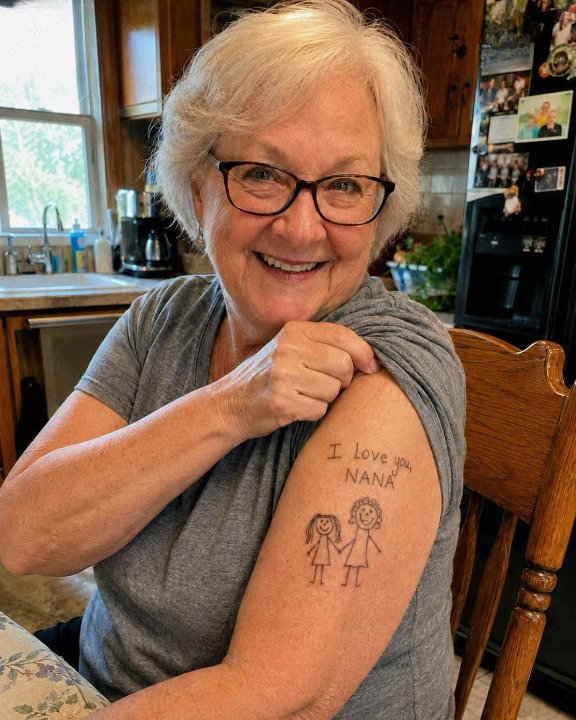
I brought a copy of Lily’s drawing to the artist and asked her to preserve the imperfections.
I didn’t want the handwriting cleaned up.
I didn’t want the stick figures made prettier.
I wanted it exactly the way Lily had drawn it.
When the tattoo was finished, it wasn’t large.
It sat on the inside of my forearm.
Two tiny stick figures.
A crooked flower.
And above them:
I LOVE YOU NANA.
The moment Lily saw it, she screamed.
“You put my picture on you!”
“I did.”
“Forever?”
“Pretty much.”
She stared at my arm in amazement.
Then she threw both arms around my neck.
“Now you can never forget me.”
I laughed.
“As if that were possible.”
For the rest of the afternoon, Lily showed my tattoo to everyone she could find.
“My Nana has my art!”
Seeing how happy she was convinced me I’d made the right decision.
Then I went home.
Rob was in the kitchen when I walked in.
I put my bag down.
“Well?”
He looked at me.
“Well what?”
“I did it.”
I held out my arm.
His expression immediately changed.
“What is that?”
I laughed nervously.
“The tattoo I told you about.”
“You actually did it?”
His voice was so sharp that I lowered my arm.
“Yes.”
Rob stared at it.
Then his face tightened.
“I thought you were joking.”
“I asked if you minded.”
“You said you were thinking about it.”
“And you said it was my arm.”
“That doesn’t mean I thought you’d actually go through with it.”
I was confused.
“Why are you so angry?”
“Because it looks ridiculous.”
That hurt.
“It’s a child’s drawing.”
“Exactly.”
I stared at him.
“It’s Lily’s drawing.”
“I know whose it is.”
Then he said something I never expected from the man I’d been married to for more than three decades.
“Tattoos are trashy.”
My mouth fell open.
“Excuse me?”
“You heard me.”
Rob walked around the kitchen as though he were too irritated to stand still.
“You’re sixty-three years old, and suddenly you’re getting tattoos?”
“I’m not suddenly covering my body in tattoos. I got one small drawing from my granddaughter.”
“You’ve ruined your arm.”
“Ruined?”
“Yes.”
I couldn’t believe the conversation.
Then he said something even worse.
“I don’t find it attractive.”
For a second, I simply stared at him.
“Are you saying you’re not attracted to me because of this?”
He didn’t answer.
That silence hurt more than if he had said yes.
We argued.
I told him he was being cruel.
He told me I had made a major decision without discussing it properly.
I reminded him that I had discussed it.
He insisted that mentioning something once wasn’t the same as getting his approval.
That made me angry all over again.
“I didn’t know I needed your approval to do something to my own arm.”
“That’s not what I meant.”
“It certainly sounds like it.”
By the end of the evening, Rob was demanding that I look into laser removal.
I refused.
For the next several days, he barely spoke to me.
He slept facing the opposite direction.
He left for work early.
If I tried to discuss what had happened, he said he wasn’t ready.
At first, I was furious.
Then doubt crept in.
Was I being stubborn?
Was a tattoo worth creating this much tension in a thirty-four-year marriage?
I would look at my arm and think about Lily’s face when she saw it.
Then I would think about Rob avoiding me.
One evening, I even searched tattoo removal online.
I closed the page almost immediately.
The idea of explaining the missing tattoo to Lily made my heart ache.
She would ask why I’d removed her drawing.
What was I supposed to tell her?
Grandpa didn’t like it?
That felt terrible.
Eventually, I called Rob’s younger brother, Mark.
Mark and I had always gotten along.
He’d been Rob’s best man at our wedding and had the unusual ability to tell his brother uncomfortable truths without starting a war.
“I need advice,” I told him.
“That’s dangerous.”
“I’m serious.”
“So am I.”
I explained everything.
The tattoo.
Rob’s reaction.
His demand that I remove it.
For a long moment, Mark didn’t say anything.
Then he sighed.
“Oh.”
“What does ‘oh’ mean?”
“Rob really hasn’t told you?”
“Told me what?”
Mark sounded confused.
“I thought you knew.”
“Knew what?”
He hesitated.
Then he said, “He’s not really angry about the tattoo.”
I sat straighter.
“What?”
“The tattoo is part of it, but that’s not what set him off.”
“Then what did?”
Mark sighed.
“Don’t you know what Lily said to him?”
My heart skipped.
“Lily?”
“Yes.”
Our sweet six-year-old granddaughter?
“What could Lily possibly have said?”
Mark became quiet.
Then he answered.
“She asked him why he never tells you that he loves you.”
I stopped breathing for a second.
“What?”
“Apparently she was showing him your tattoo before you got home.”
I remembered.
Rob had watched Lily that afternoon for about an hour while my daughter and I ran an errand.
Mark continued.
“She told him she drew it because you always tell her you love her.”
My throat tightened.
“Okay…”
“Then she asked Rob why he never says it to you.”
I didn’t know what to say.
Rob wasn’t an affectionate man.
He never had been.
That didn’t mean he’d never said “I love you,” but after thirty-four years, the words had become rare.
We had routines instead.
He filled my car with gas.
I packed his lunch.
He made coffee every morning.
I reminded him about appointments.
We had somehow allowed acts of service to replace actual expressions of affection.
Mark continued.
“Lily asked him if he still loved you.”
I closed my eyes.
“And?”
“He told her of course he did.”
“What did she say?”
Mark hesitated.
“She said, ‘Then how does Nana know if you never tell her?’”
I felt something inside me shift.
A child’s question.
Simple.
Innocent.
And apparently devastating.
Mark said Rob had laughed it off initially.
But later, he called Mark.
“He was upset.”
“Why?”
“Because Lily’s question got to him.”
I looked down at the tattoo.
“Then why attack me?”
“Because Rob isn’t good with embarrassment.”
That was painfully true.
“When he feels exposed, he gets defensive.”
Mark continued.
“He said that tattoo made him feel like Lily had given you something permanent and meaningful, while he’d spent years assuming you’d always know how he felt without him saying it.”
I was stunned.
“So he called me trashy because he felt guilty?”
“I’m not defending what he said.”
“Good.”
“He handled it terribly.”
“That is an understatement.”
Mark sighed.
“But I think seeing the tattoo reminded him of the conversation with Lily, and instead of admitting it hurt, he got angry.”
I thanked Mark and hung up.
Then I sat alone at the kitchen table for nearly an hour.
Suddenly, the last several days looked completely different.
It didn’t excuse Rob.
His words had been hurtful.
But at least now I understood there was something beneath them.
When Rob came home, I was waiting.
“We need to talk.”
He stopped.
“About the tattoo again?”
“About Lily.”
His face changed instantly.
There it was.
Mark had been telling the truth.
“What about Lily?”
“She asked you why you never tell me you love me.”
Rob looked away.
“Mark told you.”
“Yes.”
He shook his head.
“He shouldn’t have.”
“You should have.”
Rob sat down.
For the first time since I’d gotten the tattoo, he didn’t look angry.
He looked tired.
Embarrassed.
Maybe even ashamed.
“She caught me off guard,” he admitted.
“She’s six.”
“I know.”
“What exactly did she say?”
Rob rubbed both hands over his face.
“She kept showing me the tattoo picture you were planning to get.”
“And?”
“She said you were getting it because her words made you happy.”
I waited.
“Then she asked what I’d ever given you that showed you how much I loved you.”
My chest tightened.
“What did you tell her?”
“Nothing.”
“Nothing?”
“I didn’t know what to say.”
Rob looked at me.
“I started thinking about it.”
His voice softened.
“I’ve spent years assuming you know.”
“I usually do.”
“That isn’t the same thing.”
I didn’t answer.
He continued.
“My father never said it. My mother didn’t either. I guess I thought providing for your family was how you showed love.”
“I know that’s how you show it.”
“But Lily didn’t.”
He laughed sadly.
“And suddenly I wondered whether you did either.”
I reached across the table.
“Rob, your problem wasn’t wondering. Your problem was coming home and insulting me instead of telling me you were hurt.”
“I know.”
“You called me unattractive.”
He closed his eyes.
“I know.”
“That really hurt.”
“I’m sorry.”
It wasn’t a defensive apology.
No “but.”
No excuse.
Just:
“I’m sorry.”
Then he looked at the tattoo.
“I don’t like tattoos.”
I almost laughed.
“I gathered that.”
“But I don’t want you to remove it.”
I raised an eyebrow.
“What changed?”
He smiled faintly.
“Apparently my six-year-old granddaughter is better at marriage counseling than I am.”
I laughed despite myself.
Then Rob did something that surprised me.
He reached across and gently touched the little words on my arm.
“I LOVE YOU NANA.”
“She really wrote this?”
“Every crooked letter.”
He smiled.
Then his expression became serious.
“I love you.”
I froze.
Not because I’d never heard him say it.
Because I couldn’t remember the last time he’d said it while looking directly into my eyes.
“I love you too.”
The following weekend, Lily came over.
She noticed immediately that Grandpa was acting differently.
He hugged me when I brought him coffee.
Later, while we were all sitting together, he said, “Thanks, sweetheart. Love you.”
Lily looked up from her coloring book.
“See?”
Rob frowned.
“See what?”
“You remembered.”
I laughed so hard I nearly spilled my tea.
Rob looked embarrassed.
Lily simply returned to coloring.
To her, the entire problem had been obvious.
If you love someone, tell them.
Children have a way of making complicated things embarrassingly simple.
Rob still doesn’t like my tattoo.
He probably never will.
But he no longer asks me to remove it.
In fact, sometimes I catch him looking at it.
A few months later, he surprised me by having Lily make another little drawing.
This one showed three stick figures.
Lily.
Nana.
Grandpa.
Across the top, she had written:
WE ALL LOVE EACH OTHER.
Rob framed it and hung it in our bedroom.
“No tattoo?” I teased.
“Let’s not get carried away.”
I laughed.
The little tattoo on my arm almost caused one of the biggest arguments of our marriage.
But in the end, it revealed something we should have dealt with years earlier.
Love shouldn’t always be assumed.
Sometimes it needs words.
Sometimes it needs a hug.
Sometimes it needs a badly drawn stick figure and crooked purple letters.
I used to think the tattoo mattered because it reminded me how loved I was by my granddaughter.
Now it reminds me of something else too.
No matter how many years you’ve spent with someone, you should never become so comfortable that you stop telling them what they mean to you.