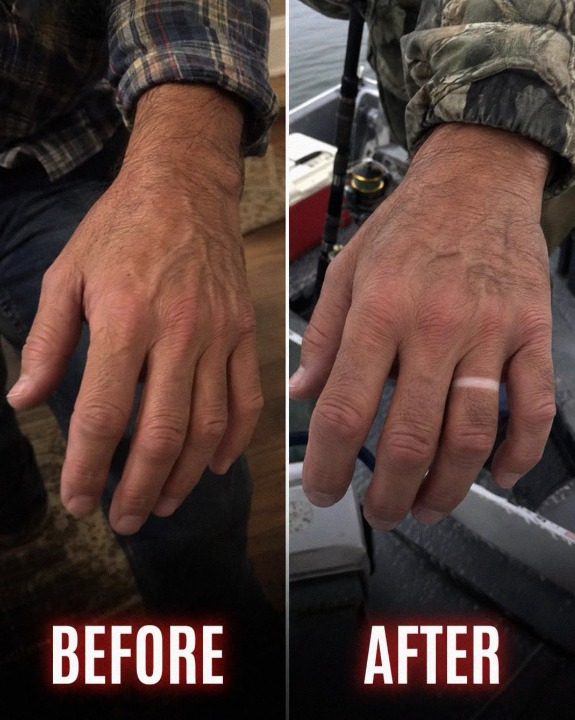
For twelve years, my husband, Mark, hadn’t worn his wedding ring.
He used to wear it every day, but after an accident at work injured his finger, the ring became uncomfortable. Eventually, he took it off and placed it in the small wooden drawer beside our bed.
I never thought much about it.
After all, we’d been married for sixteen years. I believed our commitment to each other mattered more than a piece of jewelry.
Every summer, Mark went on the same three-day fishing trip with a group of longtime friends. They stayed near a lake a few hours away, rented inexpensive rooms at a roadside motel, and spent most of their time on the water.
It was a tradition I’d grown accustomed to.
He would leave early on Friday morning and return Sunday evening, usually tired, sunburned, and eager to tell me about the fish that had escaped his line.
I never had a reason to question those weekends.
Until this year.
Mark returned home on Sunday evening carrying his duffel bag in one hand and his fishing equipment in the other.
Normally, he would greet me with a kiss, tell me how the trip had gone, and ask what we’d be having for dinner.
That evening, something felt different.
He hugged me quickly, carried his things upstairs, and barely said a word while we ate.
I assumed he was exhausted.
Then he reached across the table for his glass of water.
And I saw his left hand.
A pale band circled his ring finger.
It was narrow and unmistakable, as though a wedding ring had been worn there recently.
I stared at it for several seconds.
Mark hadn’t worn his ring in twelve years.
“What’s that on your finger?” I asked.
He followed my gaze.
For the briefest moment, his expression changed. His hand stopped halfway toward the glass, and he looked as though he’d been caught off guard by a question he hadn’t expected.
Then he laughed.
“Probably from gripping the fishing rod all weekend.”
I wanted to believe him.
I really did.
But fishing rods don’t usually leave a perfectly defined band around a finger, especially on someone who has spent more than a decade without wearing a ring.
I didn’t argue with him that night.
Instead, I quietly began paying attention.
The First Clue Was Waiting in Our Bedroom
The next morning, Mark left early for work.
I went upstairs and opened the drawer where he’d kept his wedding ring for years.
It was still there.
I picked it up and examined it carefully.
The ring was exactly as I remembered it, with a small scratch near the inside edge from the day Mark had dropped it onto the garage floor.
I turned it between my fingers.
If he hadn’t worn it for twelve years, why did his finger look as though he’d recently removed a ring?
I returned it to the drawer and closed it.
There were perfectly innocent explanations. Perhaps the mark had come from a fishing glove, a watch strap, or something else he’d worn during the weekend.
I told myself not to jump to conclusions.
But once a question enters your mind, it can be difficult to make it disappear.
That evening, I checked the photographs his friends had posted online.
The pictures showed exactly what I expected: a small fishing boat, a collection of fish laid out beside a picnic table, and a campfire surrounded by folding chairs.
Mark appeared in only two photographs.
In the first, he was standing at the back of the boat, wearing sunglasses and a cap.
In the second, he was sitting beside a cooler.
In both pictures, his left hand was either hidden behind something or outside the frame.
I leaned closer to the screen.
It could have been a coincidence.
I knew that.
Still, the photographs left me with more questions than answers.
Then I noticed another image posted by one of Mark’s friends.
It had been taken on Saturday morning outside a restaurant near the marina.
Several members of the group stood together beneath the restaurant’s sign, smiling at the camera.
Mark wasn’t there.
I checked the caption.
It mentioned breakfast before the group returned to the lake.
Why hadn’t Mark joined them?
Perhaps he had stayed at the motel. Perhaps he’d gone somewhere else to pick up supplies.
I considered asking him directly, but I knew he would probably give me a simple explanation.
And I wasn’t sure I would believe it.
A Phone Call I Wasn’t Prepared to Make
The following afternoon, I found the restaurant’s number online.
I stared at my phone for several minutes before making the call.
I felt foolish. I had never imagined myself investigating my own husband’s weekend plans.
But something about his behavior had unsettled me, and I wanted to understand what I had seen.
When a woman answered, I tried to sound casual.
“Hello. My husband visited your restaurant on Saturday, and I think he might have left something behind.”
“Do you know when he was here?” she asked.
“Saturday morning, I believe.”
There was a short pause.
“Could you describe him?”
I gave her Mark’s name and described his appearance.
The silence that followed felt unusually long.
Then she asked a question that made my stomach tighten.
“Are you his wife?”
I gripped the phone.
“Yes. Why?”
Another pause.
“I think it’s best if you speak with him directly,” she replied.
“Did something happen?”
“I’m sorry. I don’t want to get involved in a personal matter.”
I heard a faint sound in the background, followed by another voice.
Then the woman returned to the call.
“I’m sorry,” she repeated. “I really can’t help you with this.”
The line went quiet.
I lowered the phone slowly.
She hadn’t confirmed anything.
She hadn’t told me that Mark had been there or that he’d done something wrong.
Yet the way she’d reacted left me feeling as though she knew more than she was willing to say.
I sat at the kitchen table for a long time, staring at the phone.
I could feel my imagination beginning to fill the gaps with possibilities I didn’t want to consider.
I reminded myself that suspicion wasn’t proof.
Still, I knew I needed an honest conversation with my husband.
The Receipt in His Fishing Bag
That night, Mark behaved almost normally.
He asked about my day, complained about a meeting at work, and watched television beside me.
If I hadn’t noticed the mark on his finger, I might never have suspected anything unusual.
But every time he reached for something, I found myself looking at his left hand.
After he went to sleep, I remembered that his duffel bag was still sitting near the wardrobe.
I didn’t feel proud of what I was about to do.
I had always believed that a marriage should be built on trust and open communication. Searching through someone’s belongings felt like crossing a line.
But I was struggling with the growing feeling that Mark was withholding something important.
I opened the bag.
There were the usual things: a spare shirt, socks, a toiletry bag, and a folded jacket.
In the side pocket, I found a motel key card.
That wasn’t unusual by itself.
Then I discovered a receipt from a jewelry store in a town two hours away from the lake.
The purchase date was Saturday.
I checked it twice.
The receipt listed a ring resizing service and a small jewelry box.
There was no description of the item that had been purchased or serviced.
I sat back on my heels.
Had Mark visited a jeweler during his fishing trip?
Why hadn’t he mentioned it?
And why would a man who hadn’t worn his wedding ring for twelve years suddenly have a reason to visit a jewelry store?
I returned the receipt to the pocket and zipped the bag closed.
My mind was racing, but I refused to settle on a single explanation.
The receipt could have concerned a gift for a family member. The ring resizing could have been for someone else. There might be an explanation I hadn’t considered.
I needed facts, not guesses.
The next morning, I decided to ask Mark directly when he came home from work.
But before I could do that, I discovered something else.
The Folder With the Small Ring Icon
Mark left for work shortly before eight.
I watched his car disappear down the street, then returned to the kitchen and made myself a cup of tea.
I knew he sometimes left his laptop at home when he was working from the office.
That morning, it was sitting on the desk in the spare room.
I hesitated before approaching it.
I wasn’t looking for a way to invade his privacy simply because I felt insecure. I wanted to understand why several unrelated details seemed to point toward a secret he wasn’t ready to discuss.
I opened the laptop.
The password had been changed.
I tried the old one, thinking perhaps I had remembered incorrectly.
It failed.
After two more attempts, I stopped.
Then I remembered the name of the lake where Mark claimed to have spent the weekend.
It was the same name he’d used as a password for an old family account years earlier.
I entered it.
The screen unlocked.
I felt a wave of discomfort.
I knew that gaining access to a device wasn’t the same as having an explanation for the things I’d found. I also knew I should be careful about opening private files without permission.
Then I noticed a single unfamiliar folder on the desktop.
It had no title.
Just a small icon shaped like a ring.
My heart began to pound.
I clicked it.
Inside were several photographs, a scanned document, and a short video file.
The first photograph showed Mark standing outside a jewelry store.
The second showed him sitting at a table in a restaurant.
And the third made my hands go cold.
Mark was sitting beside a woman I didn’t recognize.
She wore a dark blue coat and had one hand resting on the table between them.
On that hand was a gold wedding ring.
Mark was looking at her with an expression I hadn’t seen directed toward anyone in a very long time.
I felt the room tilt around me.
I clicked the next photograph.
This one showed Mark holding a small velvet box.
The woman was smiling.
I couldn’t see what was inside the box.
But I didn’t need to.
The receipt, the strange mark on his finger, the missing photograph from the marina, and the restaurant employee’s reaction suddenly seemed connected.
I sat frozen in front of the screen.
Then I noticed the scanned document.
It was a letter.
At the top was a date from more than twenty years earlier.
And beneath it was a name I recognized immediately.
My own.
The Truth Was Older Than the Fishing Trip
I opened the scanned document.
The letter was addressed to Mark, written in handwriting I remembered from an old family friend who had moved away years earlier.
It mentioned a woman named Evelyn and referred to an event that had taken place shortly before Mark and I were married.
As I read, I began to realize that the secret wasn’t necessarily what I had feared.
The letter explained that Evelyn had once been engaged to Mark’s older brother, Daniel.
Daniel had died unexpectedly before the wedding, and the family had struggled for years to come to terms with the loss.
Evelyn had eventually moved away.
I remembered hearing her name when Mark and I were dating, but I had never met her. Whenever I asked about her, Mark would become quiet and change the subject.
According to the letter, Evelyn had recently returned to the area and contacted Mark.
She had something important to tell him about Daniel.
The photographs appeared to show Mark meeting her to discuss the past.
I looked again at the image of the jewelry box.
Perhaps it had nothing to do with a new relationship.
Perhaps it was connected to Daniel’s memory.
But why had Mark hidden the photographs? Why had he changed his laptop password? And why had he told me nothing about seeing Evelyn?
I was still trying to make sense of the document when I noticed a second page.
It was a recent note, apparently written by Mark.
The first line read:
I need to tell my wife the truth about the ring before she discovers it another way.
I stopped reading.
My husband had known that I might notice the mark on his finger.
He had known that the jewelry receipt could raise questions.
And he had apparently planned to tell me something.
I closed the document and stepped away from the desk.
I wasn’t ready to read more.
I needed to hear the explanation from Mark himself.
The Conversation We Should Have Had First
Mark came home that evening and found me waiting in the living room.
I had placed the jewelry receipt on the coffee table beside a photograph of the ring he had kept in our bedroom drawer for twelve years.
He stopped when he saw them.
For a long moment, neither of us spoke.
Then he set down his keys.
“You found the folder,” he said.
It wasn’t a question.
I looked at him.
“Who is Evelyn?”
He closed his eyes briefly.
“She’s Daniel’s former fiancée.”
I waited.
Mark sat down opposite me and explained that Evelyn had contacted him several weeks earlier. She had discovered some old family documents that she believed Daniel had wanted Mark to have.
The two had arranged to meet at the marina restaurant during his fishing weekend.
He hadn’t told me because he had been trying to understand the information before discussing it with the rest of the family.
“And the ring?” I asked.
Mark looked down at his left hand.
“Evelyn brought Daniel’s old ring. She had kept it all these years. The jeweler was helping us determine whether it could be restored before we gave it to Daniel’s daughter.”
I stared at him.
Daniel had a daughter?
Mark nodded.
“She was very young when he died. The family lost touch with her after her mother moved away. Evelyn recently found a way to contact her, and she wanted to return some of Daniel’s belongings.”
He explained that the woman in the photographs was Evelyn and that the jewelry box contained Daniel’s ring.
The pale band on Mark’s finger had come from briefly trying on a ring at the jeweler’s request to compare its size with an old measurement Daniel had left behind.
It was a strange explanation, but it matched the documents I had seen.
I looked at the receipt again.
“And the restaurant?”
Mark lowered his head.
“Evelyn asked the staff not to discuss our meeting. She didn’t want Daniel’s daughter to hear about it before she was ready to meet the family.”
I took a deep breath.
There was still one question I needed to ask.
“Why didn’t you tell me?”
Mark looked genuinely ashamed.
“I thought I could sort everything out first. I knew you’d have questions, and I didn’t know how to explain it without bringing up Daniel’s death and everything that happened afterward.”
He paused.
“I should have trusted you enough to tell you the truth from the beginning.”
That was the part that hurt most.
The secret had not been what I first feared, but the silence had still damaged my trust.
I had spent days wondering whether my marriage was falling apart because Mark had refused to tell me about a family matter that affected him deeply.
“I don’t expect you to tell me every thought that crosses your mind,” I said. “But if something is important enough for you to hide it, it’s important enough for us to talk about it.”
He nodded.
“You’re right.”
What the Ring Really Meant
Over the next few weeks, Mark and I talked more openly about what had happened.
He introduced me to Evelyn, who explained the circumstances surrounding Daniel’s belongings. She was not a romantic rival or a secret partner, but someone trying to help preserve the memory of a man she had once loved.
Eventually, we met Daniel’s adult daughter and returned the ring to her family.
It was a quiet, emotional afternoon.
Mark told stories about his brother that he hadn’t shared in years, and I learned more about the family history that had shaped the man I married.
The experience reminded me that people can carry grief and unresolved memories for decades.
Sometimes, they hide those feelings because they don’t know how to discuss them.
That doesn’t make secrecy harmless, but it can help explain why people make poor decisions when they are afraid of difficult conversations.
Mark and I still had work to do rebuilding trust.
We agreed to speak honestly when something troubled us rather than letting silence create unnecessary distance.
As for his wedding ring, it remained in the bedroom drawer until we decided together what to do with it.
One evening, Mark took it out and placed it on the table between us.
“I know I haven’t worn it for twelve years,” he said. “But I never stopped caring about what it represents.”
I reached for his hand.
“Then let’s make sure our actions represent it, too.”
He smiled sadly and nodded.
Our marriage hadn’t been threatened by the secret I first imagined, but it had been tested by the way we handled uncertainty.
I learned that an unexplained detail can quickly become frightening when communication disappears. A pale mark on a finger, a receipt, or an unexpected photograph may raise questions, but none of those things tells the whole story on its own.
And Mark learned that protecting someone from a difficult conversation can sometimes hurt more than having the conversation honestly.
The fishing trip was supposed to be an ordinary weekend away.
Instead, it brought an old family story back into our lives and forced us to confront a problem we had overlooked: the importance of telling each other the truth, even when the truth is complicated.
I still remember the moment I saw the ring mark on his finger.
At the time, I thought it meant I had lost the certainty I once had about my marriage.
Now I understand that it was a reminder of something else.
Trust isn’t built by never having secrets, doubts, or difficult memories.
It’s built by choosing to face them together, before silence turns uncertainty into fear.