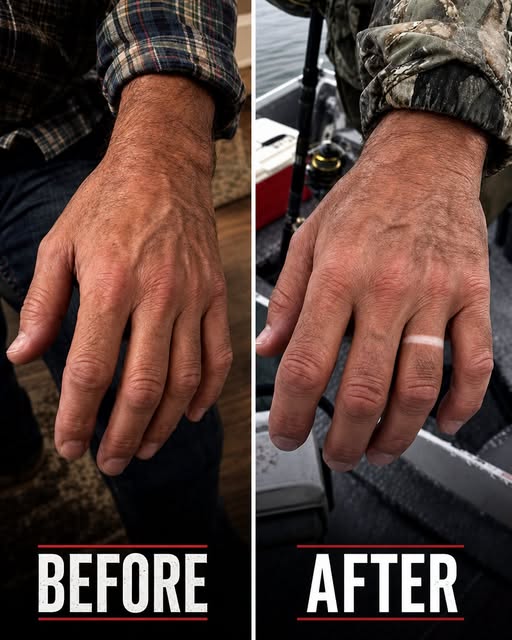
My Husband Returned From a Fishing Trip With a Wedding Ring Mark on His Finger — Then I Found a Clue in His Bag
For twelve years, my husband, Mark, had not worn his wedding ring. A finger injury had made it uncomfortable, so he had placed it in a small drawer in our bedroom, where it remained for years.
I had never considered it a problem. Our marriage had continued without the ring, and neither of us felt that wearing it every day was necessary to prove our commitment.
That was why the pale mark on his left ring finger caught my attention when he returned from his annual fishing trip.
At first, I thought I was mistaken. Perhaps the lighting made his skin look different. Maybe he had been wearing a glove or had spent hours gripping his fishing rod.
But the mark was unmistakable.
And when I asked him about it, his response left me with more questions than answers.
A Familiar Weekend Away
Mark had gone on the same fishing trip with a group of friends every summer for years. It was a tradition he looked forward to, and I had never objected to it.
The routine was always similar. He would leave on Friday morning, spend three days near a lake, stay at an inexpensive motel, and return on Sunday evening. The area had unreliable mobile reception, so our conversations during the weekend were usually brief.
I knew some of the friends who accompanied him, and I occasionally saw the photographs they shared afterward. Most showed ordinary moments: fishing boats, lakeside scenery, meals at local restaurants, and the group gathered around a campfire.
There had never been a particular reason for me to question the arrangement.
This year, however, something felt different when Mark came home.
He carried his duffel bag upstairs, gave me a quick hug, and said he was tired from the drive. At dinner, he answered my questions about the weekend with short, uncomplicated responses.
He mentioned the weather, the number of fish they had caught, and the condition of the roads. Everything sounded ordinary enough, but he seemed distracted.
I initially attributed his mood to exhaustion. Three days outdoors, followed by a long drive home, could leave anyone ready for a quiet evening.
Then he reached across the table to pick up his glass.
I noticed the pale line around his left ring finger.
For a moment, I simply stared at his hand.
The Ring He Had Not Worn in Twelve Years
Mark had stopped wearing his wedding ring twelve years earlier, after injuring his finger at work. The ring had become uncomfortable, and he eventually decided that leaving it in the bedroom drawer was the simplest solution.
I remembered the day he put it away. It had not been an emotional moment or a disagreement. We had discussed the injury, and he had promised to keep the ring somewhere safe.
Since then, I had occasionally seen it when opening the drawer to retrieve something else. It had become one of those small household details that eventually faded into the background.
Now, looking at the mark on his finger, I found myself thinking about that old conversation.
The impression looked as though a ring had recently rested in the same place.
I tried to keep my voice casual.
“What’s that on your finger?”
Mark followed my gaze.
For a brief moment, he appeared surprised. His hand stopped moving, and his expression changed before he gave a short laugh.
“Probably from holding the fishing rod,” he said.
I looked at his hand again.
The explanation was possible in a general sense. Repeated pressure, friction, or changes in skin color can leave temporary marks. But I had never noticed anything similar after his previous trips.
I wanted to ask another question. Instead, I let the conversation move on.
I did not want to turn an uncertain observation into an argument, especially when I had no reason to believe that anything serious had happened.
Still, the mark stayed in my mind long after dinner ended.
The Following Morning
The next morning, Mark left for work as usual.
I went about my routine, but my thoughts kept returning to the previous evening. The more I tried to dismiss the detail, the more I wondered why it had surprised him.
Eventually, I walked into our bedroom and opened the drawer where he kept his wedding ring.
It was still there.
The ring lay in the same small compartment where it had rested for twelve years. I picked it up, turned it between my fingers, and examined it.
There was nothing unusual about it. It had not been moved recently, at least not in any way I could identify.
I returned it to the drawer and closed it.
The discovery did not prove anything. Mark could have worn another ring, borrowed one, or developed a temporary mark for an entirely unrelated reason. There were several possibilities, and I did not know which, if any, was correct.
But the contrast between the ring in the drawer and the mark on his hand made me increasingly uneasy.
I began replaying our conversation from the previous evening. His pause. His quick laugh. The way he had moved his hand out of sight afterward.
Each detail seemed more significant when I considered it alongside the others.
I reminded myself that suspicion could change the way ordinary behavior appeared. Once a person begins looking for an explanation, it becomes easy to interpret every small detail as evidence of something larger.
I needed to be careful not to confuse a feeling with a fact.
Looking Through the Fishing Photographs
Later that day, I opened the social media posts his friends had shared from the weekend.
I had seen similar photographs in previous years. The group usually posted pictures of their fishing catches, boats, meals, and time spent outside.
This year’s collection looked much the same.
There were photographs of the lake in the early morning, a few pictures of fish laid out beside the water, and a campfire surrounded by folding chairs. Several friends appeared together in casual group shots.
Mark appeared in only two photographs.
That seemed unusual to me because he had often been included in more of the pictures from previous trips. However, I knew that the number of photographs someone appeared in could depend on who held the camera and what moments were captured.
I looked at the two images more closely.
In both, his left hand was outside the frame or hidden by his position. I could not see whether he was wearing a ring.
I sat back from the screen.
It was tempting to interpret the photographs as deliberate omissions. Yet there was no reliable way to know why his hand was not visible. He might have been holding something, standing at an awkward angle, or simply caught in a moment when the camera did not capture both hands.
The photographs provided no clear answer.
Then I noticed another image posted by one of his friends.
It had been taken outside a marina restaurant on Saturday morning.
Several members of the group were standing near the entrance, smiling at the camera. The caption mentioned breakfast before another day on the water.
Mark was not in the photograph.
Again, that did not establish anything by itself. He could have been fishing, sleeping late