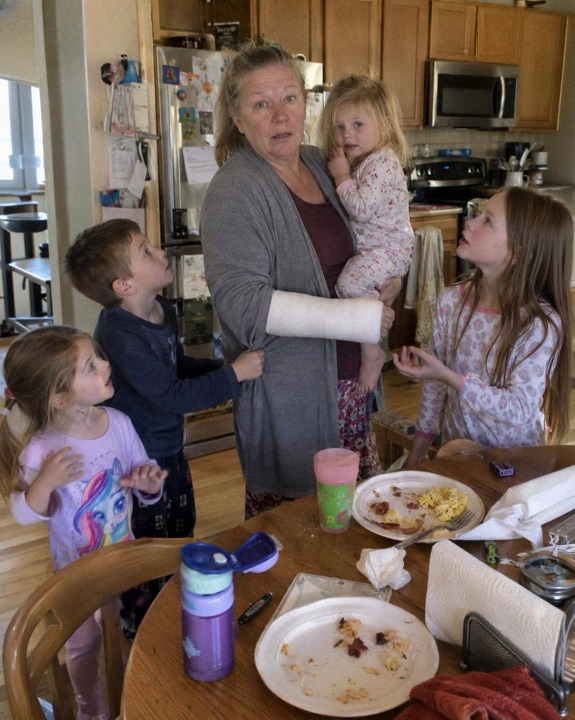
When my husband decided that my 68-year-old mother should look after our four young children simply because she was staying at our house, I realized how little he understood about kindness, responsibility, and respect.
What made the situation even worse was that my mother had recently undergone surgery for a serious arm injury. Instead of allowing her to rest and recover, my husband treated her presence in our home as an opportunity to save money.
At first, I tried to handle the situation calmly. But after discovering what was happening behind my back, I knew I had to take action.
I never imagined that one decision would lead to such a confrontation between us.
My Mother Needed Time to Recover
A few weeks earlier, my mother had suffered a painful accident that left her with several fractures in her arm. At 68, she was already dealing with the ordinary challenges of aging, and the injury made even simple daily activities difficult.
After examining her, the doctors determined that she needed surgery. Following the procedure, they placed her arm in a cast and gave her clear instructions about her recovery.
She was not supposed to lift anything heavy, put pressure on the injured arm, or perform activities that could interfere with the healing process. The doctor emphasized that she needed to be especially careful for at least two months.
Knowing that she lived alone and would struggle to manage everyday tasks, I offered to bring her to our home.
I wanted her to have a comfortable place to recover, where someone could prepare her meals, help her get dressed when necessary, and make sure she did not have to handle everything by herself.
My mother hesitated at first.
She had always been independent, and she did not like feeling that she was inconveniencing anyone. But I reassured her that she was welcome and that taking care of her was something I wanted to do.
After all, she had spent much of her life caring for our family. Now that she needed support, I believed it was only natural for us to help her.
My husband, Carl, initially agreed to the arrangement.
We both worked full-time, and we had four young children who needed attention throughout the day. Fortunately, we had a nanny who helped us manage the children’s schedules, including daycare drop-offs and pickups.
With that support in place, I believed my mother would be able to rest without worrying about household responsibilities.
Unfortunately, I was about to discover that Carl had a very different idea.
The Phone Call That Changed Everything
The following afternoon, I was at work when my phone rang.
It was someone from my youngest daughter’s daycare.
The staff member explained that no one had arrived to collect my three-year-old daughter at the expected time.
For a moment, I could hardly believe what I was hearing.
Our nanny was responsible for the pickup, and we had never experienced a problem like this before. I immediately left work, drove to the daycare, and collected my daughter myself.
Throughout the drive home, I wondered what could have happened. Had the nanny become ill? Was there an emergency? Had someone misunderstood the schedule?
When I finally arrived home that evening, I went straight to Carl.
“Do you know why nobody picked up our daughter from daycare today?” I asked.
Instead of looking concerned, he gave me a casual smile.
“Oh, that,” he replied. “I fired the nanny.”
I stared at him, waiting for an explanation.
“You did what?”
He shrugged as though he had merely canceled an unnecessary subscription.
“Your mother is home now, isn’t she? She can look after the children. There’s no reason to keep paying someone when we already have family here.”
For several seconds, I could not find the words to respond.
My mother was standing nearby. She had heard the entire conversation, and I could see the uncertainty on her face.
Then, as she so often did, she tried to smooth things over.
“Well, perhaps I can help a little,” she said gently. “I don’t want to feel as though I’m causing trouble. The children are lovely, and I’m sure we can manage.”
Her willingness to help broke my heart.
My mother was the sort of person who would offer assistance even when she was the one who needed it most. She had spent years putting other people’s needs before her own, and she rarely complained.
But there was a difference between helping with the children occasionally and being expected to take responsibility for four young children while recovering from surgery.
I turned to Carl.
“How can you expect her to look after four little children with a broken arm? The doctor specifically told her to rest.”
Carl’s expression changed immediately.
“Grandmothers look after their grandchildren all the time,” he replied. “People managed without nannies for generations. Why should we spend thousands of dollars when your mother is already here?”
Then he added something that made the situation even more upsetting.
“Besides, she’s staying in our house. It’s only fair that she helps us in return.”
I could hardly believe what I was hearing.
My mother had not moved in to take advantage of us. She had come because I had invited her to recover in a safe and comfortable environment.
She had never demanded special treatment or asked us to give her money. All she needed was a little help while her arm healed.
Now Carl was treating her recovery as though it were an unpaid job she owed us.
I told him that my mother would not be responsible for the children and that I would deal with the nanny situation myself.
I then contacted our nanny, explained what had happened, apologized for the confusion, and asked whether she would return to work.
Thankfully, she agreed.
I thought that would settle the matter.
I was wrong.
The Scene That Made Me Lose My Patience
The following day, I went to work with one request firmly in mind: my mother needed to rest.
Before leaving, I reminded Carl that the nanny was back and that my mother should not be expected to lift the children, prepare meals for everyone, or handle household chores.
He barely responded.
I chose not to start another argument that morning. I had responsibilities at work, and I hoped that a little time would allow him to reconsider his behavior.
But when I returned home that evening, I found a scene that made my heart sink.
My mother was sitting on the sofa with my youngest daughter balanced carefully against her side. She was trying to comfort the little girl while reaching for something on the nearby table with her uninjured hand.
At the same time, the kitchen was untidy, dinner had not been prepared, and the other children were moving around the living room.
My mother looked exhausted.
Her injured arm was still supported, and she was clearly struggling to manage even the simplest tasks. Yet she was doing her best to keep everyone happy.
When she saw me, she gave me a tired smile.
“I’m sorry the house is a little messy,” she said. “The children needed something to eat, and I thought I could manage.”
I immediately put down my bag and went to help her.
“Mom, you don’t have to apologize. You’re supposed to be resting.”
She looked uncomfortable.
“I didn’t want the children to go hungry. And Carl said it would be easier if I helped today.”
Those words told me everything I needed to know.
Carl had ignored our agreement and placed the responsibility on my mother again.
I helped her settle comfortably, took my daughter into my arms, and made sure my mother had everything she needed.
Then I looked around the house, trying to understand how the situation had reached this point.
Had Carl dismissed the nanny a second time? Had he told my mother to take over the children’s care despite knowing that help was available?
I was no longer willing to guess.
I needed to find out exactly what had happened.
I Decided It Was Time for a Different Approach
I could have confronted Carl immediately, but I knew how our conversations usually went.
He would insist that he was being practical. He would argue that we needed to save money. And eventually, he would turn the discussion into a debate about whether I was overreacting.
Meanwhile, my mother would continue feeling responsible for keeping the peace.
I did not want another argument that changed nothing.
Instead, I decided to take a step back and look at the situation from a practical perspective.
Carl believed that dismissing the nanny was a reasonable financial decision. He also believed that my mother should contribute to the household simply because she was staying with us.
So I began thinking about everything that decision actually involved.
Who would handle daycare pickups? Who would supervise four young children throughout the day? Who would prepare meals, manage their routines, and respond if one of them became sick or needed immediate attention?
Most importantly, who would be responsible if my mother injured herself further while attempting to do something her doctor had specifically told her to avoid?
The answer was obvious: we were both responsible for protecting her recovery, and neither of us had the right to turn her injury into an opportunity to save money.
I also realized that this was no longer simply a disagreement about childcare expenses.
It was about making decisions that affected our entire family without consulting each other. It was about expecting my mother to accept an unreasonable burden because she was too kind to refuse.
And it was about the example we were setting for our children.
I wanted them to grow up understanding that helping someone should come from compassion, not pressure or obligation.
That evening, after making sure the children were settled and my mother was comfortable, I prepared to speak with Carl.
But before I could begin the conversation, I decided to make one change that would force him to consider the consequences of his own decision.
I gathered the information I needed, reviewed our household expenses, and prepared to explain what responsible childcare actually required.
I did not intend to humiliate him or create a scene. I wanted him to understand that a family budget could not be managed by simply assigning unpaid work to someone who was injured.
About an hour later, Carl came out of our bedroom.
His face was flushed, and he looked furious.
“How dare you?” he demanded. “You can’t do this to me!”
I remained where I was, determined not to let his anger distract me from the issue.
“What exactly do you think I’ve done?” I asked.
He gestured toward the bedroom, clearly expecting me to back down.
“No, don’t do this to me! You had no right to make that decision without talking to me first!”
I looked at him in disbelief.
For days, he had made decisions about our children’s care without consulting me. He had dismissed our nanny, disrupted our daughter’s daycare pickup, and expected my injured mother to take on responsibilities she was not physically able to manage.
Yet now he was angry because I had finally taken action.
I took a deep breath.
“Carl, this isn’t about getting even with you. It’s about making sure my mother can recover safely and that our children are properly cared for.”
He started to interrupt, but I continued.
“Mom came here because I wanted to help her. She didn’t ask us to become her caregivers forever, and she certainly didn’t volunteer to replace our nanny. She is recovering from surgery. She needs rest, not another full-time responsibility.”
For the first time that evening, I saw him hesitate.
I explained that our childcare arrangements were not his decision to change unilaterally. Any change would need to be discussed and agreed upon by both of us, especially when the children’s safety and my mother’s health were involved.
Then I told him what I expected going forward.
Our nanny would continue working according to the arrangement we had originally made. My mother would not be responsible for childcare or household duties while recovering. And if Carl wanted to reduce expenses, we could review our budget together and identify reasonable alternatives.
He stared at me, apparently realizing that I was not going to change my mind simply because he was angry.
For once, I refused to smooth things over just to keep the peace.
I loved my husband, but loving someone did not mean accepting every decision they made. Marriage required cooperation, respect, and shared responsibility.
My mother had spent her life helping the people she loved. She deserved to receive that same kindness without being made to feel indebted for it.
As Carl stood there, still struggling to respond, I knew that our conversation was far from over.
The question was no longer whether we could afford a nanny.
It was whether my husband was finally willing to understand that family members are people to care for, not convenient replacements for paid help.
And this time, I was determined that things would change.