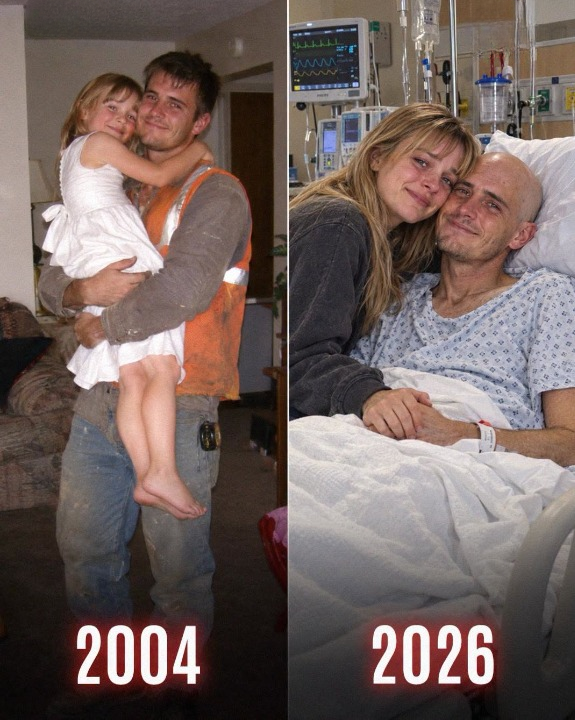
My earliest memories of my father are made up of little things.
A pair of heavy construction boots beside our apartment door. A faded orange safety vest hanging over the back of a kitchen chair. The quiet sound of him washing his hands after work, trying to remove the dust and grime that seemed to follow him home every evening.
His hands were rough from years of construction work. Whenever he tucked me into bed, he would gently smooth my hair with those same hands and ask me about my day.
I didn’t know then how much he had given up to make my childhood possible.
My father had been studying engineering when I was born. He loved solving problems, drawing plans, and imagining the buildings he might one day help design.
He had a future mapped out for himself.
Then, when I was still very young, my mother left our lives in a way neither of us had expected.
One ordinary Tuesday morning, she kissed my forehead, picked up her purse, and said she needed to go to the grocery store.
I remember standing near the kitchen doorway, watching her leave.
I thought she would return with bags of food, perhaps something sweet for me, and stories about the people she had seen.
But the hours passed, and she never came home.
At first, I was too young to understand what her absence meant. I asked my father when she would be back, and he told me that he didn’t know.
As the days passed, he stopped making promises he couldn’t keep.
He tried to explain things in a way a child could understand, but I could see the worry in his face whenever I asked questions he didn’t know how to answer.
Within a week, he made a decision that would shape the rest of his life.
He left college and began working construction full-time.
There was no dramatic announcement. He didn’t sit me down to explain how much his plans had changed. He simply put away his engineering textbooks, found steady work, and made sure there was food on our table.
From that point on, it was the two of us.
The Father Who Made Every Sacrifice Seem Ordinary
We lived in the same small rented apartment throughout my childhood.
The kitchen was narrow, the windows rattled when the wind was strong, and the living room doubled as a place for homework, meals, and quiet evenings together.
We didn’t have much money, but my father worked hard to make our home feel safe.
He left early in the morning and often returned after the sun had gone down. Sometimes, when he thought I was asleep, I heard him moving quietly around the kitchen, preparing something for the following day.
He rarely complained about being tired.
When I asked why he worked so much, he would smile and tap the end of my nose.
“Because you’re worth every sore muscle, Daddy’s Bug.”
That was his nickname for me.
Daddy’s Bug.
I never knew exactly where the name came from. I only knew that he said it with such affection that I felt special every time I heard it.
Money was always tight.
There were months when unexpected bills forced us to make difficult choices. Sometimes we bought only the essentials, and my father found ways to stretch what little we had until payday.
If there wasn’t enough food for seconds, he would tell me he had already eaten.
If his work boots developed another hole, he would repair them instead of buying a new pair.
When his clothes became worn, he continued wearing them because replacing them wasn’t a priority.
I didn’t understand the extent of those sacrifices until I grew older.
As a child, I simply assumed that fathers were supposed to work hard and that everyone else’s home probably operated in much the same way.
On birthdays, he always found a way to make me feel celebrated. My presents were rarely expensive, but he put thought into every one of them.
Sometimes he made things himself. Other times, he saved small amounts of money over several weeks to buy something he knew I wanted.
Christmas was my favorite time of year.
Our apartment never looked like the houses in holiday movies, but Dad made it feel magical. He would decorate the living room, play music while we prepared dinner, and pretend to be surprised when I guessed what was inside my presents.
One Christmas, I noticed that he was wearing the same old jacket he had worn for years.
I asked whether he wanted a new one.
He laughed and told me his jacket was perfectly fine.
Then he looked at the presents beneath the tree and said, “Watching you open those is more than enough for me.”
I believed him.
For a long time, I didn’t realize that he had become so skilled at making his sacrifices invisible that I had mistaken them for ordinary life.
The Promise I Made When I Finally Understood
As I grew older, I began to notice the things other children took for granted.
Some classmates went on family vacations. Others had larger homes, newer clothes, or parents who attended every school event without having to arrange their work schedules around it.
I sometimes wondered what our lives would have been like if my mother had stayed.
I wondered whether my father would have finished college, become an engineer, and spent his days designing buildings instead of carrying materials across construction sites.
Those thoughts made me feel guilty, even though I knew I hadn’t caused what happened.
Whenever I asked him about his old college days, he spoke about them fondly but never for very long.
“Do you ever wish you had finished?” I asked him once.
He was sitting at the kitchen table, looking through a stack of household bills.
He set the papers aside and considered my question.
“Sometimes I wonder what might have happened,” he admitted. “But wondering about a different life doesn’t mean I regret the one I have.”
Then he reached across the table and squeezed my hand.
“You gave my life a purpose I couldn’t have planned for.”
I didn’t know how to respond.
By then, I understood enough to recognize that my father had made a choice with consequences that reached far beyond money. He had given up a career he wanted, years of education, and much of the freedom people his age usually enjoyed.
I promised myself that I would repay him someday.
I would get a good job, save money, and give him the opportunities he had missed.
I imagined moving him into a comfortable home, taking him on a proper vacation, and buying him the new clothes he always insisted he didn’t need.
Most importantly, I wanted him to rest.
I wanted him to wake up one morning without an alarm, without worrying about bills, and without having to put on those heavy boots.
I told myself there would be time.
I believed I had years to make good on that promise.
I was wrong.
The Diagnosis That Changed Everything
I was twenty-five when my father began experiencing health problems that he could no longer ignore.
At first, he dismissed his symptoms as the result of years of physical work. He had spent decades lifting, bending, and working long hours, so he was accustomed to feeling sore.
But the discomfort continued, and eventually he agreed to see a doctor.
The appointments led to more tests.
Then came the diagnosis: late-stage cancer.
I remember the room where we received the news. I remember the doctor’s careful voice and the way my father sat quietly, asking practical questions while I struggled to process what I was hearing.
He wanted to understand the treatment options and what the coming months might look like.
Even then, he seemed more concerned about making things easier for me than about expressing his own fear.
After we returned home, he tried to continue our routines.
He asked about my work, reminded me to eat properly, and made jokes when I became too serious around him.
But the illness gradually changed what he could do.
The man who had spent his life working with his hands now needed more time to rest. Tasks that had once seemed simple became difficult, and our conversations sometimes stretched into the quiet hours of the evening.
I did everything I could to be there for him.
I accompanied him to appointments when possible, helped organize the practical details of his care, and sat beside him when he didn’t feel like talking.
During those months, I often remembered my childhood promise.
I had wanted to give him a comfortable life after years of sacrifice.
Instead, I found myself wishing for something much simpler: more ordinary mornings, more conversations at the kitchen table, and more chances to hear him call me Daddy’s Bug.
Eight months after his diagnosis, my father passed away.
I was twenty-five years old.
The man who had been my home, my protector, and my greatest source of reassurance was gone.
At his funeral, relatives and friends spoke about his generosity and determination. Some remembered working alongside him on construction sites. Others described the quiet ways he helped people without expecting anything in return.
I listened, grateful that so many people had cared about him.
But the stories that stayed with me were the small ones.
The times he had worked through bad weather to provide for us. The holidays he had made special despite our limited budget. The evenings he had sat beside my bed, pretending not to be tired because I wanted to tell him one more story.
I would have given anything to hear his voice again.
I thought I had already learned the most important things about the life he had lived.
Then, after the funeral, his lawyer asked me to stay behind.
The Ordinary Grocery Bag His Lawyer Handed Me
Most of the relatives had already left when the lawyer approached me.
He spoke gently and asked whether I had a few minutes.
I nodded, although I was exhausted from the long day and struggling to concentrate.
He reached into a nearby case and removed an ordinary plastic grocery bag.
There was nothing remarkable about it. It was the kind of bag my father might have carried home from a small neighborhood shop.
He handed it to me along with a folded note.
“Your father left instructions that I should give you these after the funeral,” he explained. “He was very specific about it.”
I looked at the bag, then at the note.
“Did he tell you what it was?”
The lawyer shook his head.
“He asked me to let you discover that for yourself.”
My fingers began to tremble.
I recognized my father’s handwriting immediately. It leaned slightly to the right, with certain letters connected in a way I had seen on birthday cards, school forms, and notes he used to leave on the kitchen counter.
I unfolded the paper.
There was only one sentence.
“Daddy’s Bug, I hope you’ll forgive me after you see what’s inside.”
I read it again.
Then I read it a third time.
Forgive him?
My father had spent his entire life trying to protect me. Even when he was exhausted, he had found ways to reassure me. Even when we had very little, he had made sure I never felt that I was a burden.
I couldn’t imagine what he might have done that would require my forgiveness.
I looked toward the door through which my relatives had left, wishing I could ask someone what they knew.
But the lawyer had already stepped away to give me privacy.
I sat down and placed the bag on my lap.
For a long time, I simply stared at it.
Part of me wanted to open it immediately. Another part was afraid that whatever it contained would change the memories I had treasured for twenty-five years.
I took a slow breath and loosened the handles.
Inside were several carefully arranged items, protected by folded paper.
The first thing I noticed was an old envelope.
Beneath it was a small collection of documents and a photograph that looked as though it had been kept safe for a very long time.
I lifted the photograph.
My father was younger in it, with darker hair and a face I recognized even though he looked different from the man I remembered.
He was standing beside someone.
I leaned closer to the picture, trying to understand why he had kept it.
Then I noticed the writing on the back.
My father’s handwriting.
And a date from before I was old enough to remember anything.
I turned the photograph over again, my heart beating faster.
Whatever this was, it had been part of his life long before he handed me my first birthday present or tucked me into bed after a long day.
I began examining the documents one by one.
Some appeared to relate to his education. Others contained names and dates I didn’t immediately recognize.
The envelope remained at the bottom of the bag.
I saved it for last.
When I finally opened it, I found a letter written in my father’s careful handwriting. It was longer than the note he had left outside the bag, and the first paragraph began with the same affectionate nickname.
“Daddy’s Bug,” he had written, “there are things about the beginning of our life together that I should have explained to you a long time ago.”
I stopped reading.
The room seemed unusually quiet.
I thought about the father who had raised me alone, the engineering student who had put his education aside, and the man who had worked through countless difficult days without asking me to repay him.
I thought about the questions I had asked as a child and the answers he had given me.
For the first time, I wondered whether there were parts of our family history he had never known how to explain.
I looked at the photograph again.
Then I returned to the letter.
I didn’t know what the remaining pages would reveal, or whether the truth would bring comfort, sadness, or a mixture of both.
But I knew why he had chosen that particular moment for me to receive them.
He had wanted me to have the opportunity to understand his life in a way I hadn’t been able to while he was still here.
I wiped my eyes and continued reading.
Outside, the afternoon light was fading. The funeral flowers stood quietly nearby, and the sounds of people leaving the building grew more distant.
I had arrived that morning believing that saying goodbye to my father would be the hardest thing I would ever have to do.
Now I understood that grief sometimes leaves us with another task: learning how to carry the parts of someone’s story that they were never able to tell us.
I folded the letter carefully and placed it back inside the envelope.
I would need time to read everything properly, to understand the documents, and to decide whether I needed to ask the lawyer for further clarification.
But one thing was already clear.
My father had left me more than a collection of old papers and photographs.
He had left me a final conversation, one that continued beyond his lifetime.
And as I held the bag against my chest, I heard his familiar words in my memory.
“Because you’re worth every sore muscle, Daddy’s Bug.”
For years, I had believed that I understood the full meaning of that promise.
Now, with his final letter in my hands, I was ready to learn the rest of the story.