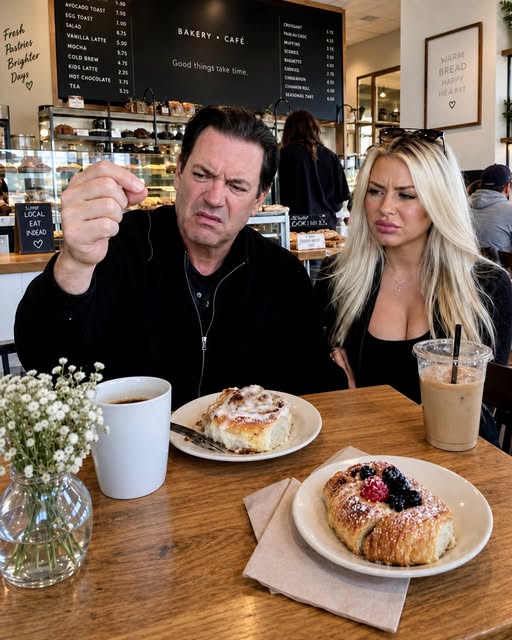
My Ex-Husband Tried to Ruin My Bakery—But My 16-Year-Old Daughter Had a Plan
When my ex-husband, Edward, walked into my bakery that Saturday morning, I had no idea he intended to turn one of the happiest days of my life into a nightmare.
The shop was packed. The smell of fresh cinnamon rolls filled the air, coffee machines hissed behind the counter, and customers sat shoulder to shoulder at the six little tables I had worked so hard to afford.
For the first time in years, I felt like my life was finally moving in the right direction.
Then Edward stepped through the door.
His girlfriend, Vanessa, held tightly to his arm. She wore a designer coat and a smile that seemed a little too pleased with itself.
Edward looked around the bakery, taking in the mismatched chairs, the framed recipes, and the display case filled with pastries.
“So this is your big business?” he said loudly. “Cute.”
I took a breath and reminded myself that he was a customer.
“Good morning, Edward. What can I get for you?”
He glanced at Vanessa.
“Coffee and cinnamon rolls. Two of them.”
I wrote down the order without responding to his tone.
I had learned during our divorce that arguing with Edward rarely accomplished anything. He always found a way to turn a disagreement into an opportunity to make himself the victim.
But I never expected what happened next.
A few minutes later, as I carried drinks toward a table near the window, I glanced toward Edward and Vanessa.
Vanessa had positioned her purse beside the plate. Edward leaned forward, his hands partly hidden by the table.
I saw him take something from a folded napkin.
Before I could understand what he was doing, he slipped it into the icing on Vanessa’s cinnamon roll.
She immediately pulled back.
“Oh my God! There’s something in my food!”
Edward shot to his feet.
“What is that?”
He lifted the plate high enough for nearby customers to see.
A thin strand of hair lay across the white icing.
Vanessa looked horrified.
“That’s disgusting!”
The conversations around us stopped.
One customer pushed her own plate away. Another looked toward the display case, suddenly uncertain about the food she had ordered.
Edward turned toward me.
“Is this how you run a bakery?”
I stared at the plate.
I knew what I had seen.
“You put that there,” I said.
Edward gave a short laugh.
“Excuse me?”
“I saw you reach into the pastry.”
His expression changed instantly.
“Are you accusing me of planting something in my own food?”
Vanessa folded her arms.
“She’s blaming customers instead of taking responsibility. That’s unbelievable.”
My face burned as the room fell silent.
I wanted to explain everything. I wanted to tell every customer exactly what I had witnessed.
But I also knew how it would look.
A bakery owner accusing a customer of tampering with his own food, without proof, was not going to inspire confidence.
Edward knew that, too.
He gave me a smug smile.
“Maybe owning a business isn’t as easy as baking cookies in Grandma’s kitchen.”
That was when the door to the dishwashing room opened.
My sixteen-year-old daughter, Nicole, stepped out.
She had been helping me wash trays and prepare the next batch of pastries. She had heard the commotion from the back.
“Dad, you’re right,” she said calmly. “A customer should always be compensated.”
Edward looked pleased.
“Finally, someone in this family understands how business works.”
Nicole walked behind the counter and reached beneath it.
She returned with a small gift bag.
“Here,” she said, placing it in his hands. “This is for you.”
Edward opened the bag.
Inside was a folded piece of paper and a small, clear plastic container.
His smile disappeared.
Vanessa leaned forward.
“What is that?”
Edward quickly closed the bag.
“Nothing.”
Nicole tilted her head.
“Nothing? That’s strange. You seemed very interested in what was inside a moment ago.”
I looked at my daughter, confused.
She turned toward me briefly, then faced her father again.
“Since you wanted an audience, Dad, I think you should have one.”
Edward’s face reddened.
“Nicole, don’t.”
But Nicole had already reached beneath the counter again.
This time, she pulled out a tablet.
And when she turned the screen toward the bakery, I finally understood why she had been smiling.
The Daughter Who Had Been Paying Attention
To understand what happened that morning, I need to explain how we got there.
Edward and I had been married for nineteen years.
For much of that time, I believed we had an ordinary marriage. We had two children, a modest home, and the usual responsibilities that came with raising a family.
I wasn’t expecting a perfect life.
I simply wanted a partner who respected me.
Then I discovered Edward was having an affair with a woman nearly twenty years younger than him.
When I confronted him, I expected denial, anger, or perhaps an awkward attempt at an explanation.
Instead, he looked at me as if I were the one who had caused the problem.
“A smart wife would look the other way and keep her family together,” he said. “You’re the one tearing this apart.”
Those words stayed with me long after the argument ended.
Edward wasn’t asking me to forgive him. He was telling me that protecting his comfort mattered more than acknowledging the hurt he had caused.
So I filed for divorce.
The process was exhausting.
Edward remained in the house for much of the proceedings. He kept arguing over expenses, disputed payments, and challenged nearly every financial arrangement we discussed.
He also refused to provide the child support I believed our children needed, leaving me struggling to cover ordinary household expenses.
I took extra shifts wherever I could find them. I cut back on groceries, postponed bills, and tried to keep our children’s lives as stable as possible.
Eventually, my grandmother, Rose, opened her home to us.
She didn’t ask me to explain every detail.
She simply made room.
Her house smelled of vanilla, butter, and the cinnamon she kept in a small jar beside the stove. It was the same kitchen where she had taught me to bake when I was a little girl.
When I was overwhelmed, she would hand me an apron.
“Come on,” she would say. “Let’s make something.”
We baked bread, pies, cookies, and cinnamon rolls. Sometimes we talked about the divorce. Sometimes we talked about nothing at all.
Those afternoons helped me remember that I was more than someone’s betrayed wife.
I was still a mother.
I was still a person with skills, ideas, and dreams.
Then Grandma’s health began to decline.
Her energy faded, and the afternoons in the kitchen became less frequent. I spent more time helping her with appointments and household tasks.
When she passed away, the grief was overwhelming.
It felt as though I had lost the one place where I could always breathe.
But Grandma had left me a small inheritance.
It wasn’t enough to make me wealthy, and it certainly wasn’t enough to erase the financial strain of the divorce.
Still, it gave me an opportunity.
I used nearly all of it to rent a tiny storefront and open a bakery.
I named it Rose’s Bakery.
The shop had six tables, secondhand chairs that didn’t match, and a display case I found through a local business sale. Behind the counter, I framed several of Grandma’s handwritten recipes.
I wanted the bakery to feel like her kitchen.
Warm. Welcoming. Familiar.
Nicole helped me after school whenever she could. She wiped tables, folded pastry boxes, washed trays, and learned how to prepare some of Grandma’s recipes.
She was only sixteen, but she understood how much the bakery meant to me.
The business grew slowly.
At first, we had a few regular customers and the occasional weekend rush. I learned to manage inventory, calculate costs, handle customer complaints, and wake up before sunrise to prepare the day’s pastries.
There were difficult days.
Some mornings, I wondered whether I had made a terrible financial decision.
But every time a customer returned and asked for another cinnamon roll, I felt a little more confident.
For the first time since my divorce, I had something that belonged to me.
Something I had built with my own hands.
And Edward couldn’t seem to tolerate it.
The Man Who Couldn’t Let Me Move On
Edward had never shown much interest in my baking while we were married.
He enjoyed eating what I made, but he rarely acknowledged the time or effort involved.
After the divorce, however, he suddenly became interested in my business.
He asked mutual acquaintances how much money the bakery was making. He made sarcastic comments about my early mornings. When he heard that we had been busy during a holiday weekend, he told someone I was probably exaggerating.
I tried not to pay attention.
My energy was better spent helping my children and building the business.
Nicole noticed more than I realized.
One evening, while she was cleaning the counter, she asked, “Why does Dad keep asking about the bakery?”
“He’s curious,” I replied.
She looked unconvinced.
“That’s not how it sounds.”
I told her not to worry about it.
At the time, I thought I was protecting her from unnecessary tension.
I didn’t realize she had already begun noticing a pattern.
Edward would occasionally appear near closing time. Sometimes he asked questions about our suppliers. Other times, he made comments about the bakery’s finances.
He also liked to remind me that I had used Grandma’s inheritance to open the shop.
“You know, that money could have been used for something more practical,” he said during one phone call.
I didn’t respond.
I had spent years explaining my decisions to Edward, hoping he would eventually understand them.
I was finished doing that.
The bakery was mine, and I was determined to make it work.
The Saturday Everything Changed
The Saturday Edward and Vanessa arrived was one of our busiest mornings.
We had a local event nearby, and several people had stopped in for coffee and pastries before heading over.
Nicole was helping in the back, preparing trays and washing equipment.
I was serving customers when Edward walked in.
His comments about the bakery were familiar enough that I tried to ignore them.
I took their order, brought their coffee, and returned to the counter.
Then I saw him put something into Vanessa’s cinnamon roll.
I was certain of it.
But when he stood up and began complaining, I had no immediate way to prove what I had witnessed.
The situation could have become much worse.
Customers were watching. Vanessa was raising her voice. Edward was holding the plate as though he had uncovered a serious health concern.
I could already imagine the consequences.
A customer complaint could spread online. A photograph of the pastry could circulate without context. People who had never visited the bakery might decide not to give us a chance.
I felt my confidence slipping.
Then Nicole stepped forward.
She placed the gift bag in Edward’s hands.
Inside was the clear container and the folded note.
Edward’s expression changed so quickly that I barely recognized him.
Nicole turned the tablet toward the customers.
“Before anyone makes a decision about this bakery,” she said, “I think you should see what happened.”
The screen showed a video.
It was footage from a small security camera we had installed above the service counter several weeks earlier.
The camera had been purchased after a delivery went missing. It recorded the front counter and several tables, but it did not capture the entire bakery.
Nicole had been helping me review the camera settings the previous evening because we were having trouble saving recordings.
She had noticed that the camera captured the table where Edward and Vanessa were sitting.
When she heard the commotion that morning, she checked the footage.
And there it was.
Edward’s hand moving toward the pastry.
The camera angle wasn’t perfect, but it clearly showed him leaning forward and placing something onto the icing while Vanessa positioned her purse beside the plate.
The recording continued.
Vanessa lifted the plate.
Then she began shouting.
The bakery was silent.
Edward stared at the tablet.
Vanessa’s face had lost its confident expression.
Nicole paused the video.
“I thought customers deserved to know what happened,” she said.
Edward stepped toward her.
“Turn that off.”
Nicole didn’t move.
“Why?”
“Because this is private.”
Nicole glanced around the room.
“You made it everyone’s business when you started shouting.”
The Gift Bag
Edward looked down at the gift bag in his hand.
“What is this supposed to prove?”
Nicole answered carefully.
“The container has the strand you claimed was in your food.”
I looked at her, surprised.
She explained that after reviewing the recording, she had noticed something near the edge of the table.
The camera did not provide a clear view of the object Edward had used, but it showed him handling a small item before placing it into the pastry.
Nicole had not touched the plate.
She had not taken anything from Edward.
Instead, she had asked me to keep the pastry and plate separate from the other food while we figured out what to do.
I had placed them in a clean container and set them aside.
Nicole had simply brought the container out when Edward began making accusations.
The folded note inside the bag was a short statement she had written:
The bakery takes customer concerns seriously. We are preserving the food and available security footage so the incident can be reviewed accurately.
It wasn’t a threat.
It wasn’t an insult.
It was a record of what had happened.
Edward looked around the room.
“You can’t record people without telling them!”
I stepped forward.
“The camera is visible, Edward. It was installed for the safety of the business.”
I didn’t know every legal detail about recording in a commercial space, and I wasn’t about to make a sweeping claim. But the footage had been captured by the bakery’s security system, and I intended to preserve it rather than argue with him.
Vanessa grabbed her purse.
“This is ridiculous. We’re leaving.”
Nicole nodded.
“That’s your choice.”
Edward placed the gift bag on the table.
“You think you’ve won something?”
“No,” Nicole replied. “I think Mom deserves to run her business without someone trying to damage it.”
For a moment, Edward looked as though he might say something else.
Then he noticed several customers watching him.
He picked up his coat.
Vanessa followed him toward the door.
Before leaving, Edward turned back.
“This isn’t over.”
I felt the old familiar fear rise in my chest.
But Nicole stood beside me.
And for the first time in a long time, I didn’t feel alone.
What the Customers Did Next
After Edward and Vanessa left, the bakery remained quiet for several seconds.
I looked at the customers, unsure what to say.
“I apologize for the disturbance,” I began. “We take food safety very seriously, and we’re reviewing what happened.”
A woman sitting near the window raised her hand.
“I saw the video,” she said. “You don’t need to apologize for someone else’s behavior.”
Another customer nodded.
“I’ve been coming here for months. Your food has always been wonderful.”
A man near the counter added, “I’m glad you had the footage.”
Their kindness nearly brought me to tears.
Still, I knew I had responsibilities.
I offered to replace the affected order and reminded customers that anyone with a concern about food could speak with me directly.
A few people chose to leave. I understood.
Trust matters in a bakery, and no business should expect customers to ignore a food-related concern.
But many stayed.
One woman ordered another coffee. A couple at the corner table asked for two more cinnamon rolls.
Slowly, the normal sounds of the bakery returned.
The coffee machine hissed.
The bell above the door rang.
Nicole began clearing the table where Edward had been sitting.
I walked over and gently touched her shoulder.
“Thank you,” I whispered.
She looked up.
“Mom, I didn’t want him to get away with it.”
I took a breath.
“I know. But I need you to understand something. You shouldn’t have to defend me against your father.”
Nicole lowered her eyes.
“I just wanted to help.”
“I know you did.”
I hugged her.
And for a moment, the bakery felt like Grandma’s kitchen again.
The Review That Followed
By Monday morning, I had received a message from a customer who had been in the bakery during the incident.
She asked whether she could share what she had witnessed on her personal social media account.
I thanked her but asked her not to post the security footage or identify anyone.
I didn’t want the situation to turn into an online argument.
My priority was protecting the bakery, my employees, and my children.
Still, the incident had already become a topic of conversation among a few local customers.
Someone had seen Edward and Vanessa leaving. Another person had heard the commotion.
I decided to prepare a brief, factual statement in case anyone contacted the bakery.
It explained that a customer had raised a food concern, that the business had preserved the relevant evidence, and that we were handling the matter privately.
I avoided making accusations online.
I also contacted my business insurance provider to ask whether the incident required any formal documentation.
The representative advised me to preserve the recording, keep a written account of what happened, and avoid altering or circulating the footage.
I followed that advice.
The bakery was too important to me to risk making a careless decision out of anger.
For the next few days, I checked the security system regularly and made sure the footage was securely saved.
I also reviewed our customer complaint procedures.
The incident had reminded me that running a small business required more than good recipes and friendly service.
It required preparation.
Edward’s Next Move
Three days later, Edward called me.
I almost let it go to voicemail.
But because the children were involved, I answered.
“What do you want?”
His voice was tense.
“You need to delete that video.”
I stood behind the bakery counter, looking at the framed recipe Grandma had written years earlier.
“Why?”
“Because you’re making me look bad.”
I closed my eyes briefly.
“Edward, you made a scene in my business. I’m preserving the footage in case it’s needed.”
“You’re trying to destroy my reputation.”
“I’m not posting anything. I’m keeping a record of what happened.”
He accused me of encouraging Nicole to embarrass him.
That was the part that hurt most.
Nicole had not planned the incident. She had not invited him to the bakery. She had not placed anything in the pastry.
She had simply responded when he tried to turn a false complaint into a public accusation.
“I didn’t ask Nicole to do anything,” I said. “She saw what happened and wanted to help.”
Edward scoffed.
“She needs to stay out of adult matters.”
“She is my daughter, and she was working in the bakery. You brought this situation into her workplace.”
He went quiet.
Then he said, “You always have to make me the villain.”
I thought about the years I had spent trying to explain my feelings to him.
I thought about the divorce, the arguments over money, and the months when I had struggled to provide for the children.
I no longer needed him to agree with my version of events.
“I’m not discussing this anymore,” I said.
Then I ended the call.
My hands were shaking, but I felt something else, too.
Relief.
I had finally stopped trying to convince Edward to understand me.
A Meeting With the School Counselor
The following week, Nicole’s school counselor contacted me.
Nicole had asked to speak with her after the incident.
The counselor explained that Nicole had been feeling caught between her parents for some time. She loved her father, but she was angry about how he treated me and worried about the bakery.
I felt a pang of guilt.
I had been so focused on keeping our lives together that I hadn’t fully understood how much Nicole was carrying.
That evening, we sat at the kitchen table.
“Are you okay?” I asked.
She shrugged.
“I don’t know.”
I waited.
After a moment, she said, “I hate seeing him treat you like that. But I also hate that he’s my dad.”
I reached across the table and took her hand.
“You don’t have to choose between loving your father and knowing that something he did was wrong.”
She looked at me.
“Then why does it feel like I do?”
I didn’t have a perfect answer.
I told her that adults were responsible for their own choices, and that she was not responsible for fixing the relationship between her parents.
We talked about boundaries.
We talked about what to do if Edward came to the bakery again and began arguing.
And we agreed that Nicole would not be expected to confront him or manage difficult situations involving adults.
She could help with baking, serving customers, and learning about the business.
She did not need to become my protector.
That conversation mattered more to me than anything that had happened in the bakery.
I wanted my daughter to grow up knowing that courage didn’t mean carrying every burden herself.
Sometimes courage meant asking for help.
The Letter From Edward
Two weeks after the incident, I received a letter from Edward.
It wasn’t handwritten. It was a short email with a subject line that read: We Need to Talk.
He wrote that he regretted how the situation had unfolded.
He claimed that Vanessa had been upset and that he had acted impulsively.
He also said he never intended to damage the bakery.
I read the email twice.
There was no clear explanation for the footage.
No acknowledgment that he had placed something into the pastry.
No direct apology to Nicole.
I didn’t respond immediately.
Instead, I saved the email with the rest of the documentation.
A few days later, Edward sent another message.
This time, he asked whether he could speak to Nicole.
I told him that any conversation needed to be respectful and that Nicole should be allowed to decide whether she felt comfortable speaking with him.
I also made it clear that the bakery was not an appropriate place for personal confrontations.
Edward didn’t reply.
For a while, I wondered whether he would try to return.
But he didn’t.
At least, not for several months.
The Bakery Begins to Grow
Life slowly returned to normal.
The incident had been frightening, but it did not define the bakery.
Our regular customers continued to visit. A few new customers came in after hearing about the situation, although I never encouraged anyone to take sides.
I focused on what I could control.
I improved our ordering system, added a few seasonal pastries, and began offering preordered weekend boxes.
Nicole helped design a small menu board featuring Grandma’s most popular recipes.
We added a simple note beneath the bakery’s name:
Inspired by Rose, who believed every kitchen should have room for one more.
Customers often asked about the quote.
I told them about my grandmother, how she taught me to bake, and how the bakery began.
Those conversations reminded me why I had opened the shop in the first place.
It wasn’t to prove Edward wrong.
It wasn’t to make him jealous.
It was to build something meaningful for myself and my children.
One Saturday morning, a customer ordered a dozen cinnamon rolls for her daughter’s birthday.
As Nicole packed the box, she smiled.
“Grandma would have loved this.”
I nodded.
“She would have asked for one before it left the shop.”
We both laughed.
For the first time in months, the memory of Grandma’s kitchen brought more warmth than sadness.
The Conversation I Never Expected
Several months later, Edward asked to meet with me.
I agreed to a brief conversation in a public place, away from the bakery and the children.
When he arrived, he looked uncomfortable.
He began by saying that the incident had been a mistake.
I waited.
He admitted that he had wanted to embarrass me.
He said he thought the bakery’s success had made me believe I no longer needed him.
I listened, but I didn’t interrupt.
Then he said something I had never expected to hear.
“I didn’t think you’d actually build something without me.”
I looked at him.
“I didn’t build the bakery to compete with you.”
He nodded, staring down at the table.
“I know that now.”
I wasn’t sure whether I believed him.
But I no longer needed to decide whether his regret was genuine.
I told him that the incident had affected our daughter and that I expected him to take responsibility for his relationship with her.
I also told him that the bakery was off-limits for personal arguments.
If he had a concern, he could communicate with me respectfully and away from the business.
Edward agreed.
We didn’t hug.
We didn’t become friends.
We simply ended the conversation and went our separate ways.
For me, that was enough.
What Nicole Taught Me
Sometimes people assume that the person who survives a difficult relationship must become tougher, louder, or more willing to fight.
But what Nicole taught me was different.
She showed me the value of staying calm when someone is trying to provoke a reaction.
She showed me that facts matter more than insults.
And she reminded me that protecting yourself doesn’t require becoming cruel.
Her response that Saturday was clever, but what mattered most was that she didn’t let Edward’s behavior define who we were.
She didn’t scream at him.
She didn’t threaten him.
She simply made sure the truth could be seen.
Still, I never wanted her to believe she had to be the brave one every time.
She was sixteen.
She deserved to worry about school, friends, and the ordinary things teenagers should be thinking about.
I wanted her to know that I could stand up for myself, too.
And I was learning.
The Cinnamon Roll That Changed Everything
Today, Rose’s Bakery is still small.
We haven’t become a chain. We haven’t bought a mansion or suddenly become wealthy.
But we have something I once thought I had lost forever.
Stability.
Customers who know our names.
A place filled with familiar smells and warm conversations.
The framed recipes behind the counter are still there. Grandma’s handwriting has faded a little, but I refuse to replace them.
Nicole still helps when she has time, although school and her own life are becoming more important.
Sometimes, when the bakery is quiet, I take one of Grandma’s old recipe cards from the wall and read it.
Her instructions are simple.
A little flour.
A little sugar.
Butter softened at room temperature.
And patience.
I think about how long it took me to understand that last ingredient.
For years, I believed I had to fight Edward to prove that I was strong enough to survive without him.
But I didn’t need to win an argument.
I needed to build a life that no longer revolved around his approval.
The morning he tried to embarrass me, I thought the bakery might lose everything it had worked for.
Instead, I learned that a difficult moment does not have to become the story of your entire life.
The security footage helped establish what happened. The customers who stayed reminded me that trust is built over time. And Nicole reminded me