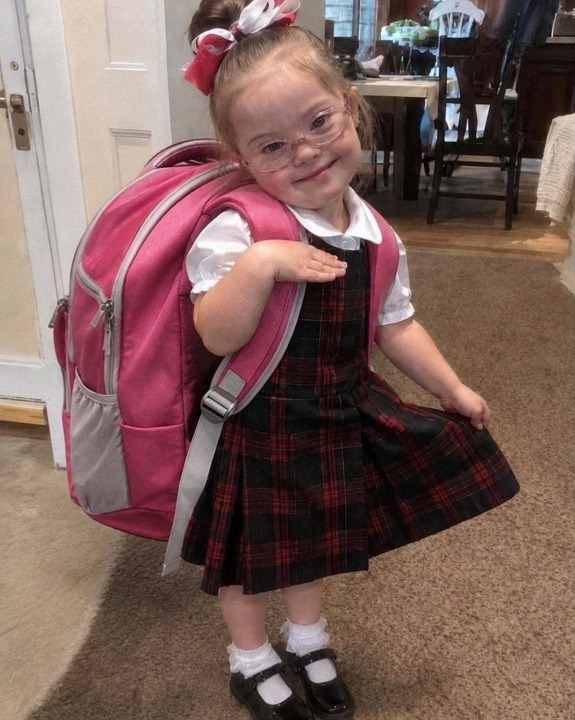
My six-year-old daughter, Victoria, had been looking forward to her first school festival for weeks. She had talked about it every morning, carefully chosen the outfit she wanted to wear, and even practiced smiling in front of the mirror because she wanted to look special for the occasion.
But just an hour after I dropped her off at school, my phone rang.
It was the principal.
“Mrs. Parker, could you please come to the school as soon as possible? Victoria is very upset, and she keeps asking for you.”
My heart immediately began racing.
“What happened? Is she hurt?”
“She’s physically fine, but something has upset her quite badly. I think it would be best if you came.”
I grabbed my keys and hurried out of the house, wondering what could possibly have happened in such a short amount of time.
To understand why that phone call affected me so deeply, you need to know a little about my daughter.
Victoria was born with Down syndrome. From the moment she entered my life, I knew that I would have to help her navigate a world that wasn’t always as understanding or welcoming as it should be.
I worried about many things as she grew older.
Would other children accept her? Would she find friends who appreciated her personality? Would people treat her with patience and kindness?
Those questions followed me everywhere, especially when the time came for her to start first grade.
I wanted to protect her from every disappointment, but I also knew that she deserved the opportunity to experience childhood just like any other little girl.
And Victoria was determined to attend school.
She loved learning new things, meeting people, drawing pictures, and telling stories. Every morning, she would wake up excited to put on her backpack.
Fortunately, her first two weeks of school had been wonderful.
She came home every afternoon with something new to tell me.
Sometimes it was a funny story about a classmate. Other times, it was a drawing she had made or a song she had learned.
She even started talking about two girls she hoped would become her best friends.
Seeing her happiness made me feel that perhaps my worries had been unnecessary.
Then came the school festival.
Victoria had been talking about it for days.
There would be music, games, colorful decorations, snacks, and a special face-painting table where children could choose butterflies, flowers, stars, or little animals to have painted on their cheeks.
The night before the festival, she stood in front of her bedroom mirror wearing the outfit she had chosen.
“Mommy, do you think they’ll paint a butterfly on my face?”
“I’m sure they will, sweetheart.”
“I want a pink one with purple wings!”
I smiled and helped her put her clothes away.
“That sounds beautiful.”
The following morning, she was practically jumping with excitement.
I packed her little bag, helped her brush her hair, and drove her to school.
Before she got out of the car, she turned toward me.
“Mommy, will you come see my butterfly later?”
“Of course I will.”
She hugged me tightly and ran toward the school entrance.
I watched her disappear inside, smiling to myself.
I had no idea that the day was about to take such an upsetting turn.
About an hour later, the principal called.
By the time I arrived at the school, I was so worried that I barely remembered parking my car.
I hurried through the entrance and found Victoria sitting in the hallway.
Other children were enjoying the festival. Some had colorful butterflies painted on their cheeks, while others were showing off flowers and little stars.
A teacher was sitting behind the face-painting table, carefully decorating another child’s face.
But my daughter wasn’t smiling.
Her eyes were red, and she was holding her little hands together.
The moment she saw me, she rushed into my arms.
“Mommy, I want to go home.”
I hugged her and gently brushed her hair away from her forehead.
“Sweetheart, what happened? Why are you crying?”
She looked toward the face-painting table.
“Mommy, I asked the teacher if she could paint a butterfly on my face.”
“And what did she say?”
Victoria hesitated.
“She said I didn’t need one because it wouldn’t make me look pretty.”
For a moment, I couldn’t believe what I had just heard.
I carefully looked at my daughter’s face.
“Did she really say that to you?”
Victoria nodded.
“She said some girls look better without makeup, and I should just enjoy watching the other children.”
My heart sank.
I knelt in front of her so we could look directly at each other.
“Victoria, sweetheart, did that make you feel sad?”
She nodded again.
Then she asked a question that I will never forget.
“Mommy, am I not pretty?”
I felt tears forming in my eyes, but I didn’t want my daughter to see how deeply those words had affected me.
I held her little hands.
“Listen to me, Victoria. You are beautiful exactly as you are. You don’t need paint, makeup, special clothes, or anything else to make you wonderful.”
She looked down.
“But why did the other girls get butterflies?”
I took a deep breath.
“Because they asked for them, sweetheart. And you should have been given the same opportunity.”
She remained quiet for a moment.
Then she whispered:
“I just wanted to look like everyone else.”
Those words broke my heart.
I hugged her again and let her cry against my shoulder.
Children should never have to question their worth because of something an adult says. A school should be a place where every child feels welcome, respected, and encouraged.
And I knew I couldn’t simply pretend that nothing had happened.
I looked toward the face-painting table.
The teacher was still there, smiling as she painted a colorful design on another child’s cheek.
She appeared completely unaware of the effect her words had had on Victoria.
I could have walked straight over and confronted her.
I could have raised my voice and demanded an explanation.
But I decided that the first thing I needed to do was make sure my daughter felt safe.
“Victoria, sweetheart, would you like to sit with the principal for a few minutes?”
She nodded.
“Are we going home?”
“Not just yet. I want to talk to someone first. And then we’re going to do something special together.”
“What?”
“How about a little trip to the movies, followed by your favorite ice cream?”
For the first time since I had arrived, a small smile appeared on her face.
“Chocolate?”
“Of course.”
I kissed her forehead and walked her to the principal’s office.
Once she was safely inside, I returned to the festival area.
I approached the teacher’s table.
“Excuse me,” I said politely. “May I speak with you for a moment?”
She looked up.
“Certainly. How can I help you?”
“My name is Mrs. Parker. I’m Victoria’s mother.”
Her expression changed slightly.
“Oh, Victoria. Yes, I know her.”
I kept my voice calm.
“My daughter told me she asked you to paint a butterfly on her face. She also told me that you discouraged her by suggesting that the activity wouldn’t make her look pretty.”
The teacher looked uncomfortable.
“I think there may have been a misunderstanding.”
“Perhaps,” I replied. “But my daughter came away believing that she wasn’t pretty enough to participate in the same activity as the other children.”
The teacher put down her paintbrush.
“That wasn’t what I intended.”
“I understand that you may not have intended to hurt her. But children don’t always understand the difference between someone’s intentions and the words they actually hear.”
She looked toward the principal’s office.
“Is Victoria very upset?”
“She was crying when I arrived. She asked me whether she was beautiful. Imagine how heartbreaking that question is for a parent to hear from a six-year-old.”
The teacher lowered her eyes.
“I didn’t realize she would take it that way.”
I paused before responding.
“That’s exactly why we need to be careful with our words. Every child deserves to feel included. Having Down syndrome doesn’t make my daughter less deserving of kindness, encouragement, or the same opportunities as her classmates.”
Just then, the principal approached us.
“Mrs. Parker, I understand there’s been an incident.”
I explained everything I had heard from Victoria and described how upset she had been.
The principal listened carefully.
When I finished, she turned toward the teacher.
“Is this what happened?”
The teacher hesitated before answering.
“I may have chosen my words poorly. I didn’t mean to make Victoria feel excluded.”
The principal nodded.
“Regardless of the intention, we need to take this seriously. Every student should feel welcome at school activities.”
Then she turned to me.
“I am very sorry that Victoria experienced this. We will address the situation with the staff and make sure our festival activities are accessible and welcoming to every child.”
I appreciated her response, but I wanted something more important than an apology.
I wanted my daughter to understand that she had done nothing wrong.
“Would it be possible for Victoria to return to the festival and have her butterfly painted, if she still wants one?” I asked.
The principal immediately agreed.
We returned to the office together.
When Victoria saw me, she stood up.
“Mommy, are we going now?”
“Not quite, sweetheart. There’s something I want you to know.”
I knelt beside her.
“You didn’t do anything wrong by asking for a butterfly. You deserve to enjoy the festival just like everyone else.”
The principal smiled gently.
“And if you’d still like a butterfly, we’d love to help you choose one.”
Victoria looked surprised.
“Really?”
“Absolutely.”
She thought for a moment before answering.
“Can it be pink and purple?”
“Of course,” I said.
A few minutes later, we returned to the face-painting table.
The teacher approached Victoria and spoke gently.
“I’m sorry that my words made you feel left out. That wasn’t fair to you. Would you like to choose a butterfly design?”
Victoria looked at me, then back at the teacher.
Finally, she nodded.
She sat down, and the teacher carefully painted a beautiful pink butterfly with purple wings on her cheek.
When she finished, Victoria ran toward the nearest mirror.
Her face lit up.
“Mommy! Look!”
I smiled.
“You’re beautiful, sweetheart.”
She touched the painted butterfly carefully.
“I knew I wanted this one!”
For the rest of the festival, Victoria enjoyed herself. She played games, listened to music, and spent time with her classmates.
Later that afternoon, she came home with a small paper crown and several pictures from the event.
At dinner, she told her father everything.
He listened quietly, then gave her a hug.
“I’m proud of you for telling Mommy how you felt.”
Victoria smiled.
“Next year, I want two butterflies!”
We all laughed.
But after she went to bed, I couldn’t stop thinking about what had happened.
One careless comment had nearly ruined an experience my daughter had been looking forward to for weeks.
It reminded me that words carry enormous weight, especially when they come from adults whom children are expected to trust.
A teacher’s responsibility goes beyond lessons, homework, and classroom activities. It also includes helping children understand that everyone deserves respect and that differences should never be treated as reasons to exclude someone.
Victoria has Down syndrome, but that is only one part of who she is.
She is funny, curious, affectionate, determined, and full of dreams.
She deserves friendships, celebrations, opportunities, and the freedom to enjoy being a child.
And no one should ever make her feel that she has to earn the right to belong.
That evening, before going to sleep, she asked me one last question.
“Mommy, will I get another butterfly next year?”
I kissed her forehead.
“You can have as many butterflies as you want, sweetheart.”
She closed her eyes with a smile.
And I made myself a promise: I would always speak up when someone made my daughter feel less important than the children around her.
Because every child deserves to feel beautiful, valued, accepted, and loved — not because they look or act like everyone else, but simply because they are themselves.