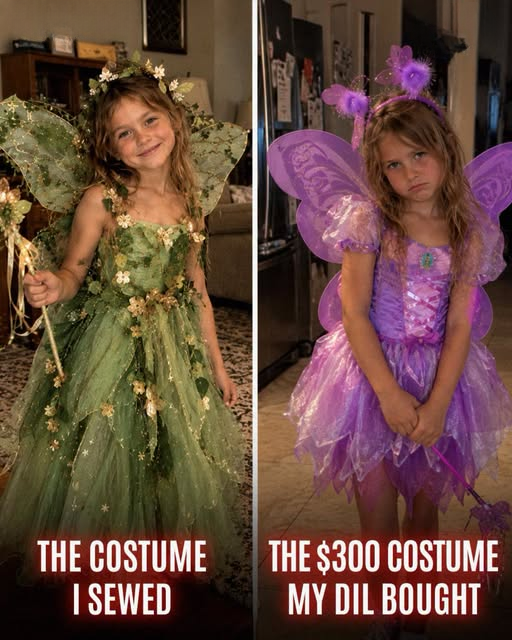
I spent three weeks making a Halloween costume for my eight-year-old granddaughter, Lily. I carefully chose the fabric, stitched every detail by hand, and added tiny golden stars that sparkled whenever the light touched them.
Lily wanted to dress as a fairy, and I wanted to create something special just for her.
When she first tried on the costume, her face lit up with excitement. She twirled around my living room, watching the skirt move as she spun, and asked me whether she could wear it to school before Halloween.
For me, that moment made every hour of sewing worthwhile.
But my happiness didn’t last long.
Two days before Halloween, my daughter-in-law, Elizabeth, arrived at my house carrying an expensive shopping bag. Inside was a designer fairy costume that she proudly announced had cost her $300.
She looked at the dress I had made and laughed.
“Well, now Lily can wear a real costume,” she remarked.
Her words hurt more than I expected. I had never claimed that my sewing was perfect, but I had put a great deal of love and effort into making something personal for my granddaughter.
Before I could respond, Lily hugged my handmade dress against her chest.
“I like Grandma’s costume,” she said.
Elizabeth rolled her eyes.
“You’re only eight, sweetheart. You don’t understand the difference yet.”
I looked at my granddaughter and saw the disappointment on her face. I wanted to defend my work, but I didn’t want to turn the afternoon into an argument.
Instead, I gently told Lily that she could choose whichever costume made her happiest.
I thought that would be the end of the disagreement.
I was wrong.
That evening, something unexpected happened while Lily and I were upstairs looking for an old sewing box. Beneath the window stood a cedar trunk that had belonged to my late mother, Margaret.
I hadn’t opened it in years.
When Lily lifted the lid, she discovered something that left us both speechless: an old green fairy costume that looked remarkably similar to the one I had just made.
And when Elizabeth saw it, her reaction was so unusual that I immediately realized there was more to the story than I had ever imagined.
Three Weeks of Love and Careful Stitching
I’ve always enjoyed sewing.
My mother taught me when I was young, sitting beside me at a small table while she showed me how to thread a needle, measure fabric, and repair a torn seam.
She believed handmade gifts carried a special kind of meaning. They showed that someone had taken time out of an ordinary day to create something for another person.
Over the years, I made birthday dresses, school costumes, and little decorative items for family celebrations.
When Lily told me she wanted to be a fairy for Halloween, I immediately began imagining the dress.
I chose soft green fabric, added tiny golden stars, and designed sleeves that ended in delicate points. I also shaped a pair of lightweight wings that would be comfortable for a child to wear.
The work took longer than I expected.
Some evenings, I spent hours adjusting the seams. On other days, I carefully repositioned the stars because I wanted them to look balanced.
I could have purchased a ready-made costume, of course. But Lily had asked me to make one, and I wanted to give her something that felt uniquely hers.
When she visited and tried it on, she ran to the mirror.
“Grandma, I look like a fairy from a storybook!”
She spun around several times, laughing as the skirt swirled around her knees.
I couldn’t stop smiling.
I imagined her wearing it to school, showing her friends the wings, and remembering that her grandmother had made it especially for her.
I never expected the costume to become a source of conflict.
The Expensive Gift That Changed the Mood
Elizabeth arrived two days before Halloween.
She was carrying a glossy shopping bag from a well-known designer children’s clothing store. She placed it on the sofa and announced that she had bought Lily a special costume.
“It’s a designer outfit,” she explained. “It cost $300, but the quality is worth it.”
I congratulated her on finding something Lily might enjoy.
Then Elizabeth noticed the handmade dress hanging near the fireplace.
She walked over, examined it briefly, and gave a dismissive laugh.
“Well, now she can wear a real costume.”
For a moment, I wasn’t sure whether I had heard her correctly.
I had spent three weeks making that dress, and she had dismissed it in a single sentence.
I tried to remain polite.
“I made it because Lily told me she wanted a fairy costume. She seemed very happy with it.”
Elizabeth shrugged.
“Children get excited about all kinds of things. That doesn’t mean we should settle for something homemade when we can buy something better.”
Before I could answer, Lily hurried over and wrapped her arms around the green dress.
“I want to wear Grandma’s,” she said.
Elizabeth looked impatient.
“Lily, you’re eight. You don’t know the difference between an expensive costume and a homemade one.”
Lily lowered her eyes but continued holding the dress.
I felt a wave of sadness for her.
This should have been a happy moment. Instead, she was being made to feel that choosing something handmade meant choosing something inferior.
I decided not to argue in front of her.
I told Elizabeth that Lily could decide which costume she preferred, and I reminded Lily that both outfits were available if she wanted to compare them.
But the tension remained.
Later that evening, Elizabeth went outside to speak with my son, Daniel, while Lily followed me upstairs.
She was unusually quiet.
The Cedar Trunk Beneath the Window
In the guest room, I began looking for an old sewing box.
I remembered keeping extra thread, buttons, and fabric scraps in it, and I thought Lily might enjoy looking through the colorful materials.
As I searched a cupboard, she noticed a large cedar trunk beneath the window.
“Grandma, what’s inside that?”
I turned and smiled.
“Old family things, mostly. It belonged to my mother.”
My mother, Margaret, had passed away six years earlier. I had kept the trunk after her death, but I rarely opened it because so many of its contents reminded me of her.
Lily knelt beside it.
“Can I look?”
I hesitated briefly, then nodded.
“Of course. Just be careful with the old photographs.”
The lid wasn’t locked, and Lily lifted it with both hands.
A familiar cedar scent drifted into the room. Inside were neatly folded blankets, family photographs, ribbons, and several dresses wrapped in tissue paper.
Lily carefully moved aside a blanket.
Then she gasped.
“Grandma, look at this!”
She had found a child’s green fairy costume.
I moved closer, and my breath caught in my throat.
The dress looked remarkably similar to the one I had made for Lily.
It had tiny gold stars scattered across the fabric, unusual pointed sleeves, and a pair of delicate wings shaped almost exactly like mine.
For several seconds, I simply stared at it.
I had never seen that costume before.
I lifted it carefully and examined the stitching. The fabric was older, and some of the seams had faded, but the design was unmistakable.
Then I noticed a small paper tag attached to the inside of the collar.
Written in neat handwriting were the words:
“Lily — age 8.”
My hands suddenly felt cold.
My mother had died two years before Lily was born.
How could she have made a costume for a child whose birth she would never live to see?
I turned the tag over, hoping to find an explanation.
There was nothing on the other side.
Lily looked from the old dress to the one I had made.
“They’re almost the same,” she whispered.
I nodded, still trying to understand what I was seeing.
Then we heard footsteps in the hallway.
Elizabeth appeared in the doorway.
The moment she noticed the costume in my hands, her expression changed.
The color seemed to drain from her face.
“Where did you get that?” she asked sharply.
I looked at her in surprise.
“It was inside my mother’s trunk.”
Elizabeth hurried across the room and reached for the dress.
“Give it to me.”
I moved it away from her.
“Why? What’s wrong?”
She stared at the little tag, then looked toward the trunk.
Before she could answer, Lily reached deeper inside and pulled out another folded item.
“Grandma, there’s another one!”
Elizabeth suddenly raised her voice.
“Lily, don’t touch that!”
Her reaction startled us both.
I gently asked Lily to step back while I tried to understand why Elizabeth appeared so frightened.
Something about the old costumes had clearly upset her.
But what could they possibly mean?
A Second Discovery
I placed the first costume carefully on the bed and turned toward the trunk.
Inside, beneath a stack of folded blankets, Lily had discovered a small cloth bundle tied with a faded ribbon.
I loosened the knot and found another children’s dress.
This one was cream-colored, decorated with tiny embroidered flowers. It appeared to have been made by hand, and a small envelope had been tucked into one of its pockets.
Elizabeth stood beside the doorway, watching every movement.
I looked at her.
“Have you seen these things before?”
She shook her head too quickly.
“No. I don’t know what you’re talking about.”
Her answer didn’t explain why she had reacted so strongly when Lily found the first dress.
I opened the envelope.
Inside was a letter written in my mother’s handwriting.
I recognized it immediately. Margaret had always written carefully, with rounded letters and long, graceful lines.
The letter was dated several years before her death.
As I began reading, I realized that the costumes were part of a family tradition I had never known about.
My mother had apparently kept a collection of children’s clothes she had made over the years. Each garment was associated with a special memory, and she had recorded the story behind it in a letter or note.
One of the letters mentioned a green fairy dress that had been created for a future grandchild.
But the explanation was incomplete.
The letter referred to a conversation with someone in the family, and the final paragraph suggested that Margaret had hoped the costume would eventually find its way to a little girl named Lily.
I read the passage twice.
How could my mother have known that name?
I remembered that Lily’s name had been chosen long after Margaret’s death. My son and Elizabeth had discussed several names during the pregnancy before settling on it.
There had to be another explanation.
Perhaps my mother had written the name later than I thought. Perhaps I had misunderstood the dates. Or perhaps the tag had been attached to the dress by someone else.
I refused to jump to conclusions.
Instead, I placed the letter and the costumes on the bed so we could examine them more carefully.
Elizabeth looked increasingly uncomfortable.
Finally, she sat down.
“I think I should explain something,” she said quietly.
The Story Behind the Costumes
Elizabeth admitted that she had recognized the style of the old fairy dress.
Before Lily was born, she had visited my mother several times. During one of those visits, Margaret had shown her a collection of handmade children’s clothes and talked about passing family traditions down to future generations.
Elizabeth had been surprised by the quality of the sewing and had asked whether the dresses might eventually be given to a granddaughter.
My mother had smiled and said that she hoped they would be treasured.
Elizabeth explained that she had forgotten many of the details, but seeing the old costume brought the memory back.
She had not expected to find it in the trunk, and she had reacted defensively because she felt embarrassed by her earlier comments about my handmade dress.
I listened carefully.
Her explanation helped clarify some of her reaction, but it didn’t answer every question about the tag or the date on the letter.
We agreed that we would examine the documents together and ask Daniel whether he remembered hearing anything about the collection.
I also made it clear that the discovery did not justify Elizabeth’s earlier remarks.
She had hurt Lily by dismissing something the child loved, and she had hurt me by treating three weeks of careful work as though it had no value.
Elizabeth looked down.
“I shouldn’t have said that,” she admitted. “I was trying to make the expensive costume seem special, and I didn’t think about how my words would affect either of you.”
It wasn’t a perfect apology, but it was an honest beginning.
I explained that the price of a gift did not determine how much love it contained.
A designer outfit could be beautiful, and a homemade dress could be beautiful, too. They did not need to compete.
What mattered was that Lily felt comfortable, happy, and free to appreciate both.
Lily listened quietly before holding up the two green dresses.
“Can I wear Grandma’s costume on Halloween and keep the old one safe?”
I smiled.
“Of course. We’ll make sure the old one is stored properly.”
Her face brightened.
For the first time that evening, the tension began to fade.
A Halloween We Would Remember
The next day, Daniel joined us as we examined the letters and photographs from the trunk.
Some questions remained unanswered, but we learned enough to understand that Margaret had treasured the idea of passing handmade clothing and family memories from one generation to another.
We carefully placed the older costumes in protective fabric covers and gathered the photographs and letters into a separate box.
Elizabeth apologized again for the way she had spoken about my work.
I accepted her apology, while also telling her that I hoped we could treat each other with greater consideration in the future.
We didn’t need to agree about every purchase or family tradition. We simply needed to respect one another.
On Halloween, Lily wore the green fairy costume I had made for her.
She carried a little basket, showed her wings to her friends, and happily explained that her grandmother had sewn the dress by hand.
The expensive costume stayed safely in its bag until Lily decided whether she wanted to wear it another time.
Later, we took a photograph of Lily standing beside the old cedar trunk, with the family dresses carefully stored inside.
I placed the picture beside one of my mother.
As I looked at it, I thought about the many things families pass down without realizing their value at first: sewing skills, handwritten notes, old photographs, favorite stories, and the small acts of love that connect one generation to another.
That afternoon began with hurt feelings and an unexpected disagreement. It ended with a renewed appreciation for the memories we had inherited.
I had spent three weeks making a fairy costume because I wanted my granddaughter to feel special.
I never imagined that an old trunk would reveal another part of our family’s history.
But the most important lesson was not about the dresses or their mysterious similarities.
It was that the value of a gift cannot always be measured by its price tag.
Sometimes, the most meaningful things are the ones made with patience, preserved with care, and passed down with love.