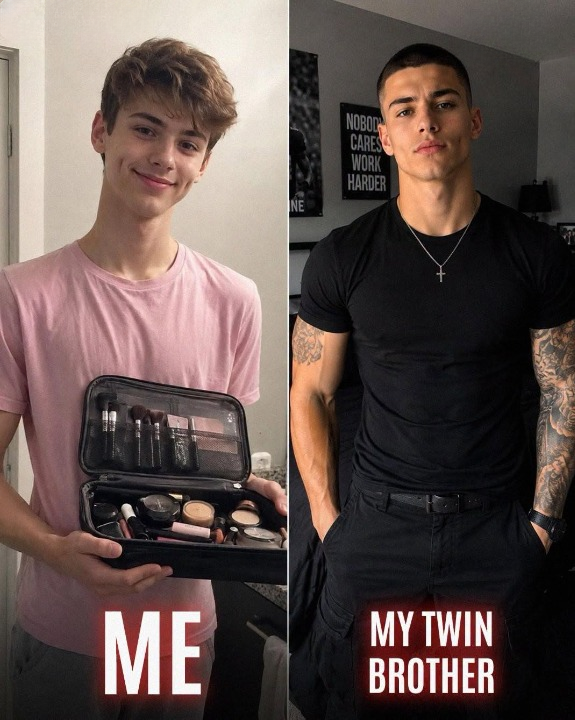
When my father threw me out of the house on my eighteenth birthday, he probably believed he was teaching me a lesson.
For ten years, I believed I had learned one too.
I learned that sometimes the people who are supposed to love you most are the people you have to learn to live without.
My twin brother, Jake, and I had looked almost identical when we were little.
Same dark hair.
Same brown eyes.
Same crooked smile.
Our mother used to dress us in different colors just so our teachers could tell us apart.
But by the time we were sixteen, nobody would have confused us.
Jake had become everything my father believed a son should be.
He played football, lifted weights, spent weekends riding dirt bikes, and came home with scraped knees and grass stains on his clothes.
Dad loved it.
He went to every game.
He bragged about Jake to his friends.
He kept newspaper clippings whenever Jake’s name appeared in the local sports section.
I was different.
I didn’t dislike sports.
They simply didn’t interest me very much.
I liked drawing.
Photography.
Color.
And eventually, makeup.
It started because of a girl named Hannah.
Hannah sat beside me in chemistry class during our junior year.
She had a noticeable scar running along one side of her cheek after an accident when she was younger.
She usually wore her hair down to cover it.
Whenever someone took out a camera, she turned away.
A few weeks before prom, she admitted she was thinking about not going.
“I don’t want to spend the whole night wondering if everyone is staring at me,” she said.
I didn’t know much about makeup then.
But I knew how much Hannah hated that scar.
So I started researching.
I watched tutorial after tutorial.
I learned about color correction, blending, concealer, lighting, and skin texture.
Then I asked Hannah if she would let me try.
She laughed at first.
“You?”
“Why not me?”
She agreed.
We spent nearly two hours in her bedroom before prom.
When I finally handed her the mirror, she stared at herself without speaking.
I thought I’d done something wrong.
Then she started crying.
“Is it bad?”
She shook her head.
“No.”
She touched her cheek carefully.
“I just haven’t looked at myself without seeing the scar first in years.”
That moment changed something inside me.
It wasn’t really about makeup.
It was about what happened to someone’s expression when they suddenly felt comfortable being seen.
I became fascinated.
I saved money and bought better brushes.
I practiced whenever friends would let me.
I learned techniques for acne, birthmarks, discoloration, scarring, and other visible differences.
My mother thought it was wonderful.
My father thought it was humiliating.
At first, he made jokes.
“Jake spends his allowance on motorcycle parts,” he’d say. “You spend yours on lipstick.”
Then the jokes became criticism.
One evening, he saw me cleaning brushes at the kitchen table.
He looked disgusted.
“Do you seriously plan on doing this forever?”
“Maybe.”
“As a job?”
“Why not?”
Dad laughed.
Not because anything was funny.
It was the kind of laugh that was meant to make you feel small.
“Your brother comes home smelling like a locker room. You come home carrying a makeup case.”
Mom immediately said, “Leave him alone.”
Dad ignored her.
“Do you know how embarrassing this is?”
I stared at him.
“Embarrassing for who?”
“For me.”
That sentence stayed with me.
Not because it hurt the most.
Because it explained everything.
Dad wasn’t worried about whether I was happy.
He was worried about what other people might think of him.
Things became worse over the next two years.
Mom defended me whenever she could.
Jake mostly stayed silent.
That hurt more than I ever told him.
He was my twin.
I didn’t expect him to understand my interests.
I only wanted him to say once that Dad was being unfair.
He never did.
Then our eighteenth birthday arrived.
Mom made a cake.
Jake got new riding equipment.
I received some money from my grandmother and planned to use it for a professional makeup course.
Dad found out.
That evening, he walked into my room and pointed at the makeup case sitting on my desk.
“You have a choice.”
I looked at him.
“What choice?”
“You throw all of that away tonight, forget this nonsense, and figure out what you’re going to do with your life.”
I stared at him.
“And if I don’t?”
“Then you can do it somewhere else.”
Mom stood behind him.
“What are you saying?”
Dad didn’t look away from me.
“If he wants to live like this, he won’t do it under my roof.”
I couldn’t believe him.
I looked at Jake.
He stood near the hallway.
Silent.
Again.
“You’re really kicking me out?”
Dad crossed his arms.
“I’m giving you an opportunity to grow up.”
I waited.
Part of me expected him to change his mind.
He didn’t.
So I packed.
Mom followed me around the bedroom crying.
She tried to put money in my bag.
I told her to keep it.
At the front door, I turned around one final time.
Dad stood in the living room.
Jake was beside him.
Dad said, “Maybe living in the real world will finally make a man out of you.”
I left.
And I didn’t go back.
The first few years were difficult.
I rented a room from a friend.
I worked in a coffee shop during the day and took makeup courses at night.
I cleaned brushes for professional artists.
I worked weddings for almost nothing.
I volunteered at a support organization that helped people recovering from serious injuries and medical procedures.
That’s where I discovered what I really wanted to do.
I began specializing in corrective and confidence-focused makeup.
Some of my clients had surgical scars.
Some had birthmarks.
Some had experienced accidents.
Others simply hadn’t allowed anyone to photograph them for years because they felt uncomfortable with their appearance.
I never promised to make anyone look like a different person.
That wasn’t the goal.
I wanted them to recognize themselves again.
Slowly, my career grew.
A dermatologist began referring clients to me.
Then a rehabilitation center did the same.
I started teaching workshops.
Eventually, I opened a small studio.
The thing my father had called embarrassing became the thing that paid my bills.
More importantly, it became the thing that allowed me to help people.
My relationship with my family, however, disappeared.
Mom called secretly for a while.
Then less often.
I later learned Dad hated when she spoke to me.
Jake sent one birthday message during the first year.
“Hope you’re okay.”
I replied.
He never answered.
After that, we became strangers.
Ten years passed.
Then, three nights ago, someone knocked on my apartment door.
It was almost nine.
I wasn’t expecting anyone.
When I opened the door, I didn’t recognize the man standing there immediately.
Then he looked up.
Dad.
He seemed smaller than I remembered.
His hair had gone almost completely gray.
His jacket was wrinkled.
His eyes were red.
And the hands I remembered as always steady were trembling.
Neither of us spoke.
Finally, he whispered, “I’ll do anything if you come home.”
I almost laughed.
Not because it was funny.
Because after ten years, the sentence felt absurd.
“You told me I didn’t have a home there.”
His face tightened.
“I know.”
“You made sure I understood that.”
“I know.”
“Then why are you here?”
Dad looked at the floor.
When he answered, his voice cracked.
“Didn’t Jake call you?”
“No.”
He looked genuinely surprised.
Then worried.
“Nothing?”
“Nothing in years.”
Dad reached into his coat.
He pulled out a photograph.
But he couldn’t seem to hand it to me.
Instead, he started crying.
I had never seen my father cry before.
Not at his father’s funeral.
Not when our dog died.
Not even when I walked out of his house.
“Please,” he whispered. “Just look.”
I took the photograph.
My breath caught.
It was Jake.
At first, I almost didn’t recognize him.
One side of his face had been badly scarred.
There were healing marks along his jaw, cheek, and forehead.
His hair had been cut short around part of his scalp.
He wasn’t looking at the camera.
He was staring down.
The photograph slipped from my fingers.
“What happened?”
Dad covered his face.
“Motorcycle accident.”
I felt the room tilt.
“When?”
“Five months ago.”
“Five months?”
He nodded.
“And nobody told me?”
“Jake wouldn’t let us.”
I stared at him.
“Why?”
Dad picked up the photo from the floor.
“Because he’s ashamed.”
My anger returned.
“Ashamed of what?”
Dad looked directly at me.
“Of needing you.”
That sentence silenced me.
Dad sat on the edge of my couch.
He told me everything.
Jake had lost control of his motorcycle on a wet road.
He survived, but the accident left extensive injuries.
He had gone through several procedures and months of recovery.
Physically, he was improving.
Emotionally, he was struggling.
“He won’t go anywhere,” Dad said. “He won’t see friends. He won’t let anyone take pictures.”
My stomach tightened.
It sounded painfully familiar.
I remembered Hannah at sixteen.
I remembered her hiding behind her hair.
I remembered the first time she looked into the mirror without immediately turning away.
Dad continued.
“He’s supposed to attend his daughter’s school ceremony next week.”
I blinked.
“Daughter?”
Dad nodded.
Jake had married.
He had a six-year-old daughter named Sophie.
I hadn’t known.
“He promised he’d go,” Dad said. “But now he says he can’t.”
“Because of the scars?”
Dad nodded.
Then he said something I never expected.
“He asked about you.”
I stared at him.
“What did he say?”
Dad swallowed.
“He said, ‘He’d know what to do.'”
My throat tightened.
Dad began crying again.
“He kept saying you were the only person who would understand.”
I didn’t know what to feel.
Anger.
Sadness.
Love.
Resentment.
All of it arrived at once.
Then Dad said, “I was wrong.”
I looked at him.
He continued.
“I spent years mocking something I didn’t understand.”
I said nothing.
“I thought I knew what strength looked like.”
He laughed bitterly.
“I thought it looked like football and motorcycles and never showing fear.”
He wiped his eyes.
“And now my son won’t leave his bedroom because he can’t stand people looking at him.”
Dad looked toward my makeup case sitting near the desk.
“The thing I told you was useless is the one thing he thinks might help him.”
I crossed my arms.
“So that’s why you want me back?”
“No.”
His answer came immediately.
“I want you back because I should never have thrown you away.”
For several seconds, neither of us spoke.
Then Dad whispered, “But I’m asking you to come because your brother needs you.”
The next morning, I drove home.
The house looked smaller.
Mom opened the door.
She stared at me for half a second before throwing her arms around me.
She cried into my shoulder.
“I’m sorry,” she kept saying.
Then I saw Jake.
He stood at the end of the hallway.
For the first time in our lives, nobody could have mistaken us for twins.
He looked different.
Not worse.
Different.
His scars were still healing.
One side of his face had changed.
But what broke my heart wasn’t his appearance.
It was the way he wouldn’t look at me.
“Hey,” I said.
“Hey.”
Ten years of silence sat between us.
Finally, Jake whispered, “I should’ve said something that night.”
I knew exactly what he meant.
Our eighteenth birthday.
“You should have.”
He nodded.
“I was scared of Dad.”
“So was I.”
“I let you leave alone.”
“Yes.”
His eyes filled with tears.
“I’m sorry.”
I didn’t forgive ten years in one second.
But I stepped forward.
I hugged him.
That was a start.
Later, we sat at the kitchen table.
I opened my professional kit.
Jake looked nervous.
“I don’t want to look fake.”
“You won’t.”
“I don’t want to hide everything.”
“Then we won’t.”
“What are we doing?”
I smiled.
“We’re helping you feel comfortable enough to walk into your daughter’s school.”
For the next hour, I showed him techniques for reducing redness and balancing some of the discoloration while leaving most of his natural skin visible.
It wasn’t about erasing what had happened.
It was about giving him choices.
When I finished, I handed him a mirror.
Jake stared.
For several seconds, he said nothing.
Then his eyes filled with tears.
“I still look like me.”
“That was the idea.”
He laughed.
Then he cried.
Behind us, Dad stood in the doorway.
He was crying too.
A week later, Jake attended Sophie’s school ceremony.
He didn’t hide in the back.
He sat in the front row.
His daughter spotted him from the stage and waved so enthusiastically that everyone around us laughed.
Jake waved back.
Dad sat beside me.
Afterward, while we waited outside, he said quietly, “I was proud of the wrong things.”
I looked at him.
He continued.
“I thought being a man meant never doing anything other people might question.”
He glanced at Jake, who was kneeling beside his daughter while she showed him a certificate.
“Turns out maybe it’s about having the courage to help people.”
I didn’t answer immediately.
Some wounds don’t disappear because someone finally says the right thing.
Dad and I still have years of conversations ahead of us.
Jake and I do too.
Ten years cannot be repaired in one weekend.
But I learned something important when I walked back into that house.
My father had thrown me out because he thought my passion made me weak.
A decade later, that same passion helped my brother face the world again.
The brushes Dad once called embarrassing became the tools that helped his other son walk confidently into his daughter’s school.
And maybe that was the lesson none of us understood when we were eighteen.
Strength doesn’t always look the way people expect.
Sometimes it wears a football uniform.
Sometimes it rides a motorcycle.
And sometimes it sits quietly at a kitchen table, holding a makeup brush and helping someone recognize themselves in the mirror again.