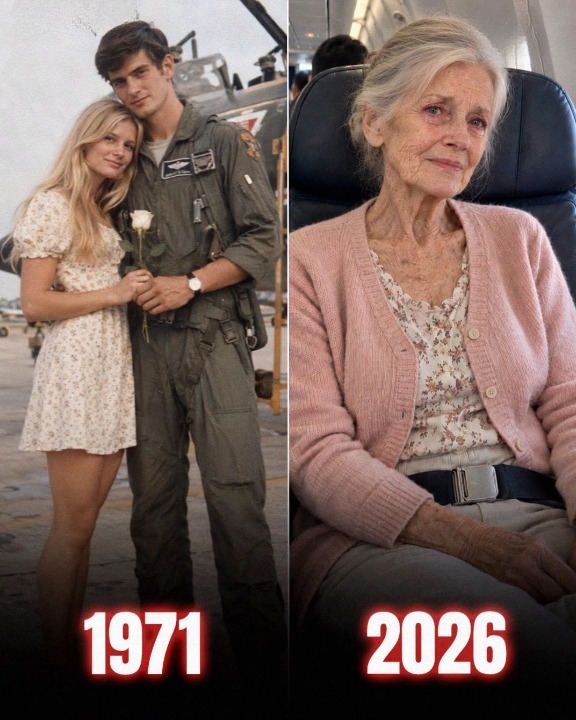
I was twenty-one years old when Thomas disappeared over Vietnam.
Fifty-five years later, I was still carrying his photograph in my handbag.
People often asked why I continued making the same journey every year. At my age, the flights were tiring, the airport corridors seemed to grow longer with every passing birthday, and the memorial itself was a place of sorrow rather than celebration.
But they never understood.
I wasn’t traveling to remember a man I had forgotten how to love.
I was traveling because, for more than half a century, I had lived with a question that nobody could answer.
What had really happened to Thomas?
And why, on the morning of my annual visit to his memorial, did a stranger’s voice suddenly come through the aircraft speakers and call my name?
The Boy Who Shared His Coffee With Me
Thomas and I met during our second year of college.
I was studying literature, spending most of my time in the library, where I preferred the company of books to crowded student gatherings. Thomas was an engineering student who always seemed to have grease on his fingers from repairing something that belonged to someone else.
We were both short of money.
Our first conversation began because he noticed me staring at the coffee machine in the student cafeteria.
“Are you trying to decide whether coffee is worth the financial ruin?” he asked.
I looked at him and laughed.
“Only because I have enough money for one cup, and I haven’t decided whether I need it more than lunch.”
He studied my expression, then placed a few coins on the counter.
“Then we’ll share.”
We sat beside a window, taking turns drinking from the same paper cup. He told me about engines, aircraft, and his dream of becoming a pilot. I told him about the books I loved and my ridiculous ambition to write a novel one day.
Neither of us had much to offer the other in material terms.
But we had time.
We spent afternoons walking across campus, evenings talking on the telephone, and weekends imagining the lives we might build together.
By our final year, our friends had stopped asking whether we intended to marry.
They simply assumed we would.
Thomas had a way of making ordinary moments feel important. He remembered the details of stories I told him. He listened when I was worried and made me laugh when I was determined to remain upset.
Once, when I asked him why he wanted to fly, he considered the question carefully.
“Because there’s something extraordinary about trusting a machine you’ve learned to understand,” he said. “You study it, respect it, and never forget what it can do.”
Then he smiled.
“And because I think I’d like to see the world from somewhere above it.”
I remember that conversation more clearly than many events from the years that followed.
Perhaps because I never imagined that one day, the sky would become the place where I lost him.
The Promise He Made Before Leaving
When Thomas announced that he had accepted a military pilot assignment, I tried to be supportive.
I told him I was proud of him.
I asked about his training, his duties, and the places he might travel.
But every time I imagined him thousands of feet above the ground, I felt an unfamiliar fear.
He noticed.
One evening, we sat together on the steps outside my parents’ house. The air smelled of wet grass, and a porch light flickered above us.
“You’re thinking about what could happen,” he said.
I didn’t deny it.
“I’m thinking about everything I can’t control.”
He took my hand.
“I can’t promise that life will always be easy, Eleanor. But I can promise I’ll do everything I can to come home.”
The night before he left, we stood outside the railway station where his transport was waiting.
I remember the cold metal of his watch against my fingers as I held his hand.
He pressed his forehead against mine.
“Don’t let me become some sad story you tell when you’re old,” he whispered.
I tried to smile.
“Then come back.”
He smiled, too.
“I will.”
It was the last promise he ever made to me in person.
Six months later, two uniformed officers arrived at my parents’ home.
I knew something was wrong before my mother opened the door.
The officers explained that Thomas’s aircraft had disappeared during a mission over Vietnam. There was no confirmed crash site, no recovered body, and no reliable information about what had happened after the aircraft was lost.
His status was recorded as missing in action.
I remember asking the same question several times.
“Are you certain?”
They explained what they knew.
I asked whether there was any chance he had survived.
They told me they couldn’t rule out every possibility, but they had no evidence that he had.
When they left, I sat at the kitchen table and stared at the untouched cup of tea in front of me.
My mother tried to comfort me.
I couldn’t hear her.
For the first time in my life, I understood that a person could disappear without leaving enough behind for the people who loved him to say goodbye.
Fifty-Five Years of Waiting
The years passed, but my life never followed the path everyone expected.
Friends married, had children, changed careers, and moved to different cities. I built a career in publishing and eventually became an editor, helping other people shape their words into stories worth sharing.
I had opportunities for love.
There were kind men who asked me to dinner, colleagues who showed interest, and friends who gently suggested that I deserved happiness.
I never believed that loving someone new would be a betrayal of Thomas. Life was more complicated than that.
But something in me remained unfinished.
I could not make peace with a story that had ended without an ending.
So I kept his photograph.
It was taken the week before he deployed. We were standing outside the college library, and Thomas had one arm around my shoulders. I was laughing at something beyond the camera, while he was looking directly at me.
I was twenty-one.
He was twenty-two.
We looked as though the world belonged to us.
Every year on his birthday, I traveled to the memorial where his name was engraved among the names of other service members whose lives had been lost or left unresolved by war.
I placed a single white rose beside his name.
I left a copy of our photograph.
And I stood there for a while, telling him about the year that had passed.
I told him about my work, the books I had edited, the friends I had lost, and the small things that made me laugh.
Sometimes, I apologized for how long it had taken me to visit.
Sometimes, I told him I missed him.
I never expected an answer.
I simply needed somewhere to place the words I had carried for decades.
This year, I made the journey as I always did.
I had no idea that before I reached the memorial, someone would tell me a truth that would change the meaning of every visit I had ever made.
The Voice From the Cockpit
The flight was approaching its destination when I first heard my name.
The aircraft had begun its descent. Passengers were returning to their seats, bags were being secured, and the cabin crew were preparing for landing.
I was sitting in seat 12A, holding a cup of water and looking through the window at the clouds below us.
Then the cabin speakers crackled.
“Ms. Eleanor?”
I barely paid attention.
There were thousands of people with my first name, and I assumed the announcement concerned someone else.
Then the voice continued.
“If you’re seated in 12A, I need you to know that this announcement is intended for you.”
My fingers tightened around the cup.
People nearby turned toward me.
The voice belonged to a man. He sounded older than I expected, and there was something strained in his delivery.
“I know where you’re going today,” he said.
My stomach tightened.
“And I know whose memorial you’re planning to visit.”
The cup trembled in my hand.
A woman across the aisle stared at me, clearly wondering whether I was part of some unusual situation.
Then the man spoke the name I had spent fifty-five years associating with a photograph, a promise, and a question that had never been answered.
“Thomas.”
I stopped breathing for a moment.
How could a stranger know about Thomas?
Why would a pilot address me over the aircraft’s public-address system?
And what could he possibly know about the memorial I visited every year?
There was a long silence.
Then the man spoke again.
“Ms. Eleanor, someone has been trying to find you for a very long time. It’s time you heard the whole truth.”
The announcement ended.
I sat frozen, unable to decide whether I was frightened, hopeful, or simply too shocked to think.
A flight attendant approached and crouched beside my seat.
“Ma’am, I need you to remain seated for a few minutes after we land. The captain has asked that the other passengers leave first.”
“Why?” I whispered.
“I’m sorry. I don’t know all the details.”
I tried to ask another question, but she was called away.
The aircraft touched down.
Passengers collected their belongings, thanked the crew, and filed into the terminal. I watched them leave one by one.
Eventually, the cabin became quiet.
I could hear the faint hum of the ventilation system.
Then a sound came from the front of the aircraft.
The cockpit door unlocked.
It opened.
A man stepped into the cabin.
He wore a pilot’s uniform, and he was holding a small, faded envelope.
He looked to be in his late sixties or early seventies.
He was not Thomas.
But the moment I saw his face, I felt as though I had stepped backward through time.
His eyes were familiar.
So was the shape of his smile.
I gripped the armrest.
“Oh my God,” I whispered.
The man stopped a few feet away.
He looked down at the envelope in his hands, then back at me.
“My name is David,” he said quietly. “I served with Thomas.”
My mouth went dry.
Then he spoke two sentences that made my entire understanding of the past begin to crumble.
“Thomas didn’t simply disappear, Eleanor. Before his last mission, he asked me to find you if I ever learned what happened to him.”
I stared at him.
“What do you mean?”
David swallowed.
“I found the answer years ago. But it took me this long to find you.”
The Envelope That Had Crossed Decades
David sat in the empty seat beside me.
For several moments, neither of us spoke.
He explained that he had served in the same unit as Thomas, although they had not known each other for very long before the mission that changed their lives.
He remembered Thomas as a thoughtful young man who spoke often about the woman he hoped to marry when he returned home.
“He carried your photograph,” David said.
I reached into my handbag and pulled out my own copy.
“This one?”
David looked at it and nodded slowly.
“That’s the photograph he showed us.”
My eyes filled with tears.
For fifty-five years, I had imagined Thomas carrying that picture somewhere in his flight equipment, perhaps keeping it in a pocket or tucked into a personal notebook.
Hearing someone confirm it made the distance between the past and present suddenly feel smaller.
David placed the envelope on my lap.
It was yellowed at the edges and had been carefully preserved.
My name was written across the front.
Not in Thomas’s handwriting, but in the hand of someone who had copied it from an old address.
“What is this?” I asked.
“Something that was preserved with records from his unit,” David replied. “I can’t promise it will answer every question. But I believe you deserve to see it.”
I opened the envelope with shaking fingers.
Inside was a short letter and a copy of an official report.
The letter was written by Thomas.
The date was several days before the mission during which his aircraft disappeared.
I recognized his handwriting immediately.
The way he formed the letter E. The slight slant of his words. The line he always drew beneath his signature.
I pressed my hand against my mouth.
David looked away, giving me time to read.
The letter was brief.
Thomas wrote that he was thinking of me and imagining the things we would do when he returned. He mentioned our college library, the coffee we had shared, and the novel I had promised to write.
Then he wrote a sentence I had never forgotten, even though I had spent years wishing I could hear it again.
“I intend to keep my promise, Eleanor. I intend to come home.”
I closed my eyes.
For a moment, I was twenty-one again, standing beside him outside the station.
Then I turned to the report.
And I began to understand why David had searched for me.
What the Records Revealed
David explained that Thomas’s aircraft had been lost during a mission, and the initial reports had not established what happened to him afterward.
At the time, the available information was incomplete. The circumstances were dangerous, communications were limited, and the confusion surrounding the loss made it impossible to determine his final movements with certainty.
Over the following years, additional information emerged from military records, witness accounts, and later investigations.
Some details remained uncertain.
Other details helped establish a clearer sequence of events.
David had spent years trying to understand what had happened to the men who had served with him. As he grew older, he began helping former service members and their families navigate old records and search for answers.
Thomas’s case remained one he could never forget.
“I remembered him talking about you,” David said. “He spoke about the life he wanted to return to. When I finally came across records that clarified part of what happened, I knew I had to find you.”
I looked at him.
“Why did it take so long?”
He didn’t offer an excuse.
“Because I didn’t know where you were. I had an old name and a college photograph. I searched through former classmates, historical records, and veterans’ contacts. I followed leads that went nowhere. More than once, I thought I would never find you.”
He paused.
“Then, a few months ago, someone who knew about your annual visits mentioned your name.”
I stared at the papers.
The documents helped explain the mission and the circumstances surrounding the aircraft’s disappearance. They provided details I had never received in the first notification.
But they did not offer the simple ending I had spent decades imagining.
There was no recovered body to bury, no final conversation to remember, and no way to know every thought Thomas had during his final hours.
David was honest about that.
“I wish I could give you every answer,” he said. “I can’t. There are still gaps in the record. I don’t want you to believe something that the evidence can’t establish.”
I appreciated his honesty, even as the truth hurt.
For so long, I had imagined that the right document or the right witness would finally make the mystery disappear.
Instead, I was learning that answers could come in pieces.
Sometimes, the truth did not remove uncertainty.
It simply gave uncertainty a shape.
The Promise Thomas Left Behind
There was one more item in the envelope.
A small sheet of paper, folded twice.
David told me that it had been preserved with Thomas’s personal effects and later included among the records that had been reviewed.
I opened it.
The writing was unmistakably Thomas’s.
It wasn’t a formal letter. It looked like a note written in a hurry, perhaps while he was waiting for something.
“Eleanor,” it began, “if I ever fail to return, I hope you won’t think that the life we imagined was wasted.”
I stopped reading.
My eyes blurred.
The next line was even harder.
“The time we have together matters, even if the future turns out differently from what we planned.”
I pressed the paper against my chest.
I had spent fifty-five years treating our unfinished future as though it were a promise I had failed to keep.
I had believed that moving forward would somehow diminish what we had shared.
But Thomas’s words offered a different way to remember him.
He had not asked me to spend my life waiting.
He had wanted us to have a future together, of course. He had wanted to come home.
But he had also understood that life was uncertain.
I looked at David.
“Did he really write this?”
David nodded.
“It was preserved with the material associated with him. I can’t tell you what he was thinking when he wrote it, but I believe the words are his.”
I read the note again.
Then I began to cry.
Not the quiet tears I had shed at the memorial each year, but the kind that rise from somewhere deep inside when a person has carried too much for too long.
David sat beside me without speaking.
He didn’t try to tell me everything would be all right.
He simply stayed.
And that was exactly what I needed.
The Memorial I Visited Differently
When I finally left the aircraft, the afternoon light was fading.
David accompanied me to the terminal and arranged to meet me later so we could discuss the records more carefully.
I still intended to visit the memorial.
For fifty-five years, I had approached it as someone who was waiting for a story to finish.
That afternoon, I approached it as someone who had finally been given another part of the story.
I carried my white rose in one hand and Thomas’s photograph in the other.
When I reached his name, I stood quietly for a long time.
I thought about the boy who had shared his coffee with me.
I thought about the young pilot who had promised to come home.
I thought about all the years in which I had wondered whether he had been afraid, whether he had remembered me, and whether he had known that his life would be remembered by someone who never stopped asking questions.
I still didn’t know everything.
Perhaps I never would.
But I knew that our relationship had been real. I knew that I had mattered to him. And I knew that he had carried memories of our life together into a future neither of us could predict.
I placed the rose beside his name.
Then I took out the photograph.
For the first time in decades, I didn’t feel that I was leaving it there as a substitute for a goodbye.
I was leaving it as a tribute to the young people we had been.
I spoke softly, telling Thomas about the journey, about David, and about the letter that had found its way back to me after so many years.
Then I said something I had never allowed myself to say at the memorial.
“I kept your memory, Thomas. But I don’t have to keep waiting for you.”
The words hurt.
They also brought a strange sense of peace.
I could remember him without making my entire future depend on the possibility of his return.
I could cherish the years we had shared without believing that the rest of my life had to remain frozen in the moment he disappeared.
The past would always be part of me.
But it did not have to be the only part.
A New Chapter at Eighty-Six
In the months that followed, David and I continued speaking.
He helped me understand the records and directed me toward people who could explain the historical details more accurately. Whenever something remained uncertain, he said so rather than filling the gaps with speculation.
I learned more about Thomas’s service and the difficult circumstances surrounding the disappearance of his aircraft.
Some answers were reassuring.
Others were painful.
None could restore the future we had imagined.
But they helped me separate what I knew from what I had feared for so many years.
I also began making small changes in my own life.
I accepted invitations I would once have declined. I reconnected with an old college friend. I began writing down memories of Thomas, not as a tragic story, but as a record of a young man whose life had touched mine.
The novel I had promised to write never became the book I imagined at twenty-one.
Instead, I began writing a collection of personal essays about memory, love, uncertainty, and the ways people carry the past.
I wrote about sharing a cup of coffee.
I wrote about the night before Thomas left.
I wrote about the two officers who arrived at my parents’ door.
And I wrote about the captain who called my name fifty-five years later, carrying a letter that helped me understand the man I had lost.
I didn’t write to turn my grief into a lesson for anyone else.
I wrote because the memories deserved somewhere to live.
One afternoon, I took Thomas’s photograph from its frame and placed it beside my writing desk.
For years, I had kept it in a drawer because looking at it hurt too much.
Now I could look at it and smile.
I could remember the awkward boy with grease on his fingers, the engineering student who dreamed of flying, and the young man who shared his coffee with me because neither of us could afford two cups.
I could remember him as someone who had lived, not only as someone who had disappeared.
And when I thought about the promise he had made, I no longer heard it as a sentence that had trapped me in the past.
I heard it as the hope of a young man who wanted to return to the woman he loved.
He hadn’t been able to keep that promise.
But the love behind it had been real.
At eighty-six, I finally understood that remembering someone and waiting for them are not the same thing.
I could continue to love the person Thomas had been without refusing the life I still had.
I could honor his memory without asking the future to remain empty.
And I could finally accept that some stories do not end with every question answered.
They end when we learn how to carry what remains.
Fifty-five years after Thomas disappeared, a stranger stepped out of a cockpit and gave me a letter I had never expected to read.
He couldn’t bring my sweetheart home.
He couldn’t return the years we had lost.
But he gave me something I had quietly searched for all my adult life: a clearer understanding of the past, and permission to stop treating my future as a place where nothing else could happen.
The next year, I visited the memorial again.
I carried one white rose.
I carried our photograph.
And for the first time, I also carried a notebook filled with the stories I had begun writing.
I stood beside Thomas’s name and smiled through my tears.
“I finally started that book,” I whispered.
The wind moved gently through the trees.
There was no voice from the sky, no miraculous answer, and no sudden end to the grief.
There was only the quiet memorial, the photograph in my hand, and the knowledge that a love can remain meaningful long after the future it promised has disappeared.
For fifty-five years, I had visited that place because I could not say goodbye.
This time, I went because I could finally remember Thomas without losing myself in the waiting.
And that was a beginning I had never believed I would find.