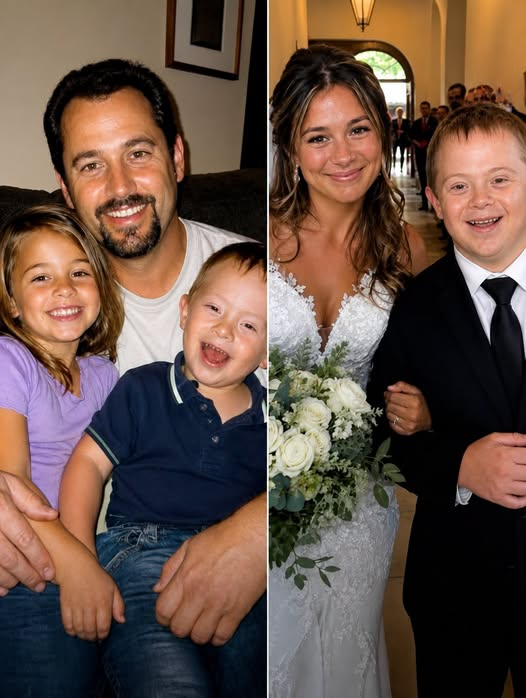
When my brother asked whether he could take our father’s place at my wedding, I had no hesitation.
My answer was yes.
What I didn’t expect was that one person’s objection would force me to rethink the entire ceremony—not because I was willing to exclude my brother, but because I wanted to make sure his role was protected from anyone who tried to diminish it.
My father had been gone for eleven months.
For nearly a year, I had avoided thinking too deeply about the moment when I would eventually walk down the aisle without him.
Then my brother gave me an answer I hadn’t realized I was waiting for.
And it changed everything.
“Can I Do Dad’s Job?”
My brother and I were sitting in the kitchen one afternoon.
We had been talking about the wedding, although neither of us had really discussed the part that mattered most to me.
He kept starting sentences and stopping.
Eventually, he looked at me.
“Can I do Dad’s job?”
I smiled, assuming he meant something simple.
“Which job?”
“At the wedding.”
I thought he might be talking about helping with the programs or greeting guests.
Then he clarified.
“I mean walk you.”
I stopped moving.
“Down the middle,” he added.
For a moment, I couldn’t answer.
Nathan was thirty-one. He has Down syndrome, and he had always shared a special bond with our father.
They were incredibly close.
Dad used to spend Saturday mornings in the garage with him. They had their own routines, their own jokes, and even a favorite coffee mug that somehow always ended up in Nathan’s hands.
They could tell the same joke five times and still laugh like it was brand new.
After Dad died, Nathan missed him terribly.
So did I.
For eleven months, I had tried not to think about who would be waiting beside me at the back of the church.
Every possibility felt wrong.
No one could actually replace Dad.
But then Nathan offered to stand where Dad should have been.
I covered my mouth with my hand.
Nathan simply waited for my answer.
“Are you sure?” I finally asked.
He nodded.
“I practiced.”
That was when I started crying.
I told him yes.
He Took the Responsibility Seriously
Nathan didn’t treat the idea like a symbolic gesture.
He treated it like an important responsibility.
Within days, he had started practicing.
My uncle later told me that Nathan had been walking repeatedly down the upstairs hallway, keeping one arm positioned as though someone were standing beside him.
He counted his steps.
Then he would turn around and do it again.
He even contacted the church himself.
He wanted to know exactly what he should do when he reached the front.
Where should he stand?
When should he stop?
Which direction should he face?
How quickly should he walk?
He wanted everything right.
Whenever someone asked whether he was nervous, Nathan gave the same response.
“I practiced.”
And he had.
Everyone who knew him understood how much the moment meant.
My mother cried when she heard about his plan.
My fiancé, Daniel, immediately told me he thought it was perfect.
“This is exactly how it should be,” he said.
For the first time since Dad’s death, I felt genuinely excited about walking down the aisle.
Nathan wasn’t replacing Dad.
He was carrying something Dad had left behind.
Then Everything Changed
Three weeks before the wedding, I was having dinner with my future mother-in-law.
Nathan was there too.
At first, everything was normal.
Then she brought up the wedding ceremony.
“He can come, obviously,” she said.
I looked at her.
“Nobody is saying he can’t.”
I didn’t understand where the conversation was going.
She continued.
“I’m only saying that he doesn’t necessarily need to be part of the ceremony.”
My stomach tightened.
“Why not?”
She sighed.
“Sweetheart, you need to think practically.”
Nathan was sitting right there.
He wasn’t interrupting.
He wasn’t making a scene.
He was simply listening.
My future mother-in-law continued.
“This isn’t just about one photograph.”
I waited.
“It’s the entire aisle sequence. The wedding album. The photographs we’ll keep forever. The picture that will eventually be enlarged and displayed in the house.”
She paused.
Then she said something I will never forget.
“His face will be in every photograph.”
I stared at her.
She continued.
“You’ll have to look at those pictures for decades. I don’t want those photographs.”
For several seconds, nobody spoke.
I felt anger rising inside me.
I wanted to tell her exactly what I thought.
I wanted to ask how she could sit across from Nathan and discuss him as though he were an inconvenience that needed to be edited out of our wedding memories.
I wanted to tell her that those photographs were supposed to represent the people who mattered to us—not the people she considered appropriate for a wedding album.
But Nathan was sitting beside her.
And I didn’t want his memory of that evening to be an argument.
So I took a breath.
I placed my glass down.
Then I said something completely ordinary.
“The salmon is very good.”
Everyone became quiet.
My future mother-in-law looked confused.
Daniel reached under the table and gently squeezed my hand.
“We’ll figure something out,” he said.
I looked at him.
And in that moment, I realized something.
I wasn’t going to give his mother the confrontation she seemed to be expecting.
I was going to handle this differently.
I Couldn’t Sleep That Night
After I got home, I kept replaying the conversation.
I thought about Dad.
I thought about Nathan practicing in the hallway.
I thought about the way his face had lit up when he asked if he could walk beside me.
And I thought about the words I had heard at dinner.
Eventually, I stopped thinking about what I wanted to say to my future mother-in-law.
Instead, I started thinking about what I wanted the wedding day to look like.
I didn’t want anyone arguing.
I didn’t want Nathan embarrassed.
I didn’t want Daniel caught between me and his mother.
And most importantly, I didn’t want a single person’s prejudice to become the central memory of our wedding.
By three in the morning, I had a plan.
The next morning, I called our photographer.
“I need to make a change to the wedding-day photography schedule,” I said.
She immediately asked what I had in mind.
“I need you to keep it confidential.”
There was a short pause.
“Of course.”
“Please don’t mention it to anyone in Daniel’s family. Especially his mother.”
“Okay,” she said. “Tell me what you need.”
I explained everything.
The Photographer Helped Me Create a New Plan
I didn’t cancel Nathan’s role.
I didn’t hide him.
I didn’t change the ceremony to make anyone comfortable.
Instead, I decided that Nathan would still walk me down the aisle exactly as we had planned.
But I also wanted to create a private moment before the ceremony.
A moment that belonged to Nathan and me.
The photographer understood immediately.
She suggested arriving early enough to photograph us together before most of the guests arrived.
We planned several pictures in the church courtyard.
There would be photographs of Nathan holding my arm.
Pictures of us laughing.
Pictures of him fixing my veil.
Pictures of him standing beside me in the same place where Dad would have stood.
And one photograph was particularly important.
I asked the photographer to take a picture of Nathan holding Dad’s old watch.
It was the watch Dad had worn almost every day.
Nathan had kept it after Dad died.
He carried it with him whenever he felt particularly emotional.
I wanted that watch in the photographs.
Not because I wanted people to feel sorry for us.
Because Dad was still part of the story.
I Also Made One More Change
I spoke privately with the priest.
I explained that Nathan would be walking me down the aisle.
The priest smiled.
“I think your father would be proud.”
Those words nearly broke me.
I asked whether Nathan could have a small role during the ceremony as well.
The priest agreed.
Nothing complicated.
Nothing that would put pressure on him.
Just something meaningful.
At the beginning of the ceremony, Nathan would stand beside me.
When we reached the front, he would hand me Dad’s old watch.
Then he would take his seat.
It was simple.
It was respectful.
And it was ours.
The Wedding Day Arrived
Three weeks later, I woke up before sunrise.
I was nervous.
Not because of the ceremony.
Not because of the guests.
Not even because of my future mother-in-law.
I was nervous because I knew that when the church doors opened, I would have to walk through them without Dad.
But I wouldn’t be alone.
Nathan arrived early.
He was wearing his suit.
His tie wasn’t quite straight.
He kept checking his shoes.
Then he looked at me.
“You ready?”
I laughed.
“I think so.”
He nodded.
“I practiced.”
I smiled.
“You’ve told me that about twenty times.”
“I practiced twenty times.”
That made me laugh harder.
For a few minutes, everything felt normal.
Then Nathan reached into his pocket.
He pulled out Dad’s watch.
“I brought it.”
I touched it carefully.
“Thank you.”
He smiled.
“Dad should be here.”
I nodded.
“He is.”
Nathan looked at me.
“How?”
I placed my hand over the watch.
“Right here.”
The First Photographs
Before the ceremony, the photographer took us outside.
The morning light was soft.
There weren’t many guests around yet.
Nathan stood beside me.
The photographer asked us to look toward the camera.
Then she stopped.
“Actually,” she said, “don’t pose.”
We looked at her.
“Just talk to each other.”
So we did.
Nathan told me he was nervous.
I told him I was too.
He reminded me that he had practiced.
I told him I knew.
Then we laughed.
The photographer captured everything.
No forced smiles.
No staged expressions.
Just two siblings standing together on an important day.
One photograph showed Nathan holding Dad’s watch.
Another showed him adjusting my veil.
Then she took one of us walking toward the church together.
That photograph became my favorite.
The Doors Opened
Eventually, the guests took their seats.
The music began.
Everyone stood.
I waited at the back of the church with Nathan.
He offered his arm.
I took it.
Then the doors opened.
For one second, I couldn’t move.
I saw the crowd.
I saw Daniel at the front.
I saw my mother crying.
And then I saw Nathan.
He wasn’t looking at anyone else.
He was looking straight ahead.
We began walking.
Slowly.
One step at a time.
Nathan counted quietly under his breath.
One.
Two.
Three.
Four.
I almost laughed.
He had practiced exactly as he promised.
Halfway down the aisle, I noticed something unexpected.
My future mother-in-law was crying.
Not dramatically.
Not loudly.
She was simply sitting there with tears running down her face.
I didn’t know what she was thinking.
And I didn’t need to know.
I kept walking.
When We Reached Daniel
Nathan and I reached the front.
Daniel stepped toward us.
His eyes were already wet.
Nathan took Dad’s watch from his pocket.
He placed it in my hand.
Then he looked at Daniel.
“Take care of her.”
Daniel nodded.
“I will.”
Nathan turned toward me.
“You look beautiful.”
I hugged him.
“Thank you for walking with me.”
He whispered something only I could hear.
“Dad would like it.”
I nodded.
“He would.”
Then Nathan took his seat.
The ceremony continued.
The Photograph She Didn’t Want
Later, during the reception, the photographer showed me one of the early photographs on her camera.
It was the picture of Nathan and me walking toward the church.
Behind us was the doorway.
Ahead of us was the aisle.
The photograph captured the exact moment we entered.
It was beautiful.
I asked her to print it.
Then I asked for another copy.
And another.
Not because I wanted to prove anything.
Because I knew that photograph would become part of our family history.
My Future Mother-in-Law Approached Me
After dinner, she came over.
For a moment, neither of us spoke.
Then she said:
“I owe you an apology.”
I wasn’t expecting it.
She looked toward Nathan, who was talking to one of my cousins.
“I was wrong.”
I didn’t respond immediately.
She continued.
“I thought I was protecting the wedding photographs.”
I almost smiled.
“But I realized something today.”
She looked at me.
“The photographs I was afraid of are probably going to be the photographs you treasure most.”
I didn’t tell her she was right.
I didn’t need to.
She continued.
“I didn’t understand what Nathan meant to you.”
I answered honestly.
“He means a lot to me.”
She nodded.
“I can see that now.”
Then she walked away.
There was no dramatic confrontation.
No shouting.
No public humiliation.
Just an apology.
And that was enough.
Nathan Never Knew About the Argument
One thing mattered to me more than anything else.
Nathan never needed to know what she had said at dinner.
He didn’t need to know that someone had questioned whether he belonged in the photographs.
He didn’t need to carry that memory.
As far as he knew, he had been asked to do something important for his sister.
And he had done it.
Perfectly.
The Photograph Became Part of Our Home
Months later, we received the finished wedding album.
There were hundreds of photographs.
Family portraits.
Pictures of the ceremony.
Pictures from the reception.
Pictures of Daniel and me.
But the photograph I loved most was the one of Nathan and me walking down the aisle.
We eventually enlarged it.
It now hangs in our living room.
Not because it represents a disagreement.
Not because it proves someone wrong.
Because it represents love.
It represents my father.
It represents my brother.
And it represents the moment when someone I love stepped forward and offered to carry a piece of my father’s place in my life.
What I Learned From That Day
Looking back, I realize that I could have handled everything very differently.
I could have argued at the dinner table.
I could have embarrassed my future mother-in-law in front of everyone.
I could have demanded an apology.
I could have turned the entire situation into a family conflict.
But none of those things would have changed the most important part.
Nathan deserved to feel valued.
He deserved to know that his role mattered.
And I wanted the wedding to be about love rather than conflict.
Sometimes, the strongest response isn’t the loudest one.
Sometimes, you don’t need to win an argument.
You simply need to protect what matters.
A Wedding Isn’t a Perfect Photograph
A wedding album isn’t supposed to document perfection.
It is supposed to preserve memories.
Real memories.
The people who stood beside us.
The people who made us laugh.
The people we missed.
The people who supported us.
And the people who helped us become who we are.
If one photograph contains someone who is different from what another person imagined, that doesn’t make the photograph less beautiful.
It can make it more meaningful.
Nathan didn’t walk me down the aisle because someone needed to replace Dad.
He walked beside me because he is my brother.
He loved Dad.
He loved me.
And he wanted to be there.
That was enough.
The Lesson I Wanted to Teach
I originally thought my response would be about teaching my future mother-in-law a lesson.
But by the end of the wedding, I realized the lesson wasn’t really for her.
It was for me.
I learned that I don’t have to fight every battle publicly.
I learned that protecting someone’s dignity can be more powerful than humiliating the person who tried to take it away.
And I learned that sometimes the best way to answer a hurtful comment is simply to live your life in a way that makes the comment meaningless.
Nathan walked beside me.
He held Dad’s watch.
He stood beside me in the photographs.
And when I look at those pictures now, I don’t see controversy.
I see my brother.
I see my father.
I see my family.
And I see one of the most meaningful moments of my life.
That is the photograph I will keep forever.