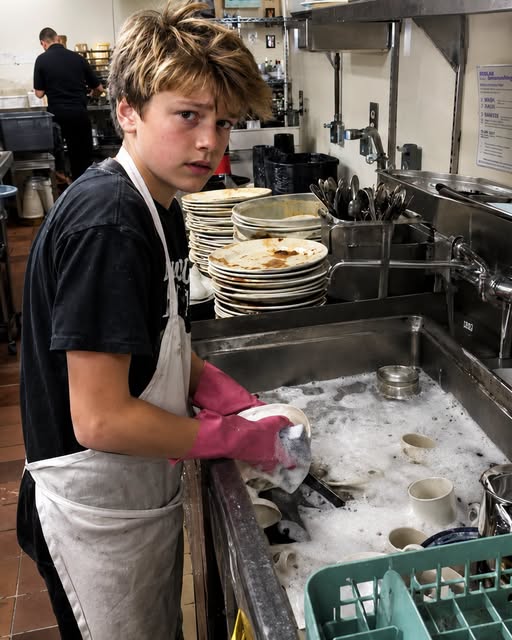
My 13-Year-Old Son Said He Was Saving for a Bike—Then His Boss Called Me
For six months, I believed my thirteen-year-old son was saving every paycheck for a bicycle.
I thought I knew exactly what he was doing.
Every Saturday morning, Evan would put on his old jeans, pull on a pair of sneakers, and leave the house carrying a small lunch bag.
When he came home several hours later, his clothes smelled like dish soap and French fries.
He always looked tired.
But he also looked proud.
“I’m almost there,” he would tell me whenever I asked about the money.
I believed him.
Until his boss called me one Saturday afternoon and said something that made my stomach drop.
“Ma’am, do you have any idea what Evan does with every paycheck?”
I laughed nervously.
“He’s saving for a bicycle.”
There was a long silence.
Then the man said:
“You need to sit down.”
The bicycle
Evan had been asking for a new bicycle for months.
His old one was small and had been passed down from a cousin.
The brakes didn’t work particularly well, one of the pedals was cracked, and the chain had fallen off more times than I could count.
Every time I suggested buying him a replacement, he refused.
“I can save for it myself.”
“You’re thirteen.”
“I know.”
“You don’t have to pay for everything yourself.”
He would simply smile.
“I want to.”
Ever since Evan’s father died three years earlier, he had become unusually independent.
Sometimes too independent.
He didn’t ask for expensive clothes.
He rarely requested new electronics.
He even apologized when I bought him something he needed.
I tried to reassure him.
“You’re allowed to be a kid.”
He always answered the same way.
“I know, Mom.”
But I wasn’t convinced.
So when he told me he’d found a Saturday job washing dishes at a local diner, I was surprised.
I asked questions.
The owner assured me that Evan would only be helping with light tasks under adult supervision and that I would need to approve the arrangement.
I wasn’t thrilled about it.
But Evan was determined.
And I agreed that if he was going to work at all, school had to remain his priority and the arrangement had to be safe and appropriate for his age.
For the first few weeks, everything seemed fine.
He came home smelling like soap and fried food.
He complained about washing the same plates over and over.
And he saved his money.
Or so I thought.
Six months without a bicycle
The strange thing was that six months passed.
And Evan still didn’t have a bicycle.
One evening, I walked past his bedroom and saw him sitting on the floor.
He had a stack of cash in front of him.
Not a huge amount.
But enough that I stopped in the doorway.
“What are you doing?”
He looked up.
Then he quickly gathered the money and put it into his backpack.
“Nothing.”
“Evan.”
“I’m saving.”
“For the bike?”
He nodded.
“How much do you have?”
“Enough.”
“That’s not an answer.”
He smiled.
“Almost there.”
Then he changed the subject.
I let it go.
At the time, I thought maybe he was embarrassed about how much he had saved.
But a few weeks later, something else happened.
He came home almost two hours later than usual.
His sneakers were covered in mud.
One sleeve of his shirt was torn.
I immediately became concerned.
“What happened?”
“I fell.”
“Where?”
“On the way home.”
“Are you hurt?”
“No.”
I checked his arms and face.
There was a small scrape on his elbow.
Nothing serious.
But I noticed something else.
His backpack looked unusually full.
“Where’s your paycheck?”
He looked away.
“I put it somewhere safe.”
“What does that mean?”
“Mom, it’s fine.”
I wasn’t convinced.
But he refused to talk about it.
The phone call
The following Saturday, Evan went to work as usual.
I was preparing lunch when my phone rang.
It was the diner.
I recognized the number.
“Hello?”
A man’s voice answered.
“Mrs. Carter?”
“Yes.”
“This is Mr. Lewis from the diner.”
“Is Evan okay?”
There was a pause.
“Yes.”
Then another pause.
“I need to talk to you about something.”
My stomach tightened.
“Did he do something wrong?”
“I honestly don’t know how to answer that.”
“What does that mean?”
Mr. Lewis lowered his voice.
“Do you know what your son does with every paycheck?”
I frowned.
“He’s saving for a bicycle.”
Another silence.
Then he said:
“Ma’am, you need to sit down.”
I sat at the kitchen table.
“What happened?”
“I think you should come here.”
“Why?”
“I don’t want to discuss this over the phone.”
Before I could respond, I heard voices in the background.
Then I recognized one of them.
Evan.
“Please don’t tell my mom.”
My heart began pounding.
“Evan?”
There was a loud sound in the background.
Not a scream.
It sounded like something had fallen.
Then Mr. Lewis came back on the line.
“Please come here.”
I grabbed my keys.
The diner
I drove faster than I should have.
Not dangerously.
But fast enough that I kept checking the clock.
Hundreds of questions were racing through my mind.
Had someone taken his money?
Was he being bullied?
Was someone threatening him?
Had he gotten into trouble?
When I arrived, I saw Mr. Lewis standing outside.
He immediately walked toward my car.
“Where’s my son?”
“He’s inside.”
“Is he hurt?”
“No.”
“Then what happened?”
Mr. Lewis hesitated.
“I think you need to see something.”
He led me through the back entrance.
The diner was nearly empty.
Evan was sitting at a small table in the office.
His head was down.
The moment he saw me, he stood.
“Mom.”
I rushed over.
I checked his face, arms, and hands.
“Are you hurt?”
“No.”
“What happened?”
He wouldn’t look at me.
Then Mr. Lewis placed something on the desk.
A large envelope.
I recognized Evan’s handwriting.
My name was written across the front.
I looked at my son.
“What is this?”
He swallowed.
“I was going to give it to you later.”
“What’s inside?”
He didn’t answer.
I opened the envelope.
Inside was a stack of receipts.
School supplies.
Grocery receipts.
Utility payments.
A few pharmacy receipts.
I looked at Evan.
None of it made sense.
Then I noticed the names on the receipts.
They were all mine.
The truth
“Evan,” I said quietly, “what is this?”
His eyes filled with tears.
“You’ve been paying bills?”
He shook his head.
“Not all of them.”
I looked at Mr. Lewis.
He explained.
A few months earlier, Evan had overheard me talking to a relative about money.
Our household had been struggling more than I had admitted to him.
I had tried to hide it.
I had stopped buying small things for myself.
I had delayed replacing a broken appliance.
I had quietly cut back on groceries.
I thought Evan hadn’t noticed.
He had.
Apparently, he noticed everything.
One afternoon, he asked Mr. Lewis whether there was a way he could earn money.
Mr. Lewis agreed to let him help with appropriate tasks under supervision, with my approval.
But Evan hadn’t been saving the money for a bicycle.
He had been