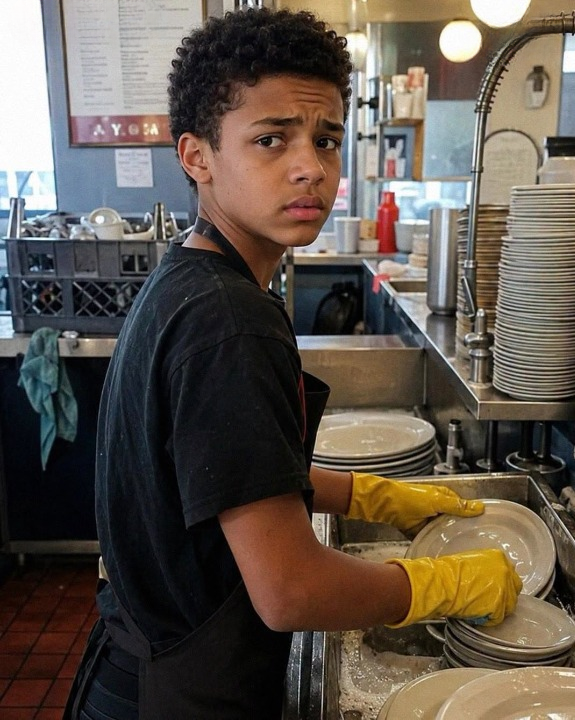
My thirteen-year-old son, Evan, had been talking about getting a bicycle for months.
Not just any bicycle, either. He had found a particular model online that he absolutely loved. It was sturdy, had thick tires, and came in the dark blue color he liked. Every time we passed a bike shop, he’d slow down to look through the window.
One evening, while we were eating dinner, he suddenly announced that he had found a way to buy it himself.
“I got a Saturday job at the diner,” he said proudly.
I nearly dropped my fork.
“A job?”
He nodded enthusiastically.
“I’ll be washing dishes and helping clean up. My boss said I can work weekends.”
I wasn’t sure how to feel. Part of me was impressed by his determination. Since his father passed away three years earlier, Evan had become unusually independent. He rarely asked me for expensive things, even when I knew he wanted them.
Still, I reminded him that he was only thirteen and that school had to come first.
“I know,” he said. “I’ll keep my grades up. I just want to earn the bike myself.”
After talking it over, I agreed that he could work a limited number of hours, provided everything was appropriate and approved by the adults responsible for him.
The following Saturday, Evan put on his oldest jeans, laced up his sneakers, and headed to the neighborhood diner.
When he returned several hours later, he smelled strongly of soap, fried food, and coffee.
He looked exhausted.
But he was smiling.
“How was it?”
“Great.”
“Did you have fun?”
He laughed.
“Fun isn’t exactly the word I’d use for washing fifty plates, but it was okay.”
I smiled.
“At least you’re learning what earning money is like.”
He nodded.
From that point forward, Saturdays became his workdays.
He would leave in the morning and return in the afternoon. Sometimes he talked about the customers. Sometimes he told me funny stories about the kitchen. Other times, he simply ate dinner and disappeared into his room.
Whenever I asked about his savings, he’d give me the same answer.
“Almost there.”
I assumed he was saving every dollar.
But after a few months, something started bothering me.
The bicycle still hadn’t appeared.
I didn’t want to pressure him. Perhaps he was saving for something else or had changed his mind.
Then, one evening, I walked past his bedroom and noticed the door was slightly open.
Evan was sitting on the floor beside his bed.
He had several bills spread out in front of him.
There seemed to be far more money than I expected.
The moment he noticed me, he quickly gathered everything and put it into a backpack.
“What are you doing?” I asked.
“Counting.”
“How much have you saved?”
He hesitated.
“A lot.”
I smiled.
“That’s good. Are you getting close to the bicycle?”
His expression changed for just a moment.
“Yeah. Almost.”
Something about the way he answered made me pause.
But I didn’t want to invade his privacy.
He was getting older, and I wanted to teach him responsibility rather than make him feel as though every decision he made was being monitored.
So I let it go.
A couple of weeks later, another strange thing happened.
Evan arrived home late from work.
Much later than usual.
His jeans were covered in dirt, and one sleeve of his shirt had a small tear.
I immediately became concerned.
“What happened?”
“I fell.”
“Where?”
“On the way home.”
I looked at him carefully.
“Are you hurt?”
“No. I’m fine.”
I wasn’t completely convinced, but he seemed physically okay.
Then I asked the question that had been bothering me.
“Where’s your paycheck?”
His eyes dropped toward the floor.
“I put it somewhere safe.”
That answer made my concern grow.
“What does that mean?”
“I don’t want to lose it.”
“You’re not in trouble, Evan. I’m just asking because you’ve been working for months and I want to make sure everything is okay.”
He nodded but didn’t say anything else.
That night, I couldn’t stop thinking about it.
I began wondering whether there was something he was embarrassed to tell me.
Maybe he had spent some of the money.
Maybe he’d bought something online.
Maybe he was saving for a surprise.
There were plenty of harmless explanations.
But something still didn’t feel right.
The next Saturday, I decided not to ask any more questions.
I wanted him to come to me when he was ready.
Then, a few days later, my phone rang.
I didn’t recognize the number.
“Hello?”
A man’s voice answered.
“Is this Evan’s mother?”
“Yes.”
“My name is Mr. Harris. I manage the diner where Evan works.”
My stomach tightened.
“Is there a problem?”
There was a pause.
“That’s what I’m trying to figure out.”
I sat down.
“What happened?”
“I think we should talk about Evan.”
I immediately became worried.
“Did he do something wrong?”
“Not exactly.”
“Then what is it?”
Another pause.
“Do you know what your son has been doing with his earnings?”
I frowned.
“He told me he was saving for a bicycle.”
Mr. Harris became quiet.
Then he said something that completely changed the way I looked at the past several months.
“I don’t think that’s the whole story.”
My heart began beating faster.
“What do you mean?”
“I’ve watched this boy carefully. He works hard. He doesn’t complain. But every time he gets paid, he takes the money and leaves.”
“Where does he go?”
“I don’t know.”
I stood up.
“Why are you calling me?”
Mr. Harris sighed.
“Because something happened today that I think you need to know about.”
Before I could ask another question, I heard Evan’s voice somewhere in the background.
“Please don’t call my mom.”
My heart sank.
“Evan?”
There was a moment of silence.
Then Mr. Harris came back onto the phone.
“Ma’am, I think you should come down here.”
I grabbed my coat.
“Is my son okay?”
“He’s fine. But there’s something you need to see.”
I drove to the diner with my mind racing.
For thirteen years, I had believed I knew my son better than anyone.
I knew what foods he disliked.
I knew which subjects he enjoyed at school.
I knew which songs he listened to when he did his homework.
I knew he missed his father.
And I knew he wanted that bicycle.
Or at least, I thought I did.
When I arrived at the diner, Mr. Harris was waiting near the entrance.
He looked unusually serious.
“Where’s Evan?”
“He’s in the back.”
I followed him through the kitchen.
When I saw my son, he was sitting at a small table with his backpack beside him.
His face immediately fell when he saw me.
“Mom…”
I walked over and knelt beside him.
“What is going on?”
He looked at Mr. Harris.
Then he looked at me.
For several seconds, he said nothing.
Finally, he reached into his backpack.
He pulled out an envelope.
Then another.
Then another.
My confusion only grew.
“What are those?”
Evan took a deep breath.
“I was going to tell you.”
“Tell me what?”
He stared at the table.
“I wasn’t saving for the bike.”
I sat down.
“Then what have you been saving for?”
He slowly pushed the envelopes toward me.
Inside were receipts, notes, and small amounts of money carefully separated into different envelopes.
I looked at him.
“Why?”
He finally raised his eyes.
“Because I wanted to help someone.”
I didn’t know what to say.
Mr. Harris quietly explained that Evan had noticed another employee at the diner was struggling to cover transportation costs after an unexpected change in her family situation.
Evan had overheard a conversation and, without telling anyone, decided to contribute some of his own earnings.
But that wasn’t all.
The reason he had been coming home late was because he had occasionally stayed after his shift to help organize donated food that the diner distributed through a local community program.
He hadn’t told me because he was afraid I’d stop him from giving away the money he had earned.
I stared at my son.
“Is that why you didn’t buy the bicycle?”
He nodded.
“I still want the bike.”
Despite everything, I couldn’t help smiling.
“But I thought someone else needed the money more.”
I felt tears welling in my eyes.
For months, I had been worried that my son was hiding something troubling from me.
Instead, he had been hiding something completely different.
He had been trying to help someone without expecting recognition.
I hugged him tightly.
“You should have told me.”
“I know.”
“You don’t have to handle everything by yourself.”
He nodded against my shoulder.
“I just wanted to do something good.”
Mr. Harris smiled.
“He does have one more problem, though.”
I looked up.
“What?”
“He has a bicycle waiting for him.”
Evan’s eyes widened.
“What?”
Mr. Harris laughed.
“The staff have been listening to you talk about that bike for months. Everyone chipped in.”
Evan looked at me in disbelief.
“You knew?”
“No,” I said, laughing through my tears. “Apparently, I knew absolutely nothing.”
A few days later, we went together to pick out the bicycle.
Evan chose the same dark blue model he’d been admiring all along.
But this time, he didn’t insist on paying for it himself.
Instead, he agreed that we’d treat it as a reward for his hard work and his willingness to help someone else.
That experience taught both of us something.
I learned that growing up doesn’t always look the way parents expect.
Sometimes children keep secrets because they’re afraid of disappointing us.
Sometimes they’re trying to solve problems that feel much bigger than they are.
And sometimes, when a teenager seems distant or unusually private, the best response isn’t immediately to assume the worst.
It’s to make sure they know they can always come home and talk.
As for Evan, he learned something too.
Helping others is a wonderful thing, but he doesn’t have to carry every responsibility alone.
He can ask for help.
He can talk to his mother.
And he can still save for the things he wants.
That weekend, we took his new bicycle to the park.
He rode ahead while I walked behind him.
Every few minutes, he turned around and shouted something about how fast the bike was.
I watched him disappear around a bend in the path and smiled.
For months, I’d thought I was waiting for my little boy to grow up.
But maybe what I was really learning was how to let him grow while still reminding him that he never has to do it alone.