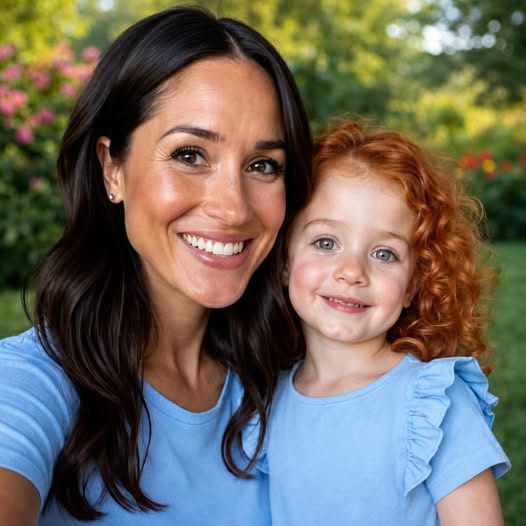
Meghan Markle Shares a Glimpse of Lilibet as Fans Notice a Familiar Family Feature
For years, Prince Harry and Meghan Markle have been careful about how much of their children’s lives they share publicly.
Their approach has been understandable. As members of one of the world’s most recognizable families, their children have attracted significant public attention from an early age. Rather than allowing every detail of their childhood to become a headline, the couple has generally chosen to reveal only limited glimpses of their family life.
That is why even a small photograph or personal comment can attract considerable attention.
Recently, renewed interest surrounding their daughter, Princess Lilibet Diana, sparked a wave of online discussion. Much of the conversation focused on her appearance, particularly her distinctive reddish hair and the resemblance some observers believe she shares with members of both sides of her family.
What began as interest in a child’s appearance quickly developed into a much broader conversation about family resemblance, privacy, and the intense public fascination surrounding the Sussex family.
However, there is an important distinction between what can actually be observed and what people simply speculate about online.
A Family Moment Draws Attention
Photographs of children belonging to famous families tend to receive an unusual amount of attention.
For most parents, a picture of their child might be shared with relatives and friends before disappearing into a personal photo album.
For the Sussexes, however, even an innocent family image can generate thousands of comments.
People examine details such as clothing, facial features, hair color, expressions, and even the setting in which a photograph was taken.
Lilibet has been the subject of this attention since her birth.
Born in June 2021, she was named Lilibet Diana Mountbatten-Windsor. Her first name has a particularly strong family connection, as “Lilibet” was a childhood nickname used by Queen Elizabeth II.
Her middle name, Diana, honors Harry’s late mother, Diana, Princess of Wales.
Because of those connections, public interest in Lilibet has always extended beyond ordinary celebrity curiosity.
People have naturally wondered which characteristics she may have inherited from her parents and grandparents.
Her hair has become one of the most frequently discussed features.
The reddish tone has prompted comparisons with Prince Harry, whose hair has long been one of his most recognizable physical characteristics.
Others have pointed to similarities with relatives on Meghan’s side of the family.
But family resemblance is rarely as simple as an online comparison makes it appear.
Hair color can change as children grow.
Lighting can alter how photographs appear.
Camera settings, image processing, and even the surrounding colors can influence how someone’s hair or skin tone looks in a particular picture.
That means a photograph can encourage conversation without necessarily proving anything beyond what the image itself shows.
Why Lilibet Attracts So Much Attention
There is another reason photographs of Lilibet generate unusual interest.
The public has seen relatively few images of her compared with many other children connected to prominent public families.
Harry and Meghan have repeatedly emphasized the importance of protecting their children’s privacy.
That has created an interesting situation.
The less frequently a family appears in public photographs, the more attention each individual appearance may receive.
A single photograph can therefore become a major topic of conversation.
People who rarely see Lilibet may notice details that would seem insignificant if photographs were published regularly.
A new hairstyle becomes interesting.
A change in height becomes noticeable.
A familiar expression becomes something people compare with older family photographs.
And hair color becomes a topic of discussion.
This doesn’t necessarily mean there is a hidden story behind the image.
Sometimes, a photograph is simply a photograph.
The Red Hair Conversation
One of the most common observations surrounding Lilibet has been the color of her hair.
Prince Harry has naturally red hair, making the similarity particularly easy for people to notice.
For years, Harry’s hair has been an instantly recognizable part of his appearance.
Lilibet’s reddish hair has therefore encouraged many people to point toward the obvious family connection.
But genetics are more complicated than simple visual comparisons.
Children inherit characteristics from multiple relatives, and traits can appear differently across generations.
A child might resemble a parent in one feature while looking more like a grandparent in another.
Two siblings can also have noticeably different hair colors, even when they share the same parents.
Hair can become darker or lighter with age.
Sun exposure can affect its appearance.
And photographs taken under different lighting conditions can make the same hair appear significantly different.
So while observers may notice a resemblance between Lilibet and her father, that observation should remain exactly that: an observation.
It doesn’t establish any broader conclusion.
Social Media Turns Family Resemblance Into a Debate
Modern social media has changed how people discuss celebrity families.
In the past, photographs of famous children appeared primarily in magazines, newspapers, television programs, or official publications.
Today, a single image can circulate across dozens of platforms within minutes.
Users can zoom in.
Compare photographs.
Create side-by-side images.
Discuss family trees.
Share theories.
And respond to one another instantly.
That creates a powerful feedback loop.
One person notices a similarity.
Another person agrees.
A third person suggests a different explanation.
Eventually, a simple observation can become an elaborate online theory.
The original photograph may have contained very little information.
But the conversation surrounding it can become enormous.
This is particularly true when the people involved belong to the British royal family.
The royal family has been the subject of intense public interest for generations.
Every relationship, wedding, birth, photograph, and public appearance can become part of a much larger discussion.
Harry and Meghan have added another layer to that interest because of their decision to step back from senior royal duties and build a life outside the traditional royal structure.
As a result, public curiosity about their children remains unusually high.
Privacy Has Become a Central Issue
Behind the discussion about Lilibet’s appearance is a much more important question: how much privacy should celebrity children have?
Lilibet did not choose to become famous.
Neither did her brother, Archie.
Their parents are internationally recognized figures, but their children are growing up in circumstances they did not create themselves.
That distinction matters.
There is a significant difference between discussing the public actions of adults and examining every detail of a child’s appearance.
Children deserve room to grow without feeling that every photograph is being analyzed.
For famous families, that can be extremely difficult.
A parent might want to share a birthday photograph with friends and relatives.
But once that photograph becomes public, it can potentially be copied, reposted, discussed, and interpreted thousands of times.
The original purpose of the photograph can quickly disappear.
Instead of being a family memory, it becomes part of a public conversation.
That is one reason Harry and Meghan have been cautious about sharing photographs of their children.
Meghan’s Role in Sharing Family Moments
Meghan Markle has occasionally shared personal glimpses of family life through public appearances, interviews, and media projects.
Whenever she does, the response can be significant.
Supporters may appreciate seeing a more personal side of the family.
Critics may question the decision.
Others simply enjoy the opportunity to see a rare glimpse of children who are otherwise kept away from much of the public spotlight.
This creates a difficult balance.
Celebrities often want some control over how their stories are told.
At the same time, audiences naturally become curious when someone shares only limited information.
The result is an ongoing tension between visibility and privacy.
For Meghan and Harry, that tension has been particularly pronounced.
Their public lives have been intensely scrutinized, while they have repeatedly emphasized that their children should have greater privacy than previous generations of royal children experienced.
Family Resemblance Is Nothing New
The fascination with Lilibet’s appearance may seem unique because of her connection to the royal family.
But people have always been interested in family resemblance.
We compare children’s eyes with their parents.
We notice grandparents appearing in grandchildren.
We see photographs of relatives taken decades apart and discover similar smiles, facial expressions, or hairstyles.
Family resemblance can be fascinating because it creates a visible connection between generations.
In Lilibet’s case, the interest is amplified by the historical significance of her family.
Her father is the son of King Charles III and the late Diana, Princess of Wales.
Her mother is a former actress who became a member of the British royal family before she and Harry stepped back from their senior royal roles.
Her grandparents and great-grandparents have been photographed extensively for decades.
That gives the public an enormous collection of family photographs with which to make comparisons.
But comparisons are not evidence of anything beyond physical resemblance.
The Danger of Turning Speculation Into Fact
Celebrity coverage often walks a fine line between entertainment and accuracy.
A headline can ask a question.
Readers may interpret that question as a suggestion.
The suggestion can then spread through social media until people begin repeating it as though it were confirmed information.
That process can be particularly problematic when discussing private family matters.
A photograph showing a child’s hair color cannot establish a hidden family secret.
A resemblance between relatives cannot prove a particular theory.
And a celebrity’s decision to share or withhold a photograph doesn’t necessarily indicate that something unusual is happening behind the scenes.
Responsible coverage should distinguish between confirmed information and public speculation.
In the case of Lilibet, the simplest explanation is often the most reasonable one.
She is a young child with characteristics inherited from a large and well-known family.
People notice those characteristics because her family is famous.
That’s enough to explain much of the attention.
A Child Growing Up Under Extraordinary Attention
Imagine growing up knowing that millions of strangers have opinions about your appearance.
For most children, a family photograph is private.
For children born into highly recognizable families, the situation can be completely different.
A casual picture can become a news story.
A birthday celebration can attract photographers.
A public appearance can generate commentary about clothing, behavior, height, hair, and facial expressions.
That level of attention can be difficult for any child.
This is one reason privacy has become such an important part of conversations surrounding celebrity families.
The public may be curious.
But curiosity doesn’t automatically create an entitlement to every personal detail.
Parents are allowed to decide what aspects of their children’s lives they want to share.
Why the Sussex Children Are Different From Earlier Royal Generations
Previous generations of royal children were photographed frequently.
Prince William and Prince Harry were photographed throughout their childhoods.
Their parents’ lives were constantly documented by the press.
That environment contributed to an enormous archive of images that still circulate today.
Harry has spoken publicly about the impact that intense media attention had on his childhood.
It is therefore understandable that he and Meghan would take a different approach with their own children.
They have attempted to establish stronger boundaries between their public responsibilities and their family life.
Whether everyone agrees with their approach is another matter.
But the reasoning behind it is easy to understand.
They want their children to have an opportunity to experience an ordinary childhood where possible.
Of course, an entirely ordinary childhood may be impossible given their family background.
But privacy can still provide some protection.
Lilibet’s Name Carries Its Own Story
Even her name connects Lilibet to royal history.
“Lilibet” was famously used as a personal nickname for Queen Elizabeth II.
According to widely reported royal history, the nickname originated from her childhood pronunciation of her own name and was later used by close family members.
Harry and Meghan choosing the name for their daughter therefore created an unusual bridge between generations.
“Diana” carries another major family connection.
It honors Harry’s mother, whose life and legacy remain deeply significant to him.
That combination means Lilibet’s name carries both personal and historical meaning.
Her appearance naturally attracts interest for the same reason.
People aren’t simply looking at a celebrity child.
They are looking at a young member of a family whose history has been followed around the world for generations.
The Bigger Story Isn’t a Secret
Despite the dramatic speculation that can surround photographs of royal children, there may be no hidden revelation at all.
Sometimes the public’s fascination becomes the story.
A simple image can remind people of family connections.
A child’s hair can resemble a parent’s.
A smile can resemble a grandparent’s.
A familiar expression can bring back memories of someone from an earlier generation.
Those observations can be enjoyable without turning them into something more mysterious than they are.
In Lilibet’s case, the attention surrounding her appearance appears to reflect the public’s continuing fascination with the Sussex family and the wider royal story.
It also highlights the unusual position her parents occupy.
Harry and Meghan remain globally recognizable while simultaneously attempting to maintain boundaries around their private lives.
That combination virtually guarantees curiosity.
A Different Kind of Royal Story
Perhaps the most interesting aspect of the discussion isn’t whether Lilibet’s appearance reveals some hidden family secret.
It is what the attention tells us about modern celebrity culture.
People are fascinated by connections between generations.
They want to know who children resemble.
They enjoy seeing familiar family characteristics appear in a new generation.
And when the family happens to be one of the world’s most recognizable, even small details can become international talking points.
But there is value in keeping perspective.
Lilibet is still a child.
Her hair color is simply one part of her appearance.
Her family history is unusual, but she deserves the same basic privacy and room to grow as any other child.
The photograph that sparked discussion may eventually become just another family memory.
Years from now, people may look back at it differently.
Her appearance will change.
Her personality will develop.
Her interests will evolve.
And the details that attract so much attention today may seem insignificant.
For now, the most reasonable takeaway is simple.
A young girl has inherited characteristics from a family with a long and well-documented history.
People noticed.
They talked about it.
And social media did what social media does best: it turned a small observation into a much larger conversation.
There may be no dramatic secret hiding behind the photograph.
There may be no major revelation waiting to be uncovered.
Sometimes, a family resemblance is simply a family resemblance.
And perhaps that is the most interesting part of all.
For a family that has spent years living under extraordinary public scrutiny, even an ordinary moment can become a reminder of how closely the world continues to watch.
Lilibet’s story, however, is still being written.
And unlike the headlines surrounding her family, her future will ultimately be shaped not by online speculation, but by the people closest to her, the values she grows up with, and the life she eventually chooses for herself.