When most people imagine a spider, they picture an animal sitting quietly in the center of a web, waiting for an insect to become trapped.
But not every spider hunts that way.
Some species have evolved a very different strategy. Instead of building a large web and waiting for prey to come to them, they actively move through their surroundings in search of food.
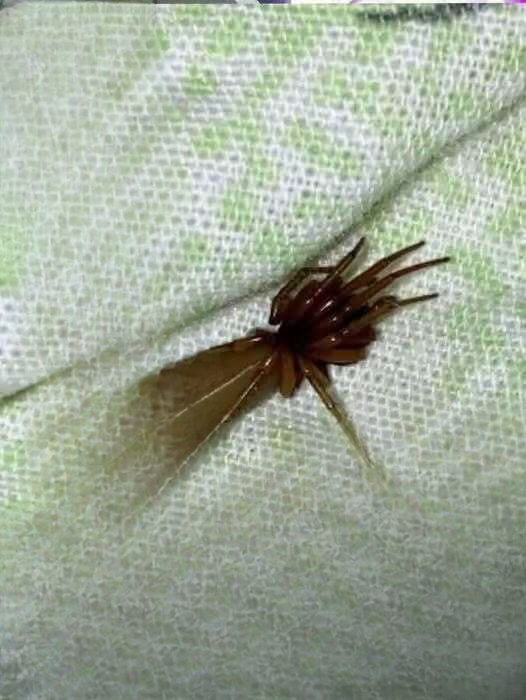
The red-fanged wandering spider is a striking example of this kind of hunting lifestyle.
Its appearance immediately attracts attention, particularly because of the contrasting coloration around its mouthparts. But the most interesting thing about this spider is not simply how it looks.
It is how it hunts.
Rather than relying primarily on a web to capture prey, this type of ground-active spider uses movement, sensory information, stealth, and speed to locate and capture small animals.
Its lifestyle offers an interesting reminder that spiders are an incredibly diverse group. They have evolved many different ways of surviving, and the familiar spider web represents only one of those strategies.
A Spider That Does Not Need a Traditional Web
The first thing that makes a wandering spider interesting is its hunting behavior.
Many familiar garden spiders construct webs that act as traps. Once an insect becomes caught in the silk, the spider can detect the disturbance and move toward the prey.
A wandering hunter takes a different approach.
Instead of waiting for an insect to arrive, it actively searches its environment.
This means the spider spends part of its active period moving through the ground, vegetation, leaf litter, or other suitable surroundings.
Its body is adapted for a lifestyle in which movement matters.
Rather than remaining in one central location, it can explore its surroundings and respond when it detects potential prey.
This is an important example of how different species can solve the same biological problem in very different ways.
The problem is simple: find enough food to survive.
The solution can be completely different.
Why Is It Active at Night?
Many wandering spiders are primarily active after dark.
Nighttime can provide several advantages for a predator.
There may be less competition from visually oriented predators, temperatures can be lower, and many potential prey species are also active during the night.
For a spider, darkness does not necessarily mean that the environment becomes impossible to navigate.
Instead, it relies heavily on other forms of sensory information.
Tiny movements and vibrations can provide important clues about what is happening nearby.
This allows a spider to detect potential prey even when it cannot depend on clear vision.
A Hidden Life During the Day
During daylight hours, a wandering spider may spend much of its time in a sheltered location.
Possible hiding places can include spaces beneath rocks, pieces of wood, leaves, vegetation, or other natural cover.
This behavior provides protection from environmental conditions and potential predators.
Remaining hidden during the day can also help the spider conserve energy.
Then, when conditions become more suitable, it can emerge and begin searching for food.
The contrast between daytime shelter and nighttime activity makes these spiders easy to overlook.
A person walking through a natural area may pass very close to one without ever realizing it is there.
Sensitive to Movement
One of the most impressive features of ground-hunting spiders is their ability to respond to movement in their surroundings.
Spiders do not experience the world exactly as humans do.
Instead of relying primarily on hearing and vision in the same way people do, they use a combination of sensory systems to detect environmental changes.
The fine structures on their legs can help them detect vibrations and movement.
This is particularly useful for a predator that spends much of its time close to the ground.
A small insect moving nearby may create signals that the spider can detect.
The spider can then orient itself toward the potential source and investigate.
This makes the surrounding environment a constant source of information.
The Moment of the Attack
Once a wandering spider encounters suitable prey, the behavior can change rapidly.
A slow search can suddenly become a fast attack.
The spider may approach carefully before making a quick movement toward the target.
Speed is important because small insects can react quickly and escape.
A successful predator therefore needs to combine patience with rapid action.
The spider cannot spend all its energy chasing every moving object.
It needs to identify opportunities and respond efficiently.
This combination of stealth and speed is one of the reasons wandering spiders can be effective hunters without relying on large prey-catching webs.
What Are the Red Fangs For?
The spider’s most noticeable feature is its vivid red coloration around the fangs or mouthparts.
These structures are not decorative.
Like other spiders, it uses its chelicerae and associated fangs to help capture and subdue prey.
Venom can play an important role in immobilizing prey and beginning the digestive process.
The details vary considerably between spider species, so it is better not to assume that every red-fanged spider has identical venom or hunting behavior.
For small prey, however, the basic sequence is straightforward:
The spider detects potential prey, approaches it, makes contact, and uses its mouthparts and venom to subdue it.
The entire encounter can happen very quickly.
An Efficient Predator
The hunting strategy of a wandering spider may appear simple, but it represents a highly specialized way of life.
The spider does not need to invest energy in constructing a large prey-catching web.
Instead, it invests in movement, sensory abilities, camouflage, and physical equipment that help it locate and capture prey directly.
Different spider species have different energy requirements and environmental challenges.
For some, web-building is the most effective strategy.
For others, active hunting works better.
Neither approach is universally superior.
Each reflects adaptation to a particular ecological niche.
Why Its Appearance Can Be Misleading
The red fangs can make this spider look intimidating.
That reaction is understandable.
Humans naturally pay attention to bright colors and unusual structures, particularly when they appear on an animal associated with venom.
But appearance alone does not tell us how an animal behaves around people.
Many spiders prefer to avoid larger animals and will generally retreat rather than seek confrontation.
A spider’s hunting behavior is primarily directed toward suitable prey, not toward humans.
That is an important distinction.
A spider can possess venom and impressive fangs without being an animal that actively wants to bite people.
As with any wild animal, however, it is sensible to avoid handling unfamiliar species.
The Spider’s Role in Nature
Predatory spiders are part of the food web.
By feeding on insects and other small invertebrates, they participate in natural population control.
This does not mean that every spider has a dramatic impact on insect numbers, but collectively, predators are an important part of healthy ecosystems.
Spiders themselves are also food for other animals.
Birds, reptiles, amphibians, insects, and other predators may feed on spiders.
That means the spider is not simply a hunter.
It is also part of a much larger network of relationships.
Its presence connects it to both the animals it hunts and the animals that hunt it.
A Different Kind of Spider
The wandering spider is interesting because it challenges one of the most familiar images associated with spiders.
We tend to think of silk webs as the defining feature of spider behavior.
Silk is certainly important to many species, and spiders have evolved remarkably sophisticated ways of using it.
But not every spider depends on a large web to catch food.
Some build small retreats.
Some use silk in other ways.
Some actively pursue prey.
Others combine multiple strategies.
This diversity is one of the reasons spiders are such successful and widespread predators.
Built for the Night
Imagine the forest or woodland after sunset.
The temperature begins to change.
Daytime animals retreat.
Night-active insects emerge.
Leaves move in the breeze.
Small creatures travel through the leaf litter.
Somewhere close to the ground, a wandering spider leaves its shelter.
It begins moving slowly through its surroundings.
It pauses.
It senses movement.
Then it continues.
The spider does not need a large web stretched between branches.
It carries its hunting equipment with it.
Its legs allow it to move across uneven ground.
Its sensory systems help it detect what is happening nearby.
And its fangs provide the means to subdue suitable prey.
The result is a completely different hunting strategy from the classic web-building spider.
An Example of Evolutionary Adaptation
Perhaps the most fascinating lesson from this spider is that evolution does not produce only one solution to a problem.
Animals need food.
But they can find that food in countless ways.
Some predators wait.
Others chase.
Some use traps.
Others rely on camouflage.
Some work alone.
Others hunt cooperatively.
The wandering spider represents the active-hunting approach.
Instead of investing heavily in a stationary trap, it moves through its environment and searches for opportunities.
That strategy has advantages in habitats where suitable prey is available across the ground or vegetation.
It also demonstrates how closely an animal’s physical features can be connected to its lifestyle.
Small Creature, Specialized Lifestyle
It can be easy to dismiss a spider as just another small creature in the environment.
Look closer, however, and its behavior becomes much more interesting.
Its nocturnal activity, sensory abilities, hunting strategy, protective hiding places, and specialized mouthparts all contribute to its survival.
Nothing about the animal’s lifestyle is accidental.
Every feature exists within a larger biological system shaped by adaptation and natural selection.
The red coloration around its fangs may be the feature that catches our attention first, but it is only one small part of a much larger story.
A Predator That Prefers to Be Left Alone
Despite its unusual appearance, a wandering spider is not simply a creature to be feared.
It is a wild predator performing an ordinary ecological role.
It searches for food.
It avoids threats.
It finds shelter.
It reproduces.
And it contributes to the ecosystem around it.
For people who encounter one outdoors, the best approach is usually simple observation from a safe distance rather than attempting to touch or capture it.
Wild animals are most interesting when we allow them to behave naturally.
The Fascinating World of Wandering Spiders
The red-fanged wandering spider is a reminder that there is much more variety in the spider world than the familiar web-building species found around homes and gardens.
Some spiders wait.
Others wander.
Some depend heavily on silk.
Others spend much of their active time moving across the ground.
The red-fanged appearance may be the first thing that catches your eye, but its hunting strategy is arguably even more fascinating.
When night arrives, this small predator can leave its shelter and begin searching for prey using sensory abilities that allow it to navigate an environment that seems almost completely dark to us.
It does not need a large web stretched between trees.
It does not need to sit patiently and wait for dinner to arrive.
Instead, it becomes the hunter.
It moves carefully.
It detects subtle changes around it.
It approaches its target.
And when the opportunity appears, it can react with remarkable speed.
That combination of patience, sensitivity, and rapid movement is a fascinating example of how specialized predators survive in the natural world.
The next time you think of a spider, remember that the classic web is only one part of the story.
There is an enormous variety of spider lifestyles waiting to be discovered—and some of the most interesting hunters are the ones that leave their webs behind and go looking for their next meal.