I Spotted Something in the Yard This Morning — What I Discovered Was a Snake That Deserves Respect
It started as an ordinary morning.
I stepped outside as I usually did, still waking up and expecting nothing more than cool air, damp grass, and the familiar sounds of the neighborhood. The yard looked completely normal at first. A few leaves had collected along the edge of the garden, and the morning light was beginning to spread across the lawn.
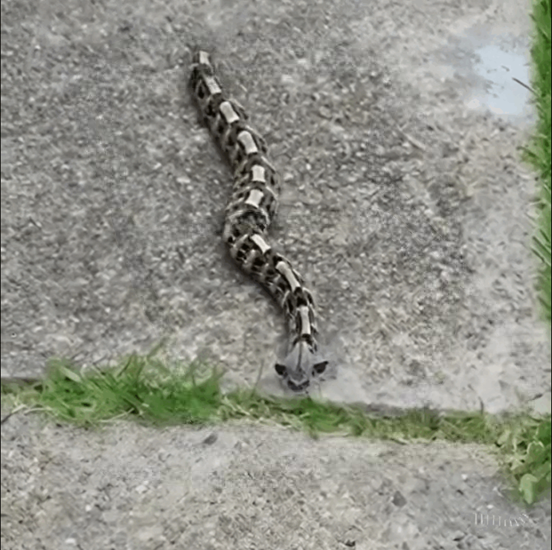
Then I noticed something near the edge of the property.
At first, I assumed it was a fallen branch.
The shape was partly hidden by grass and garden debris, and from several steps away, it was difficult to make out exactly what I was looking at. I stopped and watched for a moment.
Then it moved.
That small movement immediately changed the situation. What I had mistaken for a piece of wood was actually a snake.
I did not move closer.
Instead, I stayed where I was and observed it from a safe distance. The snake appeared to be moving slowly through the vegetation, apparently searching for shelter or a place to continue its journey.
At first, I couldn’t identify the species.
That is an important point because many snakes can look surprisingly similar, especially when they are partly hidden by grass, leaves, shadows, or garden plants. Trying to identify a snake based only on a quick glance can easily lead to a mistake.
After taking note of its general appearance from a distance, I realized that this was not an ordinary garden visitor.
The snake belonged to a species known for having medically significant venom.
That discovery made the morning much more memorable, but it also reinforced something that is useful for anyone who lives in an area where snakes occur naturally: the safest response to an unfamiliar snake is usually distance, observation, and professional assistance rather than confrontation.
Why Snakes Sometimes Appear in Residential Yards
Finding a snake in a yard can seem unusual, but it is often perfectly natural.
Snakes do not necessarily seek out houses because they want to interact with people. In many cases, residential properties simply provide the same environmental features that snakes use in natural habitats.
A yard can contain shelter, shade, water, vegetation, and food.
Tall grass can provide cover. Stacked firewood can create protected spaces. Garden sheds can offer cool areas during hot weather. Dense plants can provide hiding places, while small rodents, frogs, lizards, insects, or other prey can attract wildlife.
Even a carefully maintained garden can occasionally become part of an animal’s normal route.
This means that seeing a snake does not automatically indicate that a property is unsafe or that there is a larger problem nearby.
Wildlife occasionally moves through residential areas because neighborhoods have expanded into habitats that were once more continuous.
The snake may simply have been passing through.
The Importance of Not Relying on Appearance Alone
One of the easiest mistakes people make after seeing a snake is attempting to identify it based on one visual characteristic.
For example, someone may focus on the color of the body, the shape of the head, or the pattern along the back.
Those details can be useful, but they are not always enough for a reliable identification.
Different species can have similar colors and markings. Young snakes may also look different from adults, and lighting can dramatically change how a snake’s colors appear.
A snake that looks dark from a distance might have a completely different appearance in daylight.
Likewise, a harmless species can sometimes resemble a medically significant species closely enough to cause confusion.
For that reason, it is better to treat an unfamiliar snake cautiously rather than attempting to prove that it is harmless.
If identification is necessary, photographs taken from a safe distance can sometimes help wildlife professionals determine the species.
There is no need to approach the animal for a closer picture.
Some Snake Species Have Highly Potent Venom
The snake I encountered reminded me that the world is home to a remarkable variety of reptiles.
Some snakes are completely harmless to humans.
Others possess venom that can cause serious medical problems.
Among the snakes frequently discussed because of their medically significant venom are species such as certain cobras, mambas, kraits, taipans, and several types of vipers.
However, describing one snake as simply “the most dangerous snake in the world” can be misleading.
Danger depends on several factors.
These can include venom potency, the amount of venom delivered, the snake’s behavior, how frequently it encounters people, the likelihood of a bite, access to medical care, and the availability of appropriate treatment.
A species with extremely potent venom may rarely encounter humans, while another species may cause more injuries simply because it lives close to densely populated areas.
Therefore, a more useful way to describe a snake is by discussing its biology, habitat, behavior, and medical significance rather than relying on a dramatic ranking.
What Makes a Snake Medically Significant?
Snake venom is not a single substance.
It is a complex mixture containing different compounds that can affect the body in different ways.
Depending on the species, venom may interfere with the nervous system, blood clotting, muscle function, circulation, or tissue.
Some venoms can cause neurological symptoms. Others primarily affect blood or tissue.
This is why identifying the species can be important to medical professionals when someone has been bitten.
However, the appropriate response should never depend on a person attempting to diagnose the bite themselves.
If someone believes they have been bitten by a venomous snake, the priority is to seek emergency medical assistance as quickly as possible.
A person should not wait to see whether symptoms develop.
Why Snakes Usually Avoid People
Despite the fear that snakes can generate, most snakes do not spend their time looking for humans.
For a snake, a human is generally a large and unpredictable animal.
Avoiding people is often the safest option for the snake itself.
Many snakes will attempt to escape when they detect vibrations, movement, or other signs of human presence.
Problems can arise when a snake is accidentally cornered, stepped on, disturbed while hiding, or approached by someone attempting to capture it.
That is one reason keeping a reasonable distance is so important.
A snake does not need to be aggressive for an encounter to become dangerous.
A defensive animal may react simply because it believes there is no safe way to escape.
The Yard Can Reveal Why the Snake Was There
After noticing the snake, I began looking at the yard differently.
There were several places where wildlife could easily find shelter.
A pile of branches had been left near one side of the garden. There were areas of thicker vegetation, and small gaps existed beneath some outdoor structures.
None of these things seemed unusual.
But together, they created a habitat that could be attractive to small animals.
And where prey animals are present, predators may eventually appear.
This is an important principle in wildlife ecology.
A yard doesn’t have to be neglected to attract wildlife.
Bird feeders can attract rodents.
Fruit trees can attract insects and small mammals.
Garden plants can provide shelter for frogs and lizards.
Water sources can attract many types of animals.
The presence of a snake may therefore be connected to the wider food chain rather than a single problem with the property.
How to Make a Yard Less Attractive to Snakes
Although snakes are a natural part of many ecosystems, homeowners can take reasonable steps to reduce unwanted encounters.
Keeping grass reasonably maintained can make it easier to see the ground.
Removing unnecessary piles of branches, leaves, and other debris can reduce potential hiding places.
Firewood should be stored neatly rather than directly against the house.
Outdoor storage areas can be kept organized, and gaps around structures can be inspected and repaired where appropriate.
It can also help to reduce conditions that attract rodents.
Food should not be left outside unnecessarily, and household waste should be stored securely.
These steps are not a guarantee that a snake will never enter a yard.
Wild animals can travel through almost any outdoor environment.
The goal is simply to make the property less attractive as a hiding or feeding area and to make animals easier to notice.
What to Do If You Find a Snake
The most important rule is simple:
Do not approach it.
Do not attempt to pick it up.
Do not try to move it with a stick.
Do not attempt to trap it in a container.
Do not try to kill it.
These actions can increase the chance of an accidental bite.
Instead, move yourself, children, and pets away from the area.
If the snake is inside a home or in a location where people are likely to encounter it, contact an appropriate local wildlife professional, animal-control service, or other qualified authority.
Professionals have the equipment and experience necessary to assess the situation safely.
If the snake is outdoors and has a clear route away from people, the safest option may simply be to give it space.
In many situations, the animal will eventually move away on its own.
Children and Snake Encounters
Children are naturally curious.
A child who discovers a snake may not immediately understand why approaching it could be dangerous.
Parents and caregivers can teach children a simple rule:
If you see a snake, stop, move away, and tell an adult.
There is no need for a child to determine whether the snake is venomous.
Teaching children not to touch unfamiliar wildlife is useful well beyond snakes.
The same principle applies to spiders, wild mammals, insects, and other animals that may behave unpredictably when disturbed.
What About Pets?
Dogs and cats can be particularly curious about snakes.
A pet may investigate an unfamiliar animal before its owner even notices what is happening.
That can create a dangerous situation.
If a snake is found in a yard, pets should be brought indoors or kept well away from the area.
Pet owners should also be aware that snake bites can require urgent veterinary care.
If a pet may have been bitten, contacting a veterinarian promptly is the appropriate response.
Trying to determine the seriousness of the injury at home can waste valuable time.
Snake Bite First Aid
Snake bites should always be treated seriously when the species is unknown or potentially venomous.
The safest response is to seek emergency medical assistance immediately.
A person who has been bitten should move away from the snake without attempting to capture it.
If possible, the person should remain calm and limit unnecessary movement while waiting for medical help.
Do not attempt to suck venom from a wound.
Do not cut the bite area.
Do not apply improvised chemical substances.
Do not rely on home remedies.
Do not attempt to catch or kill the snake so that someone can identify it.
If it can be done safely, remembering the snake’s general appearance or taking a photograph from a safe distance may help professionals, but personal safety should always come first.
Why Home Remedies Can Be a Problem
Snakebite stories have circulated for generations, and some traditional methods remain popular in movies, television, and online discussions.
Unfortunately, some of these methods can make an injury worse.
Cutting the skin can cause additional injury.
Sucking at the wound does not provide a reliable way to remove venom.
Applying extreme heat or cold can damage tissue.
Trying to physically restrain a limb incorrectly can create additional complications.
Modern medical care is based on assessment, monitoring, supportive treatment, and, when appropriate, antivenom.
That is why contacting emergency services is far more appropriate than experimenting with an internet remedy.
The Role of Antivenom
Antivenom is an important medical treatment for certain venomous snakebites.
It is produced using antibodies designed to recognize and neutralize specific venom components.
Not every snakebite requires antivenom.
Doctors determine whether it is appropriate based on factors such as the suspected species, symptoms, clinical findings, and local medical protocols.
This is another reason why professional assessment matters.
A person should not attempt to obtain or administer antivenom independently.
Treatment decisions belong to qualified medical professionals.
Why Accurate Identification Matters
The discovery in my yard also reminded me how much information can be hidden behind a single animal.
Knowing the species can tell researchers where the animal is found, what it eats, how it behaves, and what role it plays in its ecosystem.
For medical professionals, species identification can also help guide treatment following a bite.
But identification should never come at the expense of safety.
A blurry photograph from several meters away is better than a perfect photograph taken from arm’s length.
Distance is more important than getting the ideal picture.
Snakes Are Important to the Ecosystem
It can be easy to think of snakes only in terms of fear.
But snakes perform important ecological functions.
Many species help regulate populations of rodents and other small animals.
This can have effects throughout an ecosystem.
By controlling prey populations, snakes contribute to the balance between different species.
Some snakes also become prey for birds of prey, mammals, and other predators.
In other words, even a snake that humans would prefer not to encounter has a role in nature.
This doesn’t mean people should approach dangerous species.
Respecting wildlife includes understanding when observation from a distance is the best option.
The Difference Between Fear and Awareness
There is a significant difference between being afraid of snakes and being appropriately cautious around them.
Fear can lead people to make impulsive decisions.
Someone may try to chase a snake away, strike it with an object, or attempt to capture it.
Those actions can increase the risk of injury.
Awareness leads to a different response.
You notice the animal.
You create distance.
You keep other people and pets away.
You contact a professional if necessary.
You allow the situation to be handled safely.
That approach is useful for almost any unexpected wildlife encounter.
Seasonal Changes Can Increase Encounters
Snake activity varies depending on climate and geography.
In many regions, snakes become more active as temperatures rise.
They may move between shelter and feeding areas, search for water, or look for suitable places to regulate their body temperature.
This means homeowners may notice more wildlife activity during certain parts of the year.
Weather conditions can also influence where snakes are found.
After periods of rain, for example, animals may become more visible as they move through different areas.
During hot weather, shaded locations may become more attractive.
The exact patterns depend on the species and local environment.
Why a Snake May Appear Near a House
There are many possible explanations.
The snake could be following prey.
It could be searching for shelter.
It could simply be moving through its normal territory.
A garden wall, driveway, shed, or fence does not necessarily represent a meaningful boundary to wildlife.
For humans, the property line is important.
For a snake, it may be almost irrelevant.
This is why even well-maintained homes can occasionally experience wildlife encounters.
A Surprising Morning With a Useful Lesson
What began as an ordinary morning became a reminder of how much wildlife can exist around us without being noticed.
The snake had probably been moving through the area long before I saw it.
It was not waiting for someone to come outside.
It was simply following its natural behavior.
The experience also changed the way I think about unusual discoveries in the yard.
Something that looks like a branch might be an animal.
A pile of leaves might contain insects or other wildlife.
A dark space beneath a shed might be shelter for a creature that prefers to remain hidden.
Nature doesn’t always announce itself.
Sometimes it is only visible when we stop and look carefully.
What I Would Do Differently Next Time
If I encountered another unfamiliar snake, I would follow the same basic approach.
I would stop.
I would maintain distance.
I would keep children and pets away.
I would avoid making sudden attempts to interact with the animal.
If necessary, I would contact someone qualified to handle wildlife.
The most important lesson is that curiosity does not require physical proximity.
You can appreciate wildlife without touching it.
You can learn about a species without trying to capture it.
And you can photograph an animal without putting yourself in unnecessary danger.
Respecting Wildlife Is Often the Best Approach
The snake in the yard may have been an unexpected visitor, but it was also part of the local environment.
People and wildlife increasingly share spaces, particularly as communities expand and natural habitats change.
That means occasional encounters are likely to continue.
The answer isn’t to panic every time an animal appears.
It is to learn how to respond responsibly.
For snakes, that generally means maintaining distance, avoiding unnecessary interaction, and contacting trained professionals when assistance is needed.
The same philosophy applies to many other forms of wildlife.
A fox in the yard, a raccoon near a garage, a bird inside a building, or a snake beneath a garden shed may all require patience rather than confrontation.
Final Thoughts
What looked like an ordinary piece of debris turned out to be a snake with characteristics that deserved respect.
The encounter was unexpected, but it offered a valuable reminder: wildlife doesn’t always stay in the places we expect to find it.
Snakes can occasionally appear in gardens, yards, garages, sheds, and other areas close to homes. Most encounters can be handled safely by creating distance and avoiding direct interaction.
If a snake is unfamiliar, assume that you cannot identify it reliably from a quick glance.
Don’t approach it simply to get a better look.
Don’t attempt to handle it.
Don’t encourage children or pets to investigate.
And if there is a genuine concern that the animal may be dangerous or trapped in an area where people could encounter it, contact a qualified local wildlife professional.
The goal isn’t to turn every snake sighting into a frightening event.
It is to replace unnecessary fear with practical awareness.
Snakes are fascinating animals with important ecological roles. Some species require considerably more caution than others, but all deserve to be observed responsibly.
That morning, I went outside expecting a quiet start to the day.
Instead, I received an unexpected lesson in wildlife, habitat, and the importance of keeping a respectful distance.
Sometimes the safest and most interesting way to experience nature is simply to stop, observe, and let the animal continue on its way.