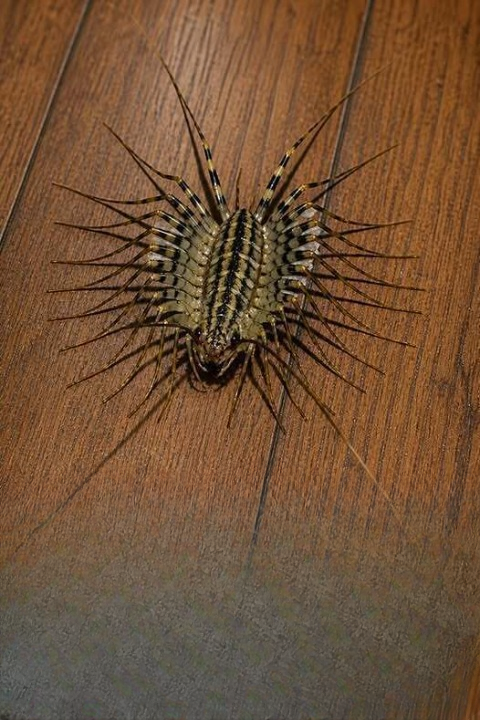
I Spotted a House Centipede Racing Across My Floor at 2 A.M.—What I Learned About These Strange Creatures Surprised Me
It was a little after two in the morning when I noticed something moving across my floor.
The house was quiet. The lights were off, the windows were dark, and there was no sound except the gentle hum of the refrigerator coming from the kitchen.
I had gotten out of bed to get a glass of water when something caught my attention near the edge of the hallway.
At first, I couldn’t tell what I was looking at.
A small, unusual creature was racing across the floor with astonishing speed. Its body was narrow, its legs seemed to extend in every direction, and its movement was so quick that I struggled to follow it with my eyes.
One moment, it was near the wall.
The next, it had disappeared beneath a piece of furniture.
I stood still, wondering what I had just seen.
I had encountered plenty of ordinary household insects before, including ants, spiders, and the occasional moth. But this creature looked different. Its long legs moved in a coordinated wave, creating the impression that it had far more limbs than any animal that small should possess.
My first reaction was simple: I wanted it out of my house.
Like many people, I had always associated creatures with numerous legs with damp corners, dark basements, and places I would rather not investigate at night. The speed of this particular visitor made the experience even more unsettling.
I searched the floor and the space beneath the nearby furniture, hoping to identify it. But the creature had vanished into a narrow gap.
The following morning, I decided to find out what it was.
That small encounter introduced me to the house centipede, an unusual arthropod that many people recognize immediately but know surprisingly little about.
What I discovered changed the way I thought about these creatures. Although their appearance can be alarming, house centipedes have fascinating adaptations, distinctive hunting habits, and an important role in controlling certain other small household pests.
Understanding them doesn’t mean everyone has to welcome them into their home. However, learning about their behavior can make it easier to distinguish a harmless visitor from a genuine household concern.
What Exactly Is a House Centipede?
The creature I had seen was most likely a house centipede, scientifically known as Scutigera coleoptrata.
House centipedes belong to the centipede group, a class of arthropods known as Chilopoda. Despite their name, centipedes are not insects. They belong to a different group of animals and have body structures and behaviors that distinguish them from insects such as beetles, ants, and flies.
An adult house centipede typically has a yellowish-gray body, three dark longitudinal stripes running along its back, and fifteen pairs of exceptionally long legs.
Those legs are the feature most people notice first.
Unlike the short, compact legs of many other arthropods, a house centipede’s limbs are slender and delicate-looking. They extend well beyond the sides of its body, giving it a distinctive silhouette that can make the animal appear much larger than it actually is.
Its antennae are also long and sensitive, helping it detect information about its surroundings.
When seen briefly in a dark hallway, these features can make the creature difficult to identify. The combination of its unusual shape and rapid movement often produces an immediate reaction of surprise or disgust.
Yet the same physical characteristics that make house centipedes unsettling to some people are also what make them successful hunters.
Their bodies are adapted for moving quickly through narrow spaces, detecting small prey, and capturing other arthropods.
In other words, the creature that seemed so out of place in my hallway was actually carrying out the same basic activities that help it survive in its natural environment.
It was searching for food and shelter.
Why Do House Centipedes Move So Quickly?
The speed of a house centipede is one of its most remarkable characteristics.
Many small creatures move in short bursts or follow relatively predictable paths. House centipedes, however, can accelerate rapidly, change direction, and disappear into narrow spaces before an observer has time to react.
Their numerous legs work together in a coordinated pattern. Rather than moving each limb independently in a random fashion, they use an organized sequence of movements that helps them travel efficiently.
Their long legs also allow them to cover ground quickly relative to their body size.
This combination of speed, coordination, and flexibility is useful when pursuing prey or escaping a threat.
Imagine being a small arthropod moving across a basement floor. A house centipede’s ability to accelerate suddenly gives it an advantage when chasing potential prey. At the same time, its agility allows it to retreat into a crack or hide beneath an object when it senses danger.
The same abilities can make it difficult for a person to catch or observe one.
During my own encounter, the animal seemed to disappear almost instantly. Once I learned more about its movement, the experience made much more sense.
It wasn’t necessarily moving toward me.
It was simply moving quickly through its environment, possibly searching for prey or trying to reach a sheltered location.
House centipedes are generally active at night, which explains why people sometimes encounter them while walking through a dark house or turning on a bathroom light after midnight.
Their nocturnal habits allow them to hunt when many potential prey animals are also active.
They may also avoid bright, exposed areas because covered spaces offer protection from predators and help them find suitable places to rest.
So if you encounter one racing across the floor at night, remember that its sudden appearance does not automatically mean it has been searching for a person or trying to approach them.
It is a small animal responding to its surroundings.
Why Do House Centipedes Enter Homes?
House centipedes are often associated with damp, dark places, but their presence inside a building can have several explanations.
Like other animals, they need food, water, and shelter.
Homes can provide all three.
Bathrooms, basements, laundry rooms, utility areas, and spaces beneath sinks may offer favorable conditions, especially when moisture is present. Small gaps around pipes, cracks near foundations, and openings around doors or windows can provide access to indoor spaces.
A house centipede may also enter a building while following a potential food source.
Its diet includes various small arthropods, such as spiders, ants, flies, moths, and other insects. The exact prey available depends on the environment.
If a house contains a steady supply of small insects or other suitable prey, it may provide an attractive hunting area.
Moisture can be another important factor. House centipedes are vulnerable to drying out, so they often seek environments where humidity