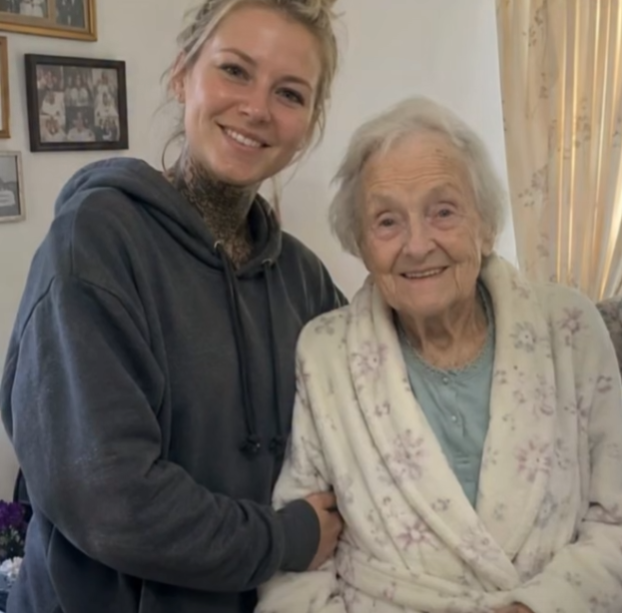
I was twenty-seven years old when I discovered a small flyer taped to the wall outside a neighborhood pharmacy.
I almost walked past it.
The paper was slightly crooked, and the message had been written in large, uneven letters:
“Wanted: Someone to Spend Sundays With an Elderly Woman. $400 Per Visit. No Special Experience Required.”
I stopped and read it again.
Four hundred dollars for a Sunday afternoon was more money than I usually earned in several days. I had grown up moving between foster homes, and by the time I reached adulthood, I had learned not to expect anyone to rescue me when life became difficult.
I worked long hours, paid my bills as carefully as I could, and tried not to think too much about how lonely my life had become.
I had no parents to call when I needed advice. I had no siblings who invited me to family dinners. Most evenings, I returned to my small apartment, heated something inexpensive for dinner, and watched television simply to make the silence less noticeable.
So when I saw that flyer, I called the number.
A woman answered after the third ring.
“My name is Marianne,” she said. “I’m eighty-four. If you’re calling about the Sunday position, you can come by tomorrow afternoon.”
There was something unusual about her voice. She sounded direct, almost impatient, as though she had already decided what kind of person I was going to be.
I agreed to visit.
I thought I was accepting a simple arrangement: company in exchange for money.
I had no idea that the woman behind that front door would eventually change the way I understood family, kindness, and the meaning of belonging.
The Woman Who Didn’t Want a Caregiver
Marianne lived in an older house on a quiet residential street.
When I arrived, she opened the door herself, holding the frame with one hand for support. Her silver hair was neatly arranged, and she wore a blue cardigan over a simple dress.
She studied me for several seconds.
“You don’t look like a nurse,” she said.
“I’m not one.”
“Good. I don’t need a nurse for Sunday afternoons.”
I glanced at the flyer in my hand.
“Then what exactly do you need?”
She stepped aside to let me enter.
“Someone to sit at my table and make this house feel a little less empty.”
I wasn’t sure what to say.
She led me into a dining room with polished wooden furniture, framed photographs, and curtains that looked as though they had been hanging there for decades.
On the table stood two teacups.
Marianne poured the tea herself, then sat opposite me.
“I used to have a large family,” she explained. “There were birthdays, Sunday dinners, people arriving without calling, and children running through the house. Now everyone seems to have somewhere else to be.”
She paused.
“I’m not asking you to love me. I’m paying you to spend time with me. We can be honest about that.”
I appreciated her straightforwardness.
“I can do Sundays,” I said.
“Then we have an arrangement.”
And just like that, I began visiting Marianne every week.
Four Hundred Dollars and a Cup of Bitter Tea
Our Sundays followed a predictable routine.
I arrived shortly after lunch. Marianne made tea that was far too bitter for my taste, and we sat at the dining table while she told me stories about her younger years.
She had been a seamstress.
For decades, she had worked in a small tailoring studio, creating and repairing dresses for women who attended formal dinners, weddings, and important social events.
She remembered fabrics with remarkable precision. She could describe the difference between two shades of silk and explain why a particular seam needed to be adjusted by only a few millimeters.
Sometimes, she showed me photographs of gowns she had helped make.
Other times, she talked about the people she had met through her work.
She told stories about difficult customers, generous strangers, and the years when her sewing business had been busy enough that she barely had time to sit down.
I listened because it was part of the arrangement.
At the end of each visit, she handed me an envelope containing my payment. She also insisted that I take home whatever food she had prepared.
“You look too thin,” she would say.
“I’m perfectly fine.”
“That is exactly what thin people say.”
Then she would place a container of soup or a wrapped portion of bread in my bag.
I never knew what to do with her fussing. I wasn’t used to people noticing whether I had eaten.
At first, I counted the minutes until I could leave.
But Marianne had a way of making even an ordinary conversation feel important. She remembered small details I mentioned weeks earlier and asked questions that suggested she had actually been listening.
Gradually, I began looking forward to Sundays.
I told myself it was because the money helped with my expenses.
That was partly true.
It was not the whole truth.
The Little Things Marianne Noticed
One afternoon, Marianne stopped talking in the middle of a story and pointed toward my coat.
“Your button is missing.”
I looked down.
She was right. One of the buttons near my sleeve had come loose, and I had been meaning to repair it for weeks.
“I’ll fix it eventually,” I said.
“Eventually is where neglected buttons go to die.”
She reached for a small sewing kit and repaired it before I had finished my tea.
On another Sunday, she noticed a faint burn mark on my wrist from a kitchen accident.
“What happened?”
“Nothing serious. I was cooking.”
She looked at me carefully.
“You always say that when something hurts.”
I laughed nervously and changed the subject.
Marianne didn’t press me.
That was one of the things I gradually came to appreciate about her. She noticed more than most people, but she rarely demanded explanations.
She also noticed that I became uncomfortable whenever conversations turned toward mothers and daughters.
I had learned early in life that not every adult who promised to care for a child would keep that promise. My childhood had been complicated, and by adulthood, I had become very good at avoiding conversations that brought those memories back.
One Sunday, Marianne asked whether I had any family nearby.
I told her the truth.
“I grew up in the foster system. I don’t really have anyone.”
She set her teacup down.
“That must have been lonely.”
I shrugged.
“You get used to things.”
She looked at me for a long moment.
“No,” she said gently. “Sometimes you simply learn how to live around the loneliness.”
I had no answer.
For the rest of that afternoon, we talked about something else. But her words stayed with me long after I returned home.
The Day I Stopped Counting the Money
Several months passed.
I no longer checked the time every few minutes when I visited Marianne. We developed little traditions, such as sharing a slice of cake on the first Sunday of each month and looking through her old photographs when the weather was bad.
She began asking for my opinion about ordinary things.
Should she move a chair closer to the window? Which flowers would look best in the garden? Was a particular scarf too bright for her age?
I answered honestly, and she usually disagreed with at least half of my suggestions.
“You have terrible taste,” she told me one afternoon after I recommended a different curtain color.
“You asked for my opinion.”
“I did. I simply expected a better one.”
I laughed so hard that tea nearly came out of my nose.
It was the first time in years that I had laughed without wondering whether I was being foolish.
Eventually, Marianne began to feel less like someone I visited for work and more like someone I genuinely cared about.
One Sunday, she forgot to place the payment envelope on the table.
I noticed it only when I was preparing to leave.
“You forgot something,” I told her.
She looked at the envelope, then at me.
“Did I?”
I smiled.
“Your four hundred dollars.”
She pushed it toward me.
I hesitated before taking it.
“Marianne, I don’t think I can keep accepting this forever.”
She studied my face.
“Why not?”
“Because I don’t come here just for the money anymore.”
For once, she didn’t respond with a joke.
Instead, she reached across the table and squeezed my hand.
“Then perhaps we have both received something valuable.”
After that conversation, our arrangement changed gradually. I continued visiting, but we talked openly about the fact that our friendship had become something neither of us had expected.
She still tried to feed me.
I still complained about her tea.
And every Sunday, her house felt a little less empty.
The Mysterious Sewing Box
One rainy afternoon, Marianne asked me to help organize a cabinet in her sewing room.
The room was filled with spools of thread, folded fabric, measuring tapes, and boxes of buttons sorted by color.
On a shelf near the window sat an old metal sewing box.
It was small enough to hold in one hand, with faded flowers painted across its lid. The corners were worn, and the clasp had darkened with age.
Marianne picked it up carefully and placed it on the table between us.
“I’ve had this for a very long time,” she said.
“Does it contain anything special?”
“Nothing that would interest most people.”
She smiled, but there was something thoughtful in her expression.
Then she pushed it toward me.
“One day, this box may save you.”
I laughed, assuming she was making another mysterious remark.
“Save me from what? Badly sewn buttons?”
“Possibly,” she replied. “You have a talent for losing them.”
I opened the clasp, but the lid seemed stuck. Marianne gently stopped me.
“Not yet.”
“Why not?”
“Because you’ll understand when the time comes.”
I looked at her, waiting for an explanation.
She gave me none.
I thought she was teasing me, and eventually we returned to sorting the fabric.
But the words stayed in my mind.
One day, this box may save you.
I did not understand what she meant.
I had no idea how important that little box would become.
The Sunday Marianne Never Answered
The following week, I called Marianne to confirm that I would be visiting as usual.
A man answered her phone.
“Who is this?” he asked.
I introduced myself and explained that I visited Marianne every Sunday.
There was a brief silence.
“So you’re the woman who’s been taking money from my aunt.”
His tone made my stomach tighten.
“I’m sorry?”
“My aunt is dead,” he said. “She passed away a few days ago.”
I gripped the phone.
For a moment, I could not understand the words.
Marianne was gone.
The woman who had argued with me about curtains, complained about her tea, and insisted that I take soup home was no longer sitting at her dining table.
I wanted to ask when it had happened. I wanted to know whether she had been frightened, whether anyone had been with her, and whether she had known how much she meant to me.
Instead, I heard the man continue speaking.
“Whatever arrangement you had with her, it is over. You shouldn’t expect anything from the family.”
I felt a wave of humiliation.
“I wasn’t calling about money,” I said.
He gave a short, dismissive laugh.
“Of course not.”
Then he ended the call.
I stood in my kitchen, staring at the phone.
I wasn’t upset because I had lost the four hundred dollars. I was upset because I had lost the person who had quietly become the closest thing to family I had ever known.
I had never told Marianne everything she meant to me.
I had assumed there would always be another Sunday.
The Hidden Compartment
That evening, I took the old sewing box from the shelf where I had placed it after our last visit.
I held it in my hands for a long time.
The little painted flowers had begun to fade, and the metal clasp looked even older than I remembered.
I ran my fingers along the bottom.
Something felt loose.
I turned the box over and pressed gently against a thin panel. It shifted with a small click.
The hidden compartment opened.
Inside was a folded letter written in Marianne’s careful handwriting.
My hands began to tremble.
The first line read:
“My dear girl, if you are reading this, then I am no longer able to explain what I have planned for you.”
I sat down.
The letter continued.
“You probably believe that I hired you because I was lonely. That is true, but it is not the whole story. When you first walked into my house, I recognized something familiar in you. You were determined to appear as though you needed nothing from anyone.”
I stopped reading.
She had understood me far better than I had realized.
The next paragraph made me cry.
“I know you have spent much of your life believing that people leave eventually. I cannot promise you that life will never hurt you again. But I want you to know that being alone is not the same as being unwanted.”
I pressed the letter against my chest.
Then I continued.
“Inside this box, you will find a small key. It opens a drawer in my sewing room. Please visit the house when the family has arranged the appropriate access, and ask the person handling my estate to help you retrieve what is inside.”
I looked into the compartment.
There, beneath the letter, was a tiny brass key.
And beside it was a second note.
“You haven’t received the real gift yet.”
I stared at the words.
What could Marianne have left me?
Why had she hidden the key?
And why had she gone to such lengths to make sure I found it?
The Gift That Was Never About Money
Several weeks later, after the necessary arrangements had been made, I was able to return to Marianne’s house with permission to collect the items she had specifically asked me to retrieve.
The house looked different without her.
The curtains were still in place, the furniture remained where I remembered it, and the dining table was clean. Yet the rooms felt strangely empty.
With the assistance of the person managing her estate, I used the key to open a small drawer in her sewing room.
Inside were several envelopes, a folder of documents, and a photograph of Marianne standing beside a younger woman.
On the back of the photograph, she had written a date from many years earlier.
The folder contained a letter explaining her wishes.
Marianne had arranged for a portion of her estate to support a local program that helped young adults leaving foster care find stable housing, develop practical skills, and access career guidance.
She had also left instructions for me to be offered a paid position helping coordinate a small community project connected to that work, provided I wanted to accept it and met the necessary requirements.
I read the letter twice.
Then I sat down and cried.
I had spent much of my life feeling as though my childhood had followed me into adulthood, defining what I could expect from the world.
Marianne had seen someone who could use her experience to help others facing similar challenges.
She had not simply wanted to give me money.
She wanted to offer me an opportunity.
The documents explained that I could decide whether to accept the position. There was no requirement to do so, and the estate arrangements would be handled through the proper legal process.
At the bottom of the letter, Marianne had written a final message.
“My dear girl, I cannot give you back the childhood you deserved. I cannot erase the lonely years or promise that the future will always be kind. But I can help you build something that belongs to you.
“You came into my house believing that you were pretending to be my granddaughter.
“Somewhere along the way, you became family.
“The real gift is not the money, the position, or anything written in these papers. It is the chance to believe that your story can become something more than the things you have lost.
“Take what I have offered if it helps you. Share what you learn if you can. And never believe that you must earn every act of kindness by pretending to be someone you are not.”
I held the letter close and allowed myself to cry.
For the first time, I understood what she had meant when she said the sewing box would save me.
It was not going to rescue me from a single dramatic disaster.
It was going to help me see a future I had never believed I was entitled to have.
What Marianne Left Behind
In the months that followed, I considered her offer carefully.
I spoke with the people responsible for the estate, learned more about the community program, and decided to accept the position.
The work was not glamorous. It involved organizing appointments, helping young adults locate practical resources, and listening to people who were trying to build independent lives.
But it mattered.
I knew what it felt like to enter adulthood without a reliable support system. I understood the embarrassment of needing help and the fear of trusting someone who might not stay.
I could not solve every problem for the people I met.
What I could do was listen without judgment, share useful information, and help them find the resources they needed.
Sometimes, I thought about Marianne sitting across from me at her dining table.
I could almost hear her criticizing my taste in curtains or insisting that I take another container of soup home.
I missed her terribly.
But I also began to understand that the kindness she had shown me was not meant to end with her death.
It was something I could carry forward.
The old sewing box now sits on a shelf in my apartment. I keep the letters inside it, along with the little brass key that opened the drawer in Marianne’s sewing room.
Whenever I look at it, I remember the woman who once hired me to spend Sundays at her table.
I remember how our arrangement began with money and ended with a kind of belonging I had never expected.
And I remember the message she left behind: a person’s past does not have to determine the limits of their future.
I went to Marianne’s house because I needed four hundred dollars.
I stayed because I discovered a friendship that neither of us had planned.
And when she was gone, I found something more valuable than an inheritance.
I found a reason to believe that I could help build the kind of world I had needed when I was young.
That was Marianne’s real gift.
Not a fortune. Not a secret that made me suddenly important.
Just an open door, a new purpose, and the understanding that family can sometimes begin with two strangers who decide to show up for each other, one Sunday at a time.