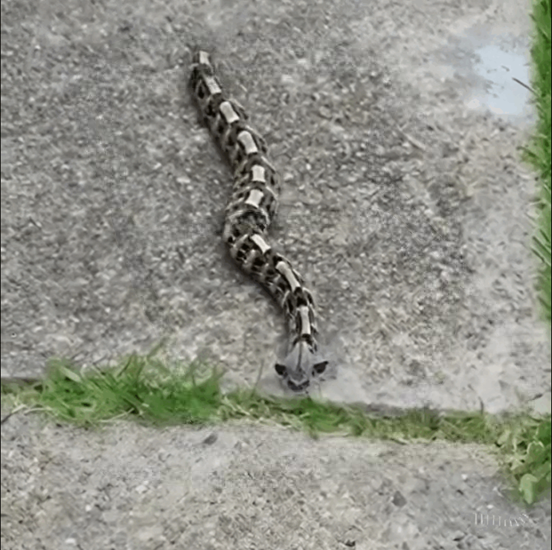
I Noticed Something Unusual in the Yard — A Closer Look Changed How I Think About Snakes
It started as an ordinary morning.
I stepped outside expecting nothing more than cool air, damp grass, and the familiar quiet of the yard. The night had left behind a thin layer of moisture, and the garden looked almost exactly as it did every other morning.
Then I noticed something near the edge of the yard.
At first, I assumed it was a fallen branch.
It was partially hidden among the grass and leaves, and from a distance it was difficult to tell what I was looking at. The object appeared to have an unusual shape, but I didn’t immediately think it was an animal.
I took another step.
Then I stopped.
The object moved.
That was when I realized I might be looking at a snake.
I didn’t move closer.
Instead, I stood where I was and watched from a safe distance.
The experience reminded me of something that is easy to forget when spending time outdoors: yards are part of the natural environment, even when they are surrounded by houses, fences, sidewalks, and roads.
Wild animals sometimes pass through.
Most of the time, they are simply moving from one place to another.
And when an unfamiliar animal appears in a yard, the safest response is usually not to investigate it by getting closer.
It is to observe from a distance and give it space.
Why Snakes Sometimes Appear in Residential Yards
Finding a snake in a yard can be surprising, especially for people who rarely see wildlife near their homes.
But residential areas can provide many of the things snakes need.
Grass offers cover.
Wood piles provide shelter.
Gardens can attract insects and small animals.
Rock borders create hiding places.
Compost areas can attract rodents.
Dense vegetation can provide shade and protection.
In other words, a carefully maintained yard may still be part of a much larger ecosystem.
A snake doesn’t necessarily recognize a property line the way humans do.
If the yard provides food, shelter, or a convenient route, an animal may pass through.
This doesn’t automatically mean that a home has a serious wildlife problem.
Sometimes the animal simply happens to be traveling through.
My First Mistake Was Assuming I Knew What I Was Seeing
From a distance, the snake looked different from the harmless snakes I had seen before.
But appearance alone isn’t enough to identify a snake accurately.
Color can vary within the same species.
Patterns can change depending on age.
Lighting can make markings look different.
A snake may also appear larger or smaller depending on how far away it is.
Even experienced observers can make mistakes when viewing an unfamiliar animal quickly.
That is why one of the most important rules of wildlife identification is simple:
Don’t rely on a quick glance.
If you don’t know what an animal is, don’t approach it just to get a better look.
Instead, stay back and use safe observation methods.
If appropriate, a photograph taken from a safe distance can later help an experienced local wildlife professional identify the animal.
Not Every Snake in a Yard Is Dangerous
The phrase “snake in the yard” can immediately create anxiety.
But snakes are an important part of many ecosystems, and the majority of encounters do not result in anyone being harmed.
Different regions have different snake species.
Some are harmless to people.
Some are venomous.
Some are difficult to distinguish from other species without a trained eye.
That is why regional knowledge matters.
A snake that is common and harmless in one part of the world may not be present in another.
Likewise, a snake that looks unfamiliar to a homeowner may be a species that local wildlife experts see regularly.
The safest approach is to avoid guessing.
Why Identification Matters
If you live in an area where venomous snakes are present, learning the general characteristics of local species can be useful.
However, identification should never require approaching or handling a snake.
Instead, homeowners can learn from reputable local wildlife agencies, nature organizations, or educational resources.
Some useful information includes:
- Which snake species commonly occur in the region
- Which species are venomous
- What habitats they prefer
- What time of year they are most active
- What to do when one appears near a home
- Which local agencies handle wildlife removal
Learning these things before an encounter happens is much easier than trying to research them while standing a few feet from an unfamiliar snake.
The Importance of Distance
When I first realized there was a snake in the yard, my instinct was to get a closer look.
That instinct is understandable.
Humans are naturally curious.
When we see something unusual, we want to know what it is.
But curiosity can become a problem when it overrides basic safety.
A snake may interpret a person approaching it as a threat.
Even an animal that normally avoids people can respond defensively if it feels cornered.
The safest response is therefore to maintain distance.
Don’t try to touch it.
Don’t try to move it with a stick.
Don’t attempt to pick it up.
Don’t block its path.
And don’t encourage children or pets to investigate.
Instead, give the animal room to leave.
What to Do If You Find a Snake Near Your Home
If you discover a snake in the yard, the first step is to remain calm.
Move children and pets indoors if possible.
Keep a reasonable distance.
Avoid sudden movements toward the animal.
If the snake has a clear path away from the property, allowing it to move away may be the simplest solution.
If it is inside the house, trapped in a confined area, or located somewhere that creates a genuine safety concern, contact an appropriate local wildlife professional.
Many communities have animal control agencies, wildlife officers, or licensed wildlife-removal services that can provide guidance.
The important point is that homeowners don’t need to solve the situation personally.
Why Trying to Kill or Capture a Snake Can Create More Risk
People sometimes assume that removing a snake themselves is the fastest solution.
It can actually create additional risk.
Trying to approach an unfamiliar snake brings a person much closer to the animal.
A frightened snake may become defensive.
A person may also misidentify the species and underestimate the situation.
There is another problem.
Even identifying a snake as “probably harmless” isn’t the same as knowing exactly what species it is.
For those reasons, physical intervention should generally be left to people who are trained to handle wildlife.
Snakes Often Prefer to Avoid People
One of the most misunderstood facts about snakes is that many species prefer not to interact with humans.
People are large compared with most snakes.
Humans create vibrations.
We produce noise.
We occupy large amounts of space.
From a snake’s perspective, a person can be something worth avoiding.
That is why a snake may quickly disappear when it notices someone nearby.
If it has a route away from the area, it may simply use it.
The best outcome is often the least dramatic one:
The person stays back.
The snake moves away.
Everyone goes about their day.
Why Yards Can Attract Wildlife
A yard doesn’t need to look wild to attract animals.
Even a neatly landscaped property can contain features that provide shelter or food.
Consider a garden with thick plants.
During the day, those plants can provide shade.
At night, they may become hiding places for insects and other small animals.
Those animals can attract predators.
Likewise, a pile of firewood can provide shelter for rodents and other small creatures.
A compost pile can provide food.
Standing water can attract insects and amphibians.
Dense ground cover can create protected spaces.
This doesn’t mean homeowners need to remove every natural feature from their yard.
It simply means that understanding how the local ecosystem works can explain why wildlife occasionally appears.
Keeping a Yard Less Attractive to Unwanted Wildlife
If snakes repeatedly appear around a home, it may be useful to examine the surrounding environment.
Start with food sources.
If rodents are frequently present, that may attract predators.
Keeping garbage secured and avoiding easily accessible food sources can help reduce rodent activity.
Next, look at shelter.
Large piles of unused materials, stacks of lumber, dense vegetation, and other clutter can provide hiding places for many animals.
Keeping outdoor areas organized can make them less attractive as permanent shelter.
However, it is important to remember that wildlife control isn’t about eliminating every animal from an environment.
The goal is usually to reduce unnecessary attractants while maintaining a safe and healthy outdoor space.
Why Rodent Control Can Matter
Snakes are predators.
Many species feed on rodents or other small animals.
If a property has an ongoing rodent problem, it may naturally attract animals that hunt those rodents.
This is one reason wildlife management often begins with understanding the entire environment.
Instead of focusing only on the snake, homeowners can ask:
Why is the snake here?
What might it be finding?
Where could it be sheltering?
What environmental conditions are making the property attractive?
These questions can lead to more useful solutions than simply trying to remove one animal.
Children and Snake Encounters
Children are naturally curious about animals.
A snake can therefore become an immediate source of fascination.
Parents and caregivers should teach children a simple rule:
If you see a snake, don’t approach it.
Children don’t need to be frightened of wildlife.
They simply need to understand boundaries.
A snake can be interesting to observe from far away.
It doesn’t need to be touched.
Children should also understand that they should immediately tell an adult if they find an unfamiliar animal.
This turns an unexpected encounter into an opportunity to teach safe wildlife observation.
What About Pets?
Dogs and cats may react very differently to snakes.
Some pets immediately move away.
Others may bark, chase, paw at, or attempt to bite the animal.
That can create a dangerous interaction.
If a snake is spotted in an area where pets spend time, bring the pets indoors or keep them away from the location.
Don’t allow a dog to investigate simply because it appears curious.
Pets cannot understand the risks associated with an unfamiliar wild animal.
Their natural hunting or play behavior can put them closer to the snake than is safe.
Why Photographs Can Be Useful
If you can safely take a photograph from a substantial distance, an image can sometimes help wildlife professionals identify an animal.
However, there is an important distinction between photographing wildlife and approaching it for a photograph.
Never move closer simply to obtain a clearer image.
Modern phone cameras often allow people to zoom in without physically approaching an animal.
Even then, if the animal moves toward you or changes its behavior, stop observing and move away.
The photograph isn’t worth creating an unnecessary risk.
Don’t Trust Viral Snake Identification Posts
Social media is full of posts claiming that a particular snake is one species or another.
Some of those identifications are correct.
Others are not.
A photograph taken under unusual lighting can make a harmless snake look similar to a venomous species.
Likewise, some venomous snakes can be mistaken for harmless ones.
This is one reason professional or regionally authoritative identification is preferable to relying on comments under a viral post.
When safety is involved, guessing isn’t a good strategy.
What Makes Some Snakes More Concerning?
When people describe a snake as “dangerous,” several different factors may be involved.
Venom is one factor.
Behavior is another.
Geographic distribution matters.
The likelihood of encountering humans matters.
The animal’s size and defensive behavior may also matter.
But danger should always be considered in context.
A highly venomous species living in a remote habitat may pose less everyday risk to a person than a more common animal frequently encountered around homes.
This is why responsible wildlife information avoids turning every snake encounter into a dramatic warning.
Understanding the animal is more useful than simply being afraid of it.
What to Do If Someone Is Bitten
Although snake bites are uncommon, anyone who believes they have been bitten by a venomous snake should treat the situation seriously.
Seek emergency medical assistance immediately.
Do not attempt to capture the snake.
Do not put yourself at additional risk trying to identify it.
If it can be safely observed from a distance, information about its appearance and location may be useful to medical professionals,