I never imagined that a visit to a hospital would change the direction of my life.
At twenty-nine, I was still trying to rebuild my life after losing my mother.
Grief had changed me in ways I couldn’t fully explain.
I had become quieter.
I avoided crowded places.
And I constantly felt as though something important was missing.
Eventually, I started volunteering at a local hospital.
I didn’t do anything extraordinary.
I spent time talking with patients who had few visitors.
Sometimes I brought them books.
Sometimes I simply sat beside them and listened.
I discovered that many people didn’t necessarily need someone to solve their problems.
They just wanted someone to be there.
That was how I met Thomas.
He was seventy-two years old and receiving treatment for a serious heart condition.
Unlike many patients I visited, Thomas was usually awake and eager to talk.
He had a gentle sense of humor and a habit of asking questions about my life.
Where did I grow up?
What did I do for work?
What had brought me to the hospital as a volunteer?
I told him about my mother.
He listened carefully.
Then he told me stories about his own life.
He had traveled when he was younger.
He had worked several different jobs.
He had made mistakes.
He had lost friends.
And he had learned, as he put it, that “people remember how you made them feel much longer than they remember what you said.”
Over the next several days, our conversations became something I looked forward to.
Thomas didn’t have many visitors.
His phone rarely rang.
There were no relatives waiting outside his room.
Whenever I asked whether someone was coming to see him, he simply smiled and changed the subject.
One afternoon, I walked into his room and found him looking out the window.
“You’re late,” he said jokingly.
I laughed.
“I’m five minutes late.”
“Five minutes is a long time when you’re seventy-two.”
I pulled up a chair.
“How are you feeling?”
He shrugged.
“About as good as you’d expect.”
We talked for a while.
Then the conversation became unexpectedly serious.
Thomas reached across the bed and gently took my hand.
“Sarah,” he said, “would you do something unusual for me?”
I smiled.
“That depends on what it is.”
“Marry me.”
I thought he was joking.
I actually laughed.
“Thomas, that’s not funny.”
“I’m serious.”
My smile disappeared.
“You’ve known me for less than a week.”
“I know.”
“And you’re very ill.”
“I know that too.”
I didn’t know what to say.
Thomas explained that he had spent much of his life surrounded by people, but that his final years had become increasingly lonely.
He didn’t want his final days to be defined by paperwork, hospital rooms, and strangers.
He wanted one person beside him who genuinely cared.
I told him I needed time to think.
That evening, I couldn’t stop thinking about his request.
It was strange.
It was unexpected.
And, honestly, it didn’t make much sense.
But I understood loneliness.
I understood what it felt like to wish someone would simply sit beside you when the world felt empty.
So, after several conversations and careful consideration, I agreed.
Two days later, a hospital chaplain conducted a small private ceremony.
There was no elaborate celebration.
No large gathering.
No expensive ring.
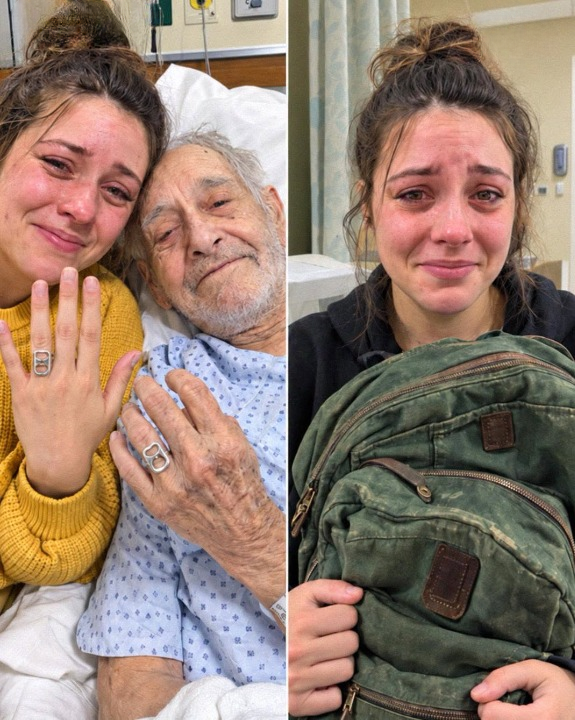
I wore a simple yellow sweater.
Thomas didn’t have a ring either, so he jokingly used a soda-can pull tab as a temporary symbol.
We both laughed.
It was unconventional.
But somehow, it felt sincere.
For the next seven days, I stayed close to him.
We talked.
We watched television.
We shared stories.
He told me about his childhood.
I told him about my mother.
We talked about regrets and second chances.
One evening, Thomas asked me what I thought made a life meaningful.
I didn’t know how to answer.
He smiled.
“It’s the people you leave better than you found them.”
I remembered those words.
I would remember them for the rest of my life.
As his condition worsened, I remained beside him.
I held his hand.
I read to him.
I reminded him of our conversations.
Eventually, the hospital became quiet.
Thomas passed away peacefully.
I sat beside his empty bed afterward, overwhelmed by emotions I couldn’t name.
I had known him for only a short time.
Yet his absence felt enormous.
I wondered how someone could enter your life so suddenly and leave such a lasting impression.
I was still sitting there when someone knocked on the door.
An older man entered carrying a green backpack.
“Sarah?”
“Yes?”
“My name is Robert. I’m Thomas’s attorney.”
I stood up.
“His attorney?”
Robert nodded.
He placed the backpack on the chair.
“Thomas left this for you.”
I stared at it.
“For me?”
“Yes.”
I picked it up.
It was surprisingly heavy.
“What is inside?”
Robert didn’t answer immediately.
Instead, he looked at me carefully.
Then he said something that made my heart stop.
“Thomas wasn’t completely honest with you.”
I frowned.
“What do you mean?”
“He wanted you to know the truth.”
I looked down at the backpack.
Suddenly, I wasn’t sure I wanted to open it.
“Why didn’t he tell me himself?”
Robert sighed.
“Because he was afraid.”
“Afraid of what?”
“Of what you might think of him.”
I sat down.
Robert explained that Thomas had left detailed instructions concerning the backpack.
He wanted me to receive it only after his death.
I opened the zipper.
Inside were several envelopes.
There were photographs.
A notebook.
A small collection of documents.
And a letter with my name written across the front.
My hands began to shake.
I opened the letter.
The first line read:
Sarah, if you’re reading this, then I didn’t get the chance to explain everything myself.
I stopped.
Robert quietly stepped toward the door.
“You should read it privately.”
After he left, I continued.
Thomas explained that the story he had told me about his life wasn’t entirely false.
But it wasn’t complete either.
Years earlier, he had made a decision that affected another family.
He had spent decades trying to correct the consequences.
The documents in the backpack were evidence of what had happened.
I read page after page.
With every paragraph, another piece of the puzzle appeared.
Then I found a photograph.
I recognized the woman immediately.
My mother.
I stared at the picture.
She was much younger.
She was standing beside Thomas.
And there was a little girl between them.
Me.
I couldn’t breathe for a moment.
I turned the photograph over.
There was a date written on the back.
It was from before I had ever known Thomas existed.
I searched through the remaining documents.
There were letters between my mother and Thomas.
There were records.
There were explanations.
And finally, there was one document that answered the question I had been too afraid to ask.
Why had Thomas chosen me?
The answer was connected to my mother.
Thomas had known her long before I ever met him.
He had been part of a chapter of her life that she had never told me about.
But the secret was more complicated than a simple family connection.
My mother had once asked Thomas to make a promise.
A promise involving me.
He had kept that promise for decades.
Even when it became difficult.
Even when it meant allowing me to believe a different version of my childhood.
I sat there for hours.
At first, I felt betrayed.
Then I felt confused.
Then I felt angry.
But eventually, something else emerged.
Understanding.
Thomas hadn’t brought me into his life simply because he was lonely.
There had been another reason.
He had wanted the opportunity to finally give me something my mother had never been able to give me:
The complete truth.
The next morning, I met Robert again.
I had dozens of questions.
He answered what he could.
Some things were still unclear.
Other answers would require speaking with people who had known my mother many years earlier.
But the biggest revelation was this:
Thomas had spent years quietly helping my family from a distance.
He had never taken credit.
He had never asked for recognition.
He had simply kept the promise he had made.
And the strange marriage that had begun in a hospital room had been, in part, his final attempt to make sure the truth reached me.
I thought back to our seven days together.
At first, I had believed I was helping a lonely man.
I now realized that he had also been trying to help me.
The marriage had been unconventional.
The circumstances had been unexpected.
But the conversations we shared had been real.
The kindness had been real.
The connection had been real.
And that mattered more than the circumstances in which we met.
Months later, I continued looking through the materials Thomas had left behind.
I learned more about my mother’s past.
I discovered stories I had never heard.
Some were difficult.
Some were beautiful.
Some changed the way I remembered certain moments from childhood.
But knowing the truth allowed me to understand my mother in a way I never had before.
I also kept the soda-can pull tab.
People might think it was an odd thing to keep.
To me, it was priceless.
It reminded me that meaningful relationships don’t always begin in the usual way.
Sometimes they begin in unexpected places.
Sometimes they last for decades.
And sometimes they last only seven days.
Thomas entered my life as a stranger.
He became my husband for a brief and unforgettable week.
But more importantly, he became the person who finally opened a door to a part of my past I had never known existed.
His backpack didn’t contain wealth or extravagant gifts.
It contained something far more valuable.
Answers.
The truth about my family.
The story of a promise.