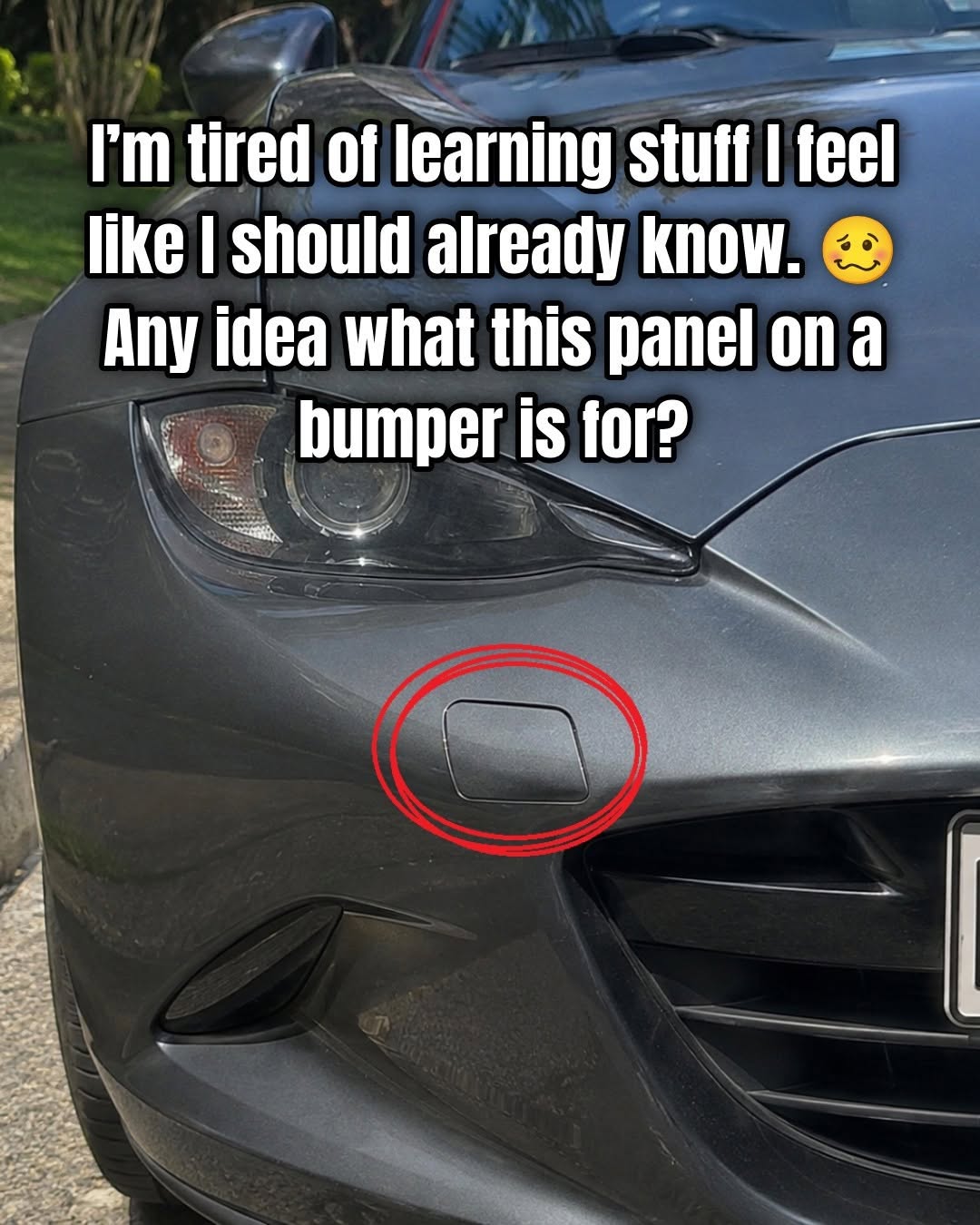
“I’m tired of discovering things about cars that I feel like I should already know! Has anyone else ever looked at a vehicle, noticed a small panel on the bumper, and wondered what it was doing there?”
That was the question that inspired this little automotive mystery. You might have seen a similar panel on a family car, a vehicle parked at the supermarket, or even your own car without giving it much thought.
At first glance, it can look like an ordinary piece of plastic fitted into the bumper. It may blend in so well with the surrounding surface that you barely notice it. But once someone points it out, the question becomes difficult to ignore: What exactly is it for?
The interesting thing is that small panels on car bumpers can serve several different purposes. Depending on the vehicle’s make, model, year, and design, a panel may conceal a towing point, provide access to a component, or form part of another vehicle-specific feature.
Without seeing the exact panel, it is impossible to identify it confidently. However, exploring the most common possibilities can help you understand what you might be looking at.
And don’t worry if you have never known the answer. Cars contain many features that manufacturers rarely explain in everyday conversations, and learning about them is part of becoming a more informed driver.
1. It Could Be a Cover for a Towing Eye
One common explanation for a small removable panel on a bumper is that it conceals a towing-eye attachment point.
Many vehicles have a threaded opening behind a small cover. In certain recovery situations, a compatible towing eye can be screwed into this opening so that a recovery professional can attach suitable equipment.
The cover helps maintain the bumper’s appearance when the attachment point is not being used.
Instead of leaving an exposed opening in the bumper, manufacturers fit a small panel that matches the surrounding design. The result is a cleaner appearance while keeping the designated attachment point accessible when needed.
These covers may be found on the front or rear bumper, depending on the vehicle.
However, not every vehicle has the same arrangement. Some have different recovery points, and the location and design can vary between models.
If you suspect that the panel covers a towing-eye attachment, check the vehicle’s owner’s manual before attempting to remove it. The manual should explain where the recovery point is located and how to access it safely.
It is also important to understand that a towing eye is not automatically suitable for every towing or recovery situation. Using the wrong attachment point or equipment can damage a vehicle or create a safety hazard.
2. It Might Conceal a Headlight-Washer Mechanism
Another possibility, particularly on some vehicles equipped with headlight washers, is that the panel is part of a small washer cover.
Certain cars have retractable or pop-out nozzles designed to spray water or cleaning fluid onto the headlights.
When the system is not operating, the nozzles may remain hidden behind covers that blend into the bumper or nearby bodywork.
When activated, the mechanism may extend briefly, spray the headlight lenses, and return to its resting position.
This design helps protect the components and preserves the vehicle’s exterior styling.
Headlight-washer systems are not fitted to every vehicle, and their operation varies by manufacturer and model. Some use visible nozzles rather than concealed mechanisms.
If the panel is positioned near a headlight and appears to have a small, carefully fitted outline, a washer-related feature may be worth considering.
Still, its location alone is not enough to confirm the answer.
3. It Could Be an Access Cover for a Vehicle-Specific Component
Modern vehicles contain many parts hidden behind exterior panels.
A small bumper cover may provide access to a designated mounting point or another component that needs occasional inspection, servicing, or use.
Manufacturers often conceal functional elements behind removable pieces of trim because exposed openings can affect the vehicle’s appearance.
These panels are usually designed to fit closely against the bumper, sometimes with small clips or retaining tabs.
The precise purpose depends on the vehicle’s design. A cover that looks almost identical on two different cars might not serve exactly the same function.
That is why identifying the make, model, and model year is so useful when trying to answer an automotive question.
A photograph of the panel, together with the vehicle details, can often narrow down the possibilities much more effectively than a general description.
4. Some Bumper Panels Are Simply Part of the Design
Not every small panel conceals a mechanical component.
Automotive designers frequently use separate trim pieces to create a particular appearance, maintain consistent styling, or accommodate differences between versions of the same model.
A panel may be decorative, or it may help create a smooth transition between different sections of the bumper.
In some cases, a vehicle’s design includes a blanking plate because another version of the same model uses that area for a different feature.
Manufacturers also have to account for different equipment packages and regional specifications. As a result, two vehicles that look similar from the outside may have slightly different bumper arrangements.
This is one reason it is best not to assume that every removable-looking panel has a special mechanical purpose.
Sometimes, the explanation is much simpler than expected.
5. Could It Be Connected to Parking or Driver-Assistance Equipment?
Many newer vehicles use sensors and cameras to assist with parking and maneuvering.
These systems can include ultrasonic parking sensors, radar equipment, and cameras positioned at different points around the vehicle.
However, most parking sensors are small circular components, and cameras generally have recognizable lenses or housings.
A larger rectangular or irregularly shaped panel is not automatically a sensor cover.
Depending on the model, nearby bumper trim may be arranged around these components, but the exact design varies considerably.
If the panel appears close to a sensor or camera, consult the owner’s manual or an official parts diagram rather than guessing.
It is especially important not to pry off a panel that may be close to electronic equipment, wiring, or other delicate components.
Even a small exterior feature can be connected to parts that are expensive or difficult to repair.
6. Why Manufacturers Make These Covers Removable
You might wonder why manufacturers use small removable panels instead of making the entire bumper one continuous piece.
There are several practical reasons.
First, a removable cover allows access to a specific point without requiring the entire bumper to be removed.
Second, it helps protect an opening or component from ordinary dirt, water, and road debris, depending on the design.
Third, it allows the exterior to maintain a consistent appearance when the feature behind the panel is not in use.
Finally, separate trim pieces can help manufacturers accommodate different equipment configurations while retaining a similar overall design.
The cover itself may be relatively inexpensive, but it can play an important role in making the vehicle easier to use or maintain.
Its small size does not necessarily mean it is unimportant.
7. How Can You Identify the Panel on Your Own Car?
If you have noticed a mysterious panel on your own vehicle, a few simple steps can help you identify it.
Start with the vehicle’s make and model.
Write down the manufacturer, model name, and model year. If you know the trim level, include that information as well.
Look closely at the panel’s position.
Is it on the front or rear bumper? Is it near a headlight, close to the center of the bumper, or positioned toward one side?
The location may help narrow down the possible functions, although it cannot confirm an identification by itself.
Take a clear photograph.
A photograph showing the entire bumper is useful because it provides context. A second, closer photograph can show the panel’s outline, edges, and any visible markings.
Try to take the photographs in good lighting without using filters that change the appearance of the vehicle.
Check the owner’s manual.
Many manuals contain diagrams identifying towing points, washer systems, sensors, and other exterior features.
If you do not have a printed copy, the manufacturer’s official website may provide a digital version.
Compare the panel with official parts diagrams.
Vehicle parts catalogs can sometimes reveal the name and function of a specific cover. Make sure the diagram matches the correct model year and vehicle configuration.
Avoid forcing it open.
Even if the panel appears removable, do not pull at it with a screwdriver or another tool until you understand how it is attached.
Some covers use clips that can break if handled incorrectly. Others may be positioned near components that should not be disturbed.
A little research can save you the cost and frustration of replacing a damaged piece of trim.
8. Is It Embarrassing Not to Know What Every Car Feature Does?
Not at all.
Cars have become increasingly complex, and most drivers learn how to operate their vehicles without studying every component.
You may know how to check tire pressure, refill the windshield-washer reservoir, and recognize warning lights on the dashboard without knowing the purpose of every small panel on the exterior.
That is perfectly normal.
Vehicle manufacturers design many features to blend into the bodywork. Some are only used in specific situations, while others may not need attention during ordinary driving.
Even experienced drivers can encounter unfamiliar features when they switch to a different make or model.
Asking questions is a practical way to learn, especially when the answer helps you understand your vehicle better.
In fact, knowing the purpose of a towing-eye cover, for example, could be useful if your car ever needs professional recovery.
Understanding the features on your own vehicle can also help you avoid accidentally damaging a component during cleaning, maintenance, or repairs.
There is no reason to feel embarrassed about discovering something new.
9. Why a Photograph Can Make All the Difference
The most useful next step in solving this mystery is to look at the actual panel.
A written description such as “a small panel on the bumper” could refer to several different features.
The shape, size, location, surrounding trim, and vehicle model can all help distinguish one possibility from another.
For example, a cover positioned near the front of the vehicle might have a different purpose from one located beside a rear bumper corner.
Likewise, a panel on a vehicle equipped with headlight washers may serve a different function from a similar-looking panel on a model without that equipment.
These details matter.
Rather than confidently identifying the panel from a vague description, it is better to compare the available evidence with the manufacturer’s information.
That approach is more reliable and can help prevent misinformation from spreading among drivers.
Final Thoughts: That Little Bumper Panel May Have a Surprisingly Practical Purpose
The next time you walk past a parked car, take a moment to notice the small details you might normally overlook.
The exterior of a vehicle contains more than decorative styling. Small covers, trim pieces, sensors, and access points can all serve different functions, even when their purpose is not immediately obvious.
The panel in question could conceal a towing-eye attachment, form part of a headlight-washer system, provide access to a specific component, or simply serve a design purpose.
Without a photograph and details about the vehicle, there is no reliable way to select one explanation as the definite answer.
And that is perfectly fine. Sometimes, the best way to solve a mystery is to gather a little more information.
Now it’s your turn: Have you noticed a small panel like this on your car? Share the vehicle’s make, model, year, and the panel’s location. If you have a photograph, include it so other readers can help narrow down the possibilities.
You might discover that the feature you have overlooked for years has a simple, practical explanation—and you may help another driver learn something new along the way.