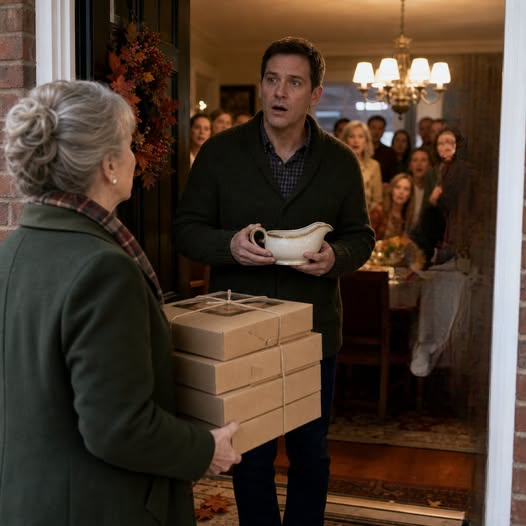
Every November, the same Thanksgiving order appeared at the bakery where I worked.
Four pies.
A table for fourteen.
And every year, my daughter-in-law was the customer.
She had no idea that the woman preparing her holiday desserts was me.
This year, however, something about the order made my hands stop.
I read the ticket once.
Then again.
Four pies. Fourteen guests.
My son had told me they were having a quiet Thanksgiving.
Just the immediate family.
“Nothing big this year, Mom,” he had said.
Apparently, “nothing big” meant fourteen people.
For three years, I had heard the same explanation.
“It’s just going to be us this time.”
“You know how hectic the holidays get.”
“We’re keeping things simple.”
I had always nodded and pretended I understood.
Then I’d go home, roast a small chicken for myself, make a single serving of potatoes, and tell the women at church that my family simply preferred private holidays.
What else was I supposed to say?
That my own son apparently had no room for me at his Thanksgiving table?
That his wife had somehow made me feel like an unwanted guest in the family I helped build?
I worked at Hartley’s Bakery, mostly in the kitchen.
My shift started at five every morning, long before the customers arrived.
I preferred it that way.
There was something comforting about the quiet hum of the ovens, the smell of cinnamon and butter, and the soft rhythm of preparing food while the rest of the town was still asleep.
The girls who worked the counter knew me as the older woman who handled the ovens.
My daughter-in-law had never seen me there.
She certainly wasn’t getting up before sunrise to collect her Thanksgiving orders.
Every year, she placed the order under her own name.
My son’s phone number was listed as the contact.
I had known that number for thirty years.
I could probably have written it from memory in the dark.
Last Thanksgiving, something happened that made the truth harder to ignore.
A young woman from my neighborhood sometimes helped me with my phone.
One afternoon, she showed me photographs my granddaughter had posted online.
I wasn’t expecting anything unusual.
Then I saw the Thanksgiving picture.
A long dining table.
Fourteen chairs.
Beautiful dishes.
A huge turkey.
Candles.
Flowers.
Everyone smiling.
It looked like a lovely family gathering.
Then I noticed something familiar.
Sitting near the center of the table was a white gravy boat decorated with a thin gold rim.
My mother’s gravy boat.
The one that had belonged to her before she passed away.
The same one I had kept carefully packed in my china cabinet for decades.
Or at least, I had thought I had kept it.
It disappeared shortly after my husband’s funeral.
My son and his wife had come over that week to help me organize some of his belongings.
When they left, the gravy boat was gone.
I had searched everywhere.
I eventually convinced myself that perhaps I had packed it away somewhere and simply couldn’t remember where.
But there it was.
In a photograph.
On my daughter-in-law’s Thanksgiving table.
I stared at that image for a long time.
Then I handed the phone back.
I didn’t accuse anyone.
I didn’t call my son.
I didn’t ask where the gravy boat came from.
Instead, I made myself a cup of tea and went to bed.
The following morning, I arrived at Hartley’s before dawn and baked pies for other people’s families.
Ninety of them.
Apple.
Pumpkin.
Pecan.
Sweet potato.
While I worked, something inside me changed.
I started paying attention.
Not spying.
Not causing trouble.
Just listening.
Working behind a bakery counter teaches you something about people.
Customers talk.
They talk while waiting for coffee.
They talk while paying for bread.
They talk when they think the person serving them isn’t important enough to remember what they say.
My daughter-in-law apparently loved talking.
One of the counter employees eventually told me something that made my stomach twist.
She didn’t realize she was revealing anything.
She was simply talking about the woman who placed the enormous Thanksgiving orders.
“She always says the same thing,” the girl told me.
“Really?” I asked casually.
“Yeah. She says her husband’s mother never comes to Thanksgiving. Says they invite her every year, but she prefers being alone.”
I didn’t say anything.
I just continued working.
So that was the story.
My son believed I didn’t want to come.
I believed they didn’t want me there.
And somehow, between those two lies, an entire family had spent years celebrating Thanksgiving without me.
My daughter-in-law had built a wall between us without ever having to admit that she was the one who built it.
And my son apparently never bothered to ask whether the story was true.
That hurt more than I wanted to admit.
Still, I kept the evidence.
Every Thanksgiving order.
Every date.
Every guest count.
I folded the bakery tickets and stored them inside my old recipe tin.
Three years of records.
Three years of proof that their “small family Thanksgiving” wasn’t small at all.
Then this year’s order arrived.
Four pies.
Fourteen people.
But there was something written at the bottom.
A special request.
“Please add extra nutmeg to the sweet potato pie. It’s a family recipe and a holiday tradition.”
I stared at those words.
That recipe wasn’t hers.
It belonged to my mother.
My mother taught it to me.
I taught it to my son.
And somehow, my daughter-in-law was now calling it a family tradition while excluding the woman who had actually carried the recipe into the family.
They wanted my cooking.
They wanted my traditions.
They wanted my mother’s recipes.
Apparently, the only thing they didn’t want was me.
There was another detail I had never mentioned to anyone.
In the same Thanksgiving photographs, sitting at the head of the table was a man I didn’t recognize.
He was wearing my late husband’s green cardigan.
The one I had donated after he passed away.
I had no idea how it ended up there.
I stopped asking my neighbor to enlarge the photographs.
Some things hurt less when you don’t know every detail.
But this year, Hartley’s Bakery introduced holiday delivery for large orders.
And when the delivery assignments were posted, I looked at the list.
Then I wrote my own name beside their address.
I would make the delivery myself.
Not because I wanted revenge.
Not because I wanted to embarrass anyone.
I simply wanted the truth to finally sit at the same table as everyone else.
The next morning, I baked those four pies myself.
I made every crust carefully.
I measured the spices twice.
I added the extra nutmeg exactly as requested.
And I made them better than any pies I had baked in years.
Maybe because I knew exactly where they were going.
Maybe because I knew who would be eating them.
Or maybe because, after three years of swallowing my hurt, I was finally ready to stop pretending everything was fine.
At nine o’clock, I put on my nicest coat.
I stacked the four pie boxes carefully in my arms.
Then I drove to their house.
I wasn’t going to scream.
I wasn’t going to insult anyone.
I wasn’t going to create a scene.
People who have the truth don’t need to shout.
I had the receipts.
I had the order tickets.
I had the photographs.
And I had one very simple request.
I wanted my mother’s gravy boat back.
The white one.
The one with the gold trim.
The one that had somehow become part of their Thanksgiving tradition while I was left outside it.
I pulled into their driveway.
Through the windows, I could see people moving around inside.
Fourteen guests.
Just as the order had said.
Her parents were there too.
I could hear laughter through the front door.
I walked up the steps.
For a moment, I stood there holding four pies that represented three years of silence.
Then I pressed the doorbell.
The sound echoed through the house.
Footsteps approached.
The door opened.
And my son stood there.
He looked at me.
Then at the boxes.
Then back at me.
His mouth opened, but no words came out.
Behind him, the Thanksgiving table slowly became silent.
Forks stopped moving.
Conversations faded.
Everyone turned toward the doorway.
And then I noticed something in my son’s hands.
The white gravy boat.
Gold rim.
My mother’s.
He was holding it as if he had suddenly realized exactly what it meant.
Before anyone could speak, a woman at the table looked toward my daughter-in-law and asked innocently:
“Melissa… isn’t that the woman you said never comes to Thanksgiving?”
The room went completely silent.